
Adaptive cruise control uses sensors like radar or lasers to monitor the road ahead continuously. It detects vehicles and adjusts your speed automatically to keep a safe following distance, slowing down when traffic slows and accelerating back to your preset speed when the road clears. The system reacts quickly to traffic changes, providing a smooth driving experience while reducing stress. To discover more about how this technology works, keep exploring the details below.
Key Takeaways
- Uses radar or laser sensors to detect vehicles ahead and monitor traffic conditions in real-time.
- Automatically adjusts vehicle speed to maintain a safe following distance based on sensor data.
- Reacts swiftly to traffic changes, decelerating or accelerating to match the flow of traffic.
- Integrates with vehicle systems to provide smooth, unobtrusive speed adjustments for driver comfort.
- Often combined with lane keeping and collision mitigation features for comprehensive highway safety.
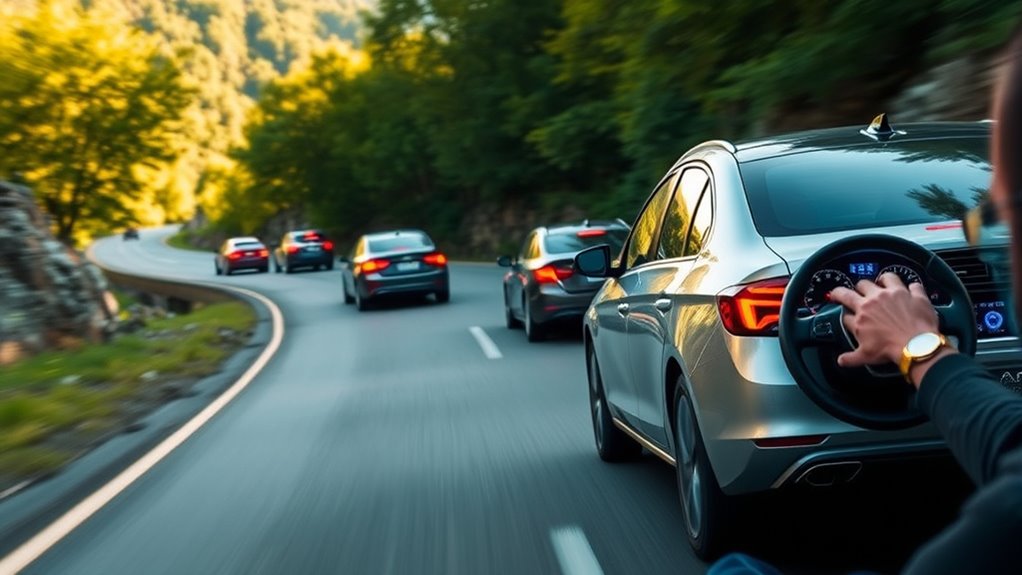
Adaptive cruise control is a technology that automatically adjusts your vehicle’s speed to maintain a safe distance from the car ahead. At the core of this system lies advanced sensor technology, which plays a vital role in detecting and monitoring surrounding vehicles. These sensors, often radar or laser-based, constantly scan the road ahead, providing real-time data that helps the system determine how fast your car should go. This sensor data allows the vehicle to respond promptly to changes in traffic flow, whether it’s slowing down to match a vehicle in front or accelerating back to your preset speed when the road clears.
Adaptive cruise control uses sensors to monitor traffic and automatically adjust your speed for safer driving.
As a driver, you benefit from this setup as a form of driver assistance, which reduces the cognitive load during long drives or heavy traffic. Instead of constantly adjusting your throttle or brake, the system takes over these tasks, allowing you to stay focused on steering and navigation. This seamless integration of sensor technology and driver assistance creates a safer driving environment by minimizing the chances of rear-end collisions caused by sudden braking or inattentiveness. Since the sensors are precise and responsive, you can trust that your vehicle will maintain the appropriate following distance, even if traffic conditions change unexpectedly.
The system works by comparing the data from the sensors with your chosen speed setting. When the sensors detect a slower vehicle ahead, adaptive cruise control automatically decelerates your car to preserve a safe gap. Conversely, if the road clears or the vehicle in front accelerates, the system smoothly increases your speed back to the preset limit. This constant adjustment feels natural and unobtrusive, helping you maintain a steady pace without constant manual input. Because sensor technology continuously feeds data to the vehicle’s onboard computer, the system can react swiftly to sudden changes, such as a vehicle cutting into your lane or a sudden stop ahead.
Furthermore, many adaptive cruise control systems are integrated with other driver assistance features, such as lane keeping or collision mitigation, creating a complete safety net. These systems work together to support your driving, making highway journeys less stressful and more comfortable. By leveraging advanced sensor technology and intuitive driver assistance, adaptive cruise control enhances both safety and convenience. It’s designed to respond proactively, giving you peace of mind that your vehicle is actively managing your speed and distance, so you can focus on the road ahead and enjoy a more relaxed driving experience.
Using high-quality sensors and proper calibration can significantly improve the system’s color accuracy and overall performance, ensuring safer and more reliable operation.

Prefer Warehouse Adaptive Cruise Speed Control Module for 68171868AC
- Product Type: Aftermarket Cruise Speed Control Module
- Compatibility: Fits Dodge Charger 2011-2014
- Part Numbers: Replaces 68171868AC, 56054171AD, 56054171, 68139561AB
As an affiliate, we earn on qualifying purchases.
As an affiliate, we earn on qualifying purchases.
Frequently Asked Questions
Can Adaptive Cruise Control Operate in Heavy Rain or Snow?
Adaptive cruise control can struggle in heavy rain or snow because sensor limitations impact its effectiveness. Weather conditions like rain or snow can obscure sensors, causing them to misread the environment or shut down temporarily. You should be cautious and not rely solely on the system during poor weather. Always keep your hands on the wheel and stay alert, as weather impact can reduce ACC’s ability to maintain safe distances.
How Does Adaptive Cruise Control Handle Sudden Braking by Other Vehicles?
When it comes to sudden braking by other vehicles, adaptive cruise control acts quickly—think of it as keeping your finger on the brake, ready to respond. It uses obstacle detection to sense abrupt stops and triggers an immediate braking response, ensuring you maintain safe distance. You can trust it to react faster than you might, helping you stay safe even when unexpected stops happen ahead.
Is Adaptive Cruise Control Compatible With All Vehicle Models?
Not all vehicle models are compatible with adaptive cruise control, as it depends on the vehicle’s compatibility features. You’ll find that many newer models, especially mid-range and luxury vehicles, incorporate adaptive cruise control technology, but some older or basic models may not support it. Before purchasing, check your vehicle’s specifications or consult your manufacturer to confirm your car’s model variations include adaptive cruise control for seamless driving assistance.
What Is the Typical Maintenance Required for Adaptive Cruise Control Systems?
You should regularly check your adaptive cruise control system, especially sensor calibration, to guarantee it functions correctly. Keep the sensors clean and free of dirt or debris, which can impair performance. Periodically, run system diagnostics through your vehicle’s maintenance schedule to identify any malfunctions. Proper maintenance helps your system respond accurately and safely, maintaining ideal performance and extending its lifespan.
Does Adaptive Cruise Control Work Seamlessly With Lane-Keeping Assist?
Yes, adaptive cruise control seamlessly integrates with lane-keeping assist through system synchronization, providing a smoother driving experience. When you activate both features, they work together to maintain your speed and stay within your lane automatically. This lane-keeping integration guarantees you don’t have to constantly adjust steering, making highway driving more comfortable and safe. The synchronized systems respond quickly to changing traffic conditions, helping you stay centered and at a safe distance.
Conclusion
Think of adaptive cruise control as your car’s dedicated guardian angel, gently guiding you through traffic’s twists and turns. It keeps a safe distance, like a loyal friend who always watches your back, ensuring a smooth journey. Just as a trusty compass points you in the right direction, this technology steers your drive with subtle precision. Embrace it as your smart co-pilot, making every trip safer, easier, and more enjoyable.