
TL;DR

Get garage and car supplies delivered free — and shop member deals
- Fast, free delivery on millions of items
- Access to Prime Big Deal Days deals on October 6–7
- Prime Video, Amazon Music and more included
In an interview published by Charged EVs on October 1, 2026, Rustam Kocher described Europe’s public charging mix: Type 2 chargers are common at business parks and shopping centers, but drivers may still need many operator apps. He also reported QR-code sticker scams and said roaming cards have made it easier to use multiple networks in some areas.
Rustam Kocher, an electric-vehicle expert who recently retired to Europe, says public Type 2 charging is common at large business parks and shopping centers, while drivers still face fragmented apps and other obstacles. In an interview published October 1 by Charged EVs, Kocher also described progress in using roaming cards across networks and recounted a QR-code scam he said drivers should watch for.
Kocher told Charged EVs he has lived in Europe for four years and sees Type 2 chargers “ubiquitous” at many large business parks and shopping centers. Drivers generally pay to use them, he said, though charging is often relatively inexpensive because the units are low power and require drivers to bring their own cables. His account offers a contrast with the interviewer’s observation that public Level 2 chargers have become less common in Florida as DC fast-charging sites have grown; that Florida trend is the interviewer’s observation, not a Europe-wide finding.
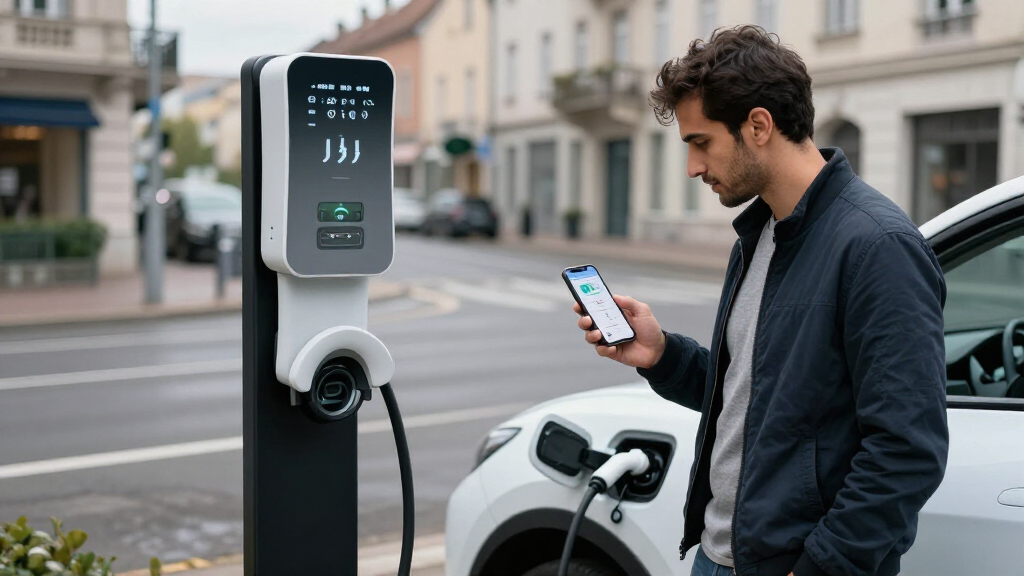
App fragmentation remains a problem in Kocher’s view. He said he has about 50 charging apps on his phone and described arriving at a charger in Spain that required an app he had not installed. In one parking garage, he said, poor cellular reception and no Wi-Fi forced him to go upstairs to download and operate the app while coordinating with his wife to start the session before the charger timed out. The account illustrates how a charger listed as available may still be hard for a driver to use.
Kocher also warned that people have placed replacement QR-code stickers over charger payment codes, directing users to spoofed sites that he said can steal payment or personal information. Separately, he described a more encouraging experience during an August trip to the Basque Country for an eclipse: he said more stations and network partnerships allowed him to use an Octopus Energy or Chargemap card at multiple chargers. That is his experience, not a guarantee that either card works at every site.
Access Depends on More Than Uptime
For drivers, a charger’s presence on a map does not by itself mean they can complete a charge. They may need a compatible account, a working phone connection, and a payment method the operator accepts. Kocher’s garage story shows how app requirements and connectivity can block a session even when equipment is physically available.
The interview also points to a measurement issue for charging operators and site hosts. A unit can be technically online yet fail to deliver a usable charging experience. Charged EVs cited Kameale Terry, CEO of ChargerHelp, who said uptime does not show whether drivers can plug in and charge on the first attempt; she identified first-time charge success rate as a measure that better reflects that experience. The article does not provide comparative performance data for either metric.
QR-code substitution adds a separate payment-security concern. Drivers who scan a code should check that the destination appears to belong to the charging provider before entering information. The reported scam is a warning from Kocher, not evidence in the article of how often it occurs or how widely it has spread.
As an affiliate, we earn on qualifying purchases.
From Single-Operator Apps to Roaming
The Charged EVs report describes a public charging business that has changed since early rollouts. According to the article, some early installations treated charging as an added attraction for retail locations, including free Level 2 units, while operators expected highway DC fast charging to have thin margins. The report says operators now expect DC fast charging to become profitable, a shift it links with declining interest in public Level 2 charging in the interviewer’s Florida example.
In Europe, Kocher uses the term Type 2 for the lower-power charging common at the locations he described. His account suggests that access can still come with practical conditions: users bring a cable, pay for electricity and may need a network-specific app or account. The interview does not offer a systematic survey of charger availability across European countries, so his observations should not be treated as a region-wide statistical assessment.
Roaming agreements are one response to the app burden, allowing a driver to access partner networks through a shared card or service. Kocher said partnerships had improved during his travels in the Basque Country. The report also mentions Octopus Charge, a US service that claims to provide access to major networks through one app and account; the interviewer said an attempt to sign up was unsuccessful because of app-design problems.
““I literally have 50 apps on my phone.””
— Rustam Kocher, speaking to Charged EVs
How Broad Are These Experiences?
The interview presents Kocher’s observations and anecdotes rather than a quantified survey of Europe’s charging networks. It does not establish how common the reported app failures or QR-code sticker scams are, which operators or locations are affected, or whether the scam has been independently verified. Kocher’s description of Type 2 availability also applies to the large business parks and shopping centers he discussed, not necessarily to every European region or type of site.
The report gives no network-by-network data on roaming coverage, pricing, charger reliability or first-time charge success. It also does not say whether Kocher reported the QR-code incident to a provider or law-enforcement agency. Those details remain unconfirmed in the source material.
Roaming and App Fixes Ahead
The report does not announce a new policy, product release or investigation tied to Kocher’s remarks. The immediate next steps for drivers are practical: check which networks a roaming card covers, confirm payment instructions through a provider’s official channels and avoid entering personal or payment details on a site reached through a suspicious replacement sticker.
For operators, the interview underscores the value of making charging sessions possible without a reliable mobile signal and of tracking whether customers can successfully start a charge, not only whether equipment appears online. Charged EVs did not report commitments or timelines from specific operators to address these issues. The extent to which roaming will reduce app switching, and whether it will make charging more reliable at individual sites, remains to be seen.
Key Questions
What did Rustam Kocher say about public EV charging in Europe?
Kocher told Charged EVs that Type 2 chargers are common at many large business parks and shopping centers he has encountered. He said drivers typically pay and bring their own cable; his remarks were personal observations, not a statistical survey of Europe.
Why did Kocher criticize charging apps?
He said drivers may need a different operator app at different sites. In one underground parking garage, he described struggling to download and use an app because there was no cellular signal or Wi-Fi near the charger.
What QR-code scam did Kocher describe?
Kocher said scammers may cover a charger’s payment QR code with a sticker that leads to a spoofed site. He warned that users could be asked to provide information to someone other than the charging company. The report does not establish how widespread the practice is.
Can one roaming card access every European charger?
No universal access is established by the report. Kocher said cards with many roaming agreements worked at multiple chargers on his trip, but coverage depends on the specific card, provider agreements and site.
What does first-time charge success measure?
It measures whether a driver can plug in and successfully charge on the first attempt. ChargerHelp CEO Kameale Terry, quoted by Charged EVs, said this gives a clearer view of driver experience than uptime alone.
Source: rss
Fall Picks
fall essentials
As an affiliate, we earn on qualifying purchases.