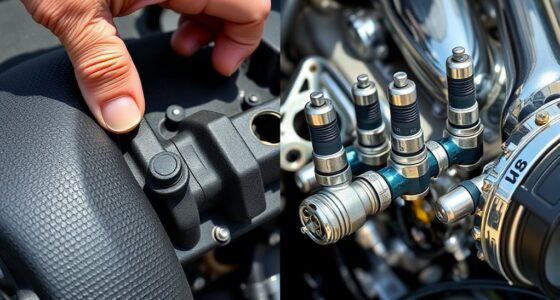

Limp mode is a safety feature in your vehicle that activates when your engine or transmission detects a problem. It limits your car’s power, speed, and acceleration to prevent further damage and help you reach a repair shop safely. This mode is controlled by onboard computers that monitor sensors and systems continuously. If you experience limp mode, it’s likely due to a fault that needs diagnosis and repair. Keep going, and you’ll discover what causes it and how to resolve it.
Key Takeaways
- Limp mode is a safety feature that limits engine power to prevent further damage during faults.
- It activates when onboard sensors detect issues with engine or transmission systems.
- The mode restricts speed and acceleration, allowing safe vehicle operation to reach a mechanic.
- Diagnostic tools are used to identify the specific fault causing limp mode.
- Repairing the underlying problem and resetting the system typically restore normal vehicle function.

Limp mode is a safety feature in your vehicle that activates when the engine or transmission detects a problem, automatically limiting power to prevent further damage. When this happens, your car reduces engine output, often restricting speed and acceleration, so you can get to a safe location or a mechanic without risking additional harm. Understanding why your vehicle enters limp mode can help you respond effectively and avoid costly repairs.
The first step when your car goes into limp mode is to identify the cause of the issue. Modern vehicles are equipped with onboard computer systems that monitor various sensors and components. When a fault occurs, these systems trigger the limp mode as a protective measure. To pinpoint the problem, mechanics rely heavily on diagnostic tools, which scan the vehicle’s electronic control units (ECUs) for error codes. These diagnostic tools read the specific fault codes stored in your vehicle’s computer, guiding you or your mechanic toward the source of the problem—be it a faulty sensor, a clogged fuel injector, or a transmission issue.
Once the diagnostic codes are retrieved, you can begin the repair procedures needed to resolve the underlying problem. Repair procedures vary widely depending on what the diagnostic tools reveal. For instance, if the codes point to a malfunctioning sensor, replacing or recalibrating that sensor might be enough. If the issue involves the transmission, more extensive repairs could be required, such as fluid replacement or component replacement. It’s important to follow manufacturer-specific repair procedures, as these are designed to ensure the correct and safe resolution of the problem.
In many cases, clearing the fault codes after repairs is necessary to reset the vehicle’s computer and take it out of limp mode. This process can be done using diagnostic tools, which communicate with your car’s ECUs to erase the stored codes. If the repair procedures are successful and the fault no longer exists, the vehicle should return to normal operation. However, if the limp mode reactivates soon after, it indicates that the problem wasn’t fully resolved, and further diagnostics may be needed.
Understanding how diagnostic tools and repair procedures work together can save you time and money. Rather than guessing or replacing parts blindly, you’ll have precise information guiding your repairs. This approach not only ensures the problem is fixed correctly but also prevents the vehicle from repeatedly entering limp mode. Additionally, knowing that error codes are essential for accurate diagnostics can help you communicate effectively with your mechanic. Ultimately, recognizing the importance of these tools and procedures empowers you to handle limp mode situations more confidently, ensuring your vehicle remains safe and reliable on the road.
Frequently Asked Questions
Can Limp Mode Cause Permanent Engine Damage?
Limp mode usually doesn’t cause permanent engine damage if you get engine repair promptly. It’s a protective feature triggered by issues found during diagnostic tests, meant to prevent further harm. However, ignoring warning signs or delaying repairs could lead to more severe damage over time. To keep your engine safe, address the problem early, and have a mechanic perform thorough diagnostic tests to identify and fix the underlying issue.
How Can I Reset My Vehicle From Limp Mode?
To reset your vehicle from limp mode, you can try turning off the engine and waiting a few minutes before restarting. If it doesn’t clear, use diagnostic tools to identify the issue. Sometimes, a simple reset works, but if the problem persists, you should seek professional repair. A mechanic can properly diagnose and fix the underlying cause, ensuring your vehicle returns to normal operation safely.
Is Limp Mode Safe to Drive Long-Term?
Driving long-term in limp mode isn’t safe because it limits your engine’s performance, and a dashboard warning indicates there’s a serious issue. You might experience reduced power, which can make driving dangerous, especially in traffic or on highways. It’s best to get your vehicle inspected promptly. Ignoring these signs could lead to more damage, higher repair costs, and potential safety risks. Always prioritize fixing the root cause before continuing your drive.
What Specific Sensors Trigger Limp Mode?
Think of your car’s sensors like vigilant guardians; when they detect sensor malfunctions, they alert you with warning lights and trigger limp mode to protect your vehicle. Specific sensors like the throttle position sensor, mass airflow sensor, and oxygen sensors can activate this mode when they send faulty signals. These sensors constantly monitor essential engine parameters, and when they falter, limp mode kicks in to prevent further damage.
Does Limp Mode Affect Fuel Efficiency?
Limp mode can negatively impact your fuel efficiency because it limits engine power, making you work harder to accelerate and maintain speed. When your vehicle is in limp mode, you might notice decreased fuel economy, especially if you keep driving it aggressively. To avoid this, adopt smoother driving habits and address underlying issues promptly. Proper maintenance and gentle driving help optimize fuel economy and prevent your car from entering limp mode.
Conclusion
Think of limp mode as your car’s way of pulling over on a busy highway, signaling you to slow down and pay attention. Just like a guardian angel shielding you from danger, it steps in to protect your engine from further harm. When you see it, don’t ignore the warning—listen carefully, diagnose the issue, and get it fixed. Only then can you safely continue your journey, confident that your vehicle’s protection is working as intended.