Crash energy paths are the designed routes your vehicle uses to guide impact forces away from you during a collision. Engineers create these pathways by shaping structures and selecting materials that absorb and redirect crash energy effectively. This process guarantees the force is spread out and dissipated gradually, reducing the risk of injury. To understand how these pathways work and improve safety features, stay with us as we explore this crucial aspect of vehicle design.
Key Takeaways
- Crash energy paths are designed routes that direct impact forces along specific structural components during a collision.
- They help dissipate energy gradually, reducing the risk of localized failure and enhancing occupant safety.
- Structural features like crumple zones control how energy flows, preventing it from concentrating in critical areas.
- Understanding these paths allows engineers to optimize vehicle design for better energy absorption and safety performance.
- Managing crash energy paths ensures controlled deformation, minimizing injury and vehicle damage during collisions.
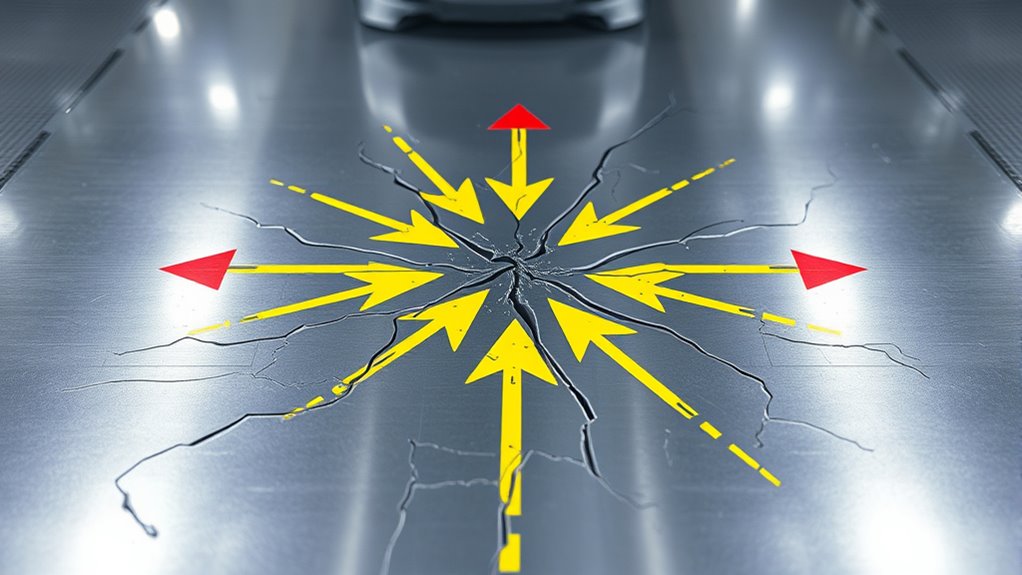
When a vehicle crashes, understanding how energy moves through its structure is crucial for designing safer cars. During a collision, the energy generated from the impact needs to be managed effectively to minimize injuries and protect occupants. One key aspect of this process involves how materials within the vehicle respond to the force. Material deformation plays a central role here; when a crash occurs, different parts of the car’s structure undergo controlled deformation, absorbing a significant portion of the impact energy. Instead of transmitting all the force directly to the occupants, these materials deform in ways that dissipate energy gradually. This deformation can be plastic, where the material permanently changes shape, or elastic, where it temporarily deforms and then returns to its original form. Engineers carefully select materials and design structures so that deformation occurs in predictable, safe ways, ensuring energy is absorbed efficiently without compromising the vehicle’s integrity. Incorporating energy absorption mechanisms like crumple zones further enhances this process, allowing for controlled deformation that maximizes safety.
Material deformation absorbs impact energy, protecting occupants by safely dissipating crash forces.
Energy absorption mechanisms are integral to this process. These mechanisms are designed to convert collision energy into other forms, such as heat or deformation, reducing the force transferred to the passenger compartment. Structural components like crumple zones exemplify this concept. They are engineered to deform progressively during impact, absorbing energy through controlled buckling or crushing. This process slows down the deceleration of the vehicle and lessens the severity of the crash for occupants. Likewise, materials with high energy absorption capacity, such as foams and composites, are embedded in areas prone to impact. These materials deform under stress, absorbing energy that would otherwise be transferred to the crash test dummies or passengers. Understanding how energy is directed along crash energy paths is essential for optimizing safety features. When impact forces encounter these designed energy absorption zones, they follow specific paths that ensure energy is gradually dissipated rather than concentrated in one spot. This controlled energy flow prevents localized failures that could jeopardize occupant safety. Engineers analyze how energy travels through various materials and structures, adjusting design features to enhance these pathways. They aim for a balance where energy absorption is maximized without overly compromising the vehicle’s structural integrity. Additionally, designing structures with energy dissipation in mind helps to improve overall crash performance.
In essence, the movement of crash energy through a vehicle depends heavily on the interplay of material deformation and energy absorption mechanisms. When you consider how these elements are integrated into car design, it becomes clear that managing crash energy isn’t just about making parts stronger—it’s about making them smarter. By controlling how energy moves and is absorbed, designers create vehicles that protect you better during a crash, saving lives and reducing injuries. This understanding shapes the future of automotive safety, ensuring that crash energy paths are engineered to keep you safer on the road.
Frequently Asked Questions
How Do Crash Energy Paths Vary Across Different Vehicle Types?
You’ll notice crash energy paths vary across vehicle types because of differences in vehicle structure and design. For example, cars with crumple zones direct energy absorption to specific areas, reducing impact force on occupants. Trucks and SUVs often have reinforced structures, which alter energy absorption routes. These variations influence how effectively crash energy is managed, ultimately affecting occupant safety during collisions.
What Role Do Crash Energy Paths Play in Vehicle Safety Design?
Crash energy paths are vital in vehicle safety design because they direct impact forces away from occupants, preserving structural integrity. You rely on material deformation to absorb energy effectively, preventing excessive intrusion. By strategically shaping crash energy paths, engineers guarantee forces are managed efficiently, minimizing injury risk. This approach enhances safety by maintaining vehicle integrity during crashes and protecting occupants through controlled energy dissipation and optimized structural design.
Can Crash Energy Paths Be Influenced by External Environmental Factors?
Did you know that environmental impact and road condition effects can alter crash energy paths? External factors like wet or icy roads, debris, or uneven surfaces influence how crash energy is absorbed and directed during collisions. These conditions can change vehicle dynamics, making crashes more severe or unpredictable. So, as you drive, remember that environmental influences play a vital role in shaping crash energy paths and overall vehicle safety performance.
How Are Crash Energy Paths Measured During Crash Testing?
During crash testing, you measure crash energy paths by analyzing sensor placement throughout the vehicle. Sensors are strategically positioned to capture data on energy absorption and transfer during impact. This data helps you understand how energy moves through the vehicle structure, revealing the effectiveness of safety features and crashworthiness. By examining sensor readings, you can evaluate how well the crash energy paths are controlled, ultimately improving vehicle safety design.
What Advancements Are Being Made to Improve Crash Energy Path Management?
Did you know that advanced simulation tools have improved crash energy path management by over 35% in recent years? You benefit from these innovations through better safety designs, thanks to material innovation and sophisticated modeling. Researchers are developing smarter algorithms and stronger materials to control energy flow more effectively during crashes. These advancements help protect you better by optimizing crashworthiness, ultimately reducing injury risks and making vehicle safety systems more reliable than ever before.
Conclusion
So, next time you’re behind the wheel, remember that crash energy paths seem simple—until they’re not. You might think physics is just a background player, but it’s really the silent director of your safety. Ironically, understanding these paths can make you more confident, yet it’s also a reminder how unpredictable crashes can be. So, stay alert, drive safely, and maybe, just maybe, let the science do its job—before it’s too late.