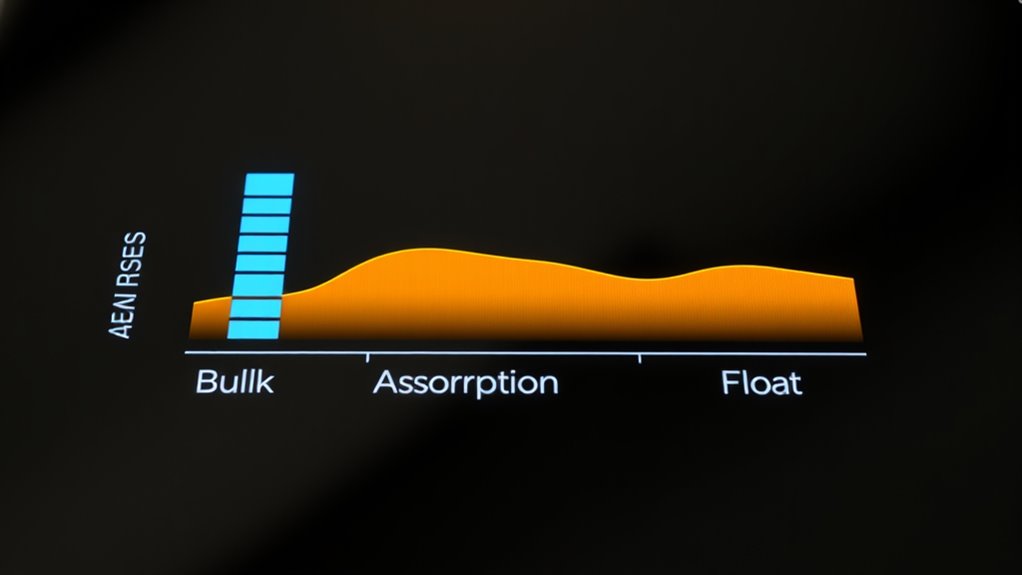

Charging profiles consist of three key stages: bulk, absorption, and float. In bulk, you deliver maximum current to quickly restore capacity, while during absorption, voltage stays steady as current decreases to guarantee a full, safe charge. The float stage maintains the battery at a lower voltage for long-term storage. Understanding these phases helps you optimize battery lifespan and efficiency, and exploring further reveals how external factors influence each stage’s effectiveness.
Key Takeaways
- Charging profiles include bulk, absorption, and float stages, each serving specific functions in battery management.
- Bulk phase delivers maximum current for rapid capacity restoration; it sets the foundation for subsequent stages.
- Absorption maintains a steady voltage while gradually reducing current to safely complete charging.
- Float stage keeps the battery at a lower voltage to offset self-discharge during long-term storage.
- External factors like solar efficiency and temperature significantly influence each charging profile’s effectiveness.
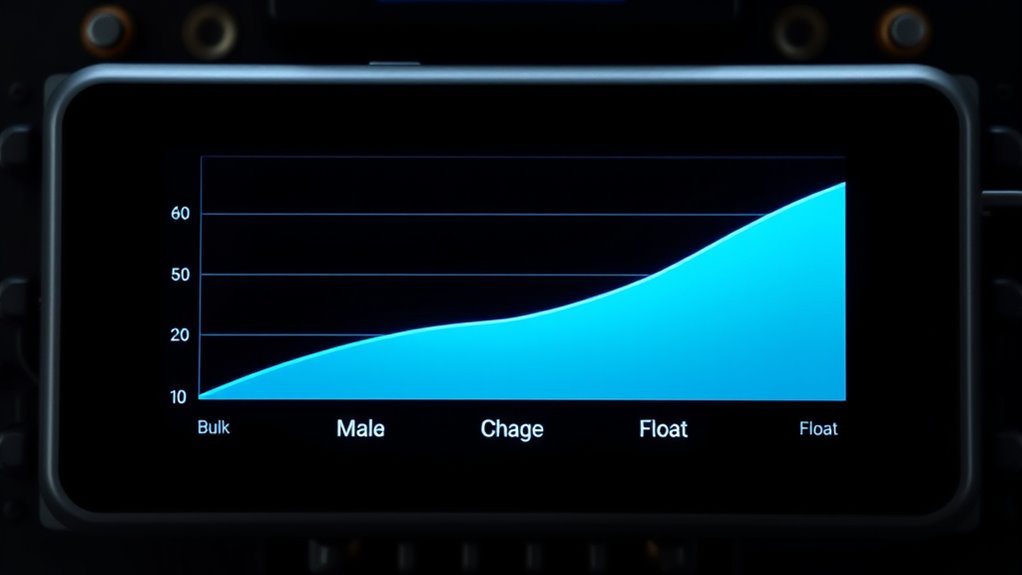
Have you ever wondered how different charging strategies can impact your device’s battery life? Understanding the various charging profiles—bulk, absorption, and float—can help you optimize the lifespan and performance of your batteries. Each phase plays a vital role in how your battery accepts, stores, and releases energy, but they also interact with external factors like solar panel efficiency and battery temperature effects, which can considerably influence overall health. Incorporating principles from Design Thinking, such as empathy and iterative testing, can further enhance how you manage and improve your charging systems. During the bulk charging phase, your battery receives the maximum current, rapidly restoring its capacity. This stage is essential because it determines how quickly your battery charges and sets the stage for the subsequent phases. Solar panel efficiency directly impacts this process; if your panels aren’t converting sunlight effectively, your battery may take longer to reach full charge or might not charge fully at all. Making sure your solar panels are clean, correctly positioned, and compatible with your system can maximize their efficiency, making bulk charging faster and more effective. However, it’s also important to watch battery temperature effects during this phase. Excessive heat can cause batteries to accept charge more quickly initially but may lead to accelerated degradation over time. Conversely, cold temperatures can slow down chemical reactions inside the battery, hindering the bulk charging process. That’s why maintaining an ideal temperature range is critical for healthy charging and long-term battery life.
Once the battery hits a certain voltage during bulk charging, it transitions into absorption mode. During this phase, the current gradually decreases while the voltage remains steady, allowing the battery to fully absorb the charge without overloading. This stage ensures that your battery reaches its full capacity safely. Here, solar panel efficiency remains important; if your panels aren’t providing consistent sunlight or are affected by weather conditions, the absorption process can be interrupted, leading to incomplete charging. Additionally, battery temperature effects continue to play a role. Elevated temperatures during absorption can cause the battery to overheat, risking damage or reduced capacity, while low temperatures can slow down the absorption process, extending charging times. Proper ventilation and temperature management are essential during this phase to prevent thermal stress.
Finally, the float stage maintains the battery at a slightly lower voltage, compensating for self-discharge and keeping the battery topped off without overcharging. This profile is essential for long-term storage, especially in solar systems that might not get continuous sunlight. Solar panel efficiency affects this stage as well; if panels aren’t providing enough power due to shading or dirt, the float charge might not be sustained properly. Battery temperature effects are also relevant here—high temperatures can cause overcharging or reduce battery lifespan, while cold conditions might lead to insufficient maintenance of the full charge. By understanding these profiles and their interaction with external factors, you can better tailor your charging system to extend your battery’s life and maximize performance.
Frequently Asked Questions
How Do Temperature Changes Affect Different Charging Profiles?
Temperature effects can substantially impact your charging profiles. When temperatures rise, your charger may slow down charging to prevent overheating, requiring charging adaptation. Conversely, colder temps can reduce battery efficiency, leading to longer charging times or the need for increased current. By monitoring temperature changes, you can adjust your charging approach, ensuring your battery charges safely and efficiently across different profiles like bulk, absorption, and float.
Can Charging Profiles Be Customized for Specific Battery Types?
Yes, you can customize charging profiles for specific battery chemistry to optimize performance and lifespan. You should verify your charger is compatible with the battery type, as different chemistries like lithium-ion, lead-acid, or NiMH require tailored profiles. Adjusting parameters such as voltage and current settings helps prevent damage and enhances efficiency, making customization essential for maintaining your batteries’ health and ensuring safe, reliable operation.
What Are Signs of Improper Charging Profiles Damaging Batteries?
You should watch for reduced battery longevity and decreased charging efficiency, which are common signs of improper charging profiles. Studies show that up to 30% of battery failures are linked to incorrect charging methods. If your battery heats up excessively, cycles faster, or loses capacity quickly, it’s likely being damaged. Adjusting charging profiles correctly helps extend battery life and optimizes performance, preventing costly replacements and ensuring reliable operation.
How Do Aging Batteries Influence Optimal Charging Profiles?
Aging batteries affect ideal charging profiles because their battery lifespan decreases, making them less efficient at holding a charge. You’ll notice reduced charge efficiency, meaning it takes longer to recharge and they don’t deliver power as well. To prolong their life, you should adjust charging profiles to prevent overcharging or deep discharges, which can accelerate aging and further diminish their capacity and overall performance.
Are There Industry Standards for Setting Charging Profiles?
Yes, industry standards guide how you set charging profiles, considering your battery chemistry and charger compatibility. These standards guarantee safe, efficient charging by defining voltage and current limits for different chemistries like lithium-ion or lead-acid. Following these guidelines helps optimize battery lifespan and performance. Always check manufacturer recommendations and adhere to relevant standards to ensure compatibility and safety during charging.
Conclusion
Mastering these charging profiles is like having a secret weapon in your battery game. By understanding bulk, absorption, and float, you’ll keep your batteries happier and last way longer—almost like giving them a superpower. Think of it as revealing the true potential of your power source, making sure it never lets you down. So go ahead, apply these profiles, and watch your batteries perform like marathon runners, unstoppable and full of energy!