
Scope probes and attenuators are essential tools that help you measure electrical signals accurately. They ensure the signal’s integrity by matching impedance, preventing reflections, and reducing distortions. Attenuators safely scale down high voltages, protecting your oscilloscope and improving measurement precision. Choosing the right probe and attenuator setup helps you capture true waveforms without interference. To learn more about how these tools enhance your signal analysis, keep exploring their functions and benefits.
Key Takeaways
- Scope probes connect circuits to oscilloscopes, enabling accurate high-frequency signal measurement and waveform analysis.
- Attenuators reduce signal amplitude, protecting the oscilloscope and ensuring measurement accuracy.
- Proper impedance matching with probes prevents signal reflections and distortions during high-speed measurements.
- High-bandwidth probes preserve signal integrity, especially for high-frequency signals, maintaining waveform fidelity.
- Attenuators improve measurement safety and accuracy by preventing overloads and maintaining consistent load impedance.
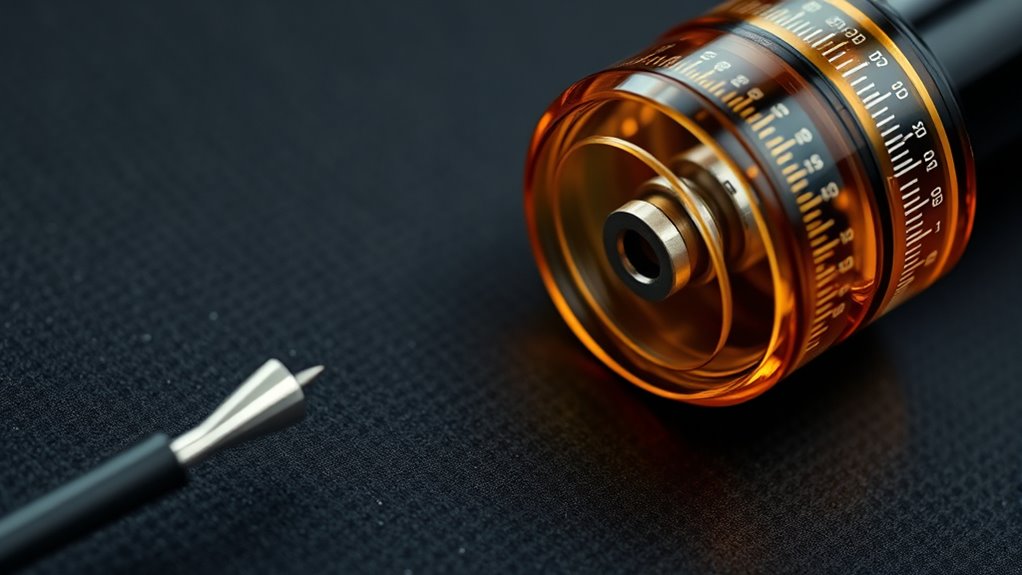
Scope probes and attenuators are essential tools for accurately measuring electrical signals with an oscilloscope. When you’re working with high-frequency signals, maintaining signal integrity becomes critical. Poor connections or mismatched impedance can distort your readings, leading to inaccurate analysis. That’s where proper probes and attenuators come into play—they help you preserve the true shape and amplitude of the signals you’re trying to observe.
Impedance matching is a key factor when selecting or designing these tools. If the oscilloscope’s input impedance isn’t properly matched to the source impedance of your circuit, reflections and signal distortions can occur. For instance, many high-speed signals rely on a characteristic impedance—like 50 ohms—to ensure minimal signal reflection. Using a probe with mismatched impedance can introduce errors, cause ringing, or degrade the quality of your measurement. To prevent this, you need probes that are designed to match the impedance of your circuit, ensuring the signal remains unaltered from source to measurement point.
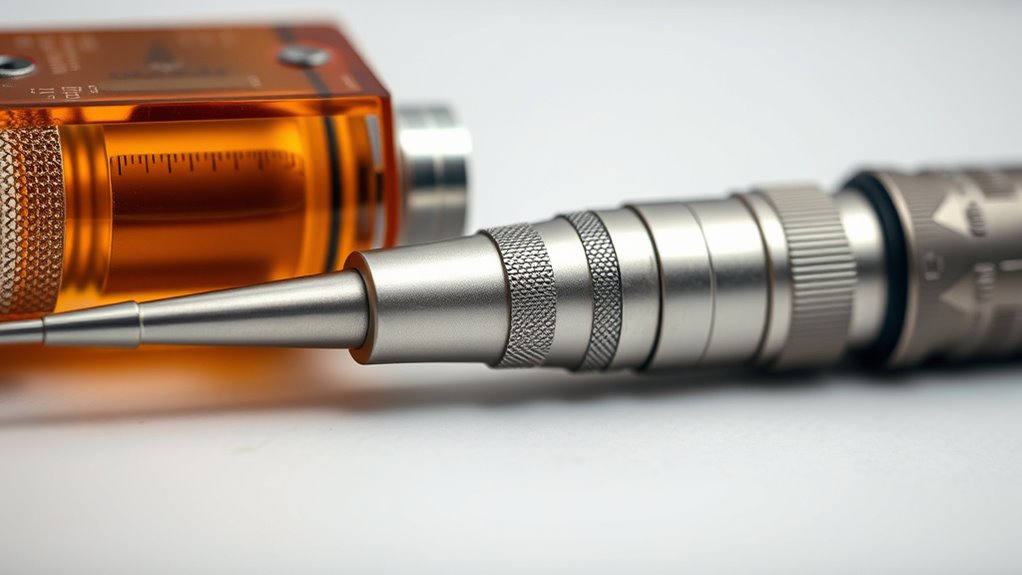
Scope probes are more than just connectors; they serve as critical interfaces between your circuit and the oscilloscope. They should be chosen based on their bandwidth, attenuation ratio, and impedance characteristics. A high-bandwidth probe preserves the high-frequency components of your signal, preventing loss of detail. Attenuation ratios, such as 10:1 or 1:1, allow you to scale down high-voltage signals to safe levels for the oscilloscope, protecting both the device and your measurements. Properly selected probes maintain the signal’s fidelity, ensuring that the waveform you see is a true representation of what’s happening in your circuit.
Attenuators, often integrated into probes, further enhance measurement accuracy by reducing signal amplitude before it reaches the oscilloscope. This is especially important for high-voltage signals that could damage the input or cause measurement inaccuracies due to overload. Attenuators work by dividing the signal, which helps in maintaining linearity and prevents the scope from clipping or saturating. They also contribute to impedance matching by ensuring that the load presented to the source is consistent, reducing the chances of signal reflection and distortion. Additionally, understanding the importance of contrast ratio in projectors can help in designing better testing setups for high-quality signals.
Frequently Asked Questions
How Do I Choose the Right Scope Probe for High-Frequency Signals?
To select the right scope probe for high-frequency signals, you need to take into account the probe’s bandwidth and how it impacts signal integrity. Opt for a probe with a bandwidth considerably higher than your signal’s frequency to minimize distortion. A high-bandwidth probe preserves signal fidelity, ensuring accurate measurements. Also, look for low capacitance and proper attenuation settings to reduce loading effects, helping you maintain the true waveform of your high-frequency signals.
What Are the Differences Between Passive and Active Attenuators?
Passive attenuators use resistors to reduce signal amplitude, preserving signal integrity with minimal power consumption. Active attenuators incorporate transistors or amplifiers, offering better calibration and higher bandwidth for delicate, high-frequency signals. You’ll find active types useful when precise probe calibration and maintaining signal fidelity are critical. Passive attenuators are simpler and more reliable for general use, but active ones excel in high-frequency applications where signal quality matters most.
How Do Attenuation Settings Affect Measurement Accuracy?
Attenuation settings directly impact your measurement accuracy by reducing signal strength, which can prevent signal distortion and overload of your scope. Proper attenuation calibration guarantees the settings are accurate, maintaining measurement reliability. If you set attenuation too high or low, it might introduce errors or distort the signal, leading to inaccurate readings. Always verify your attenuation calibration and choose appropriate attenuation levels to ensure precise measurements and avoid signal distortion.
Can Scope Probes Damage Sensitive Electronic Components?
Probe peril can pose a real risk to sensitive circuits. You must prioritize probe safety to prevent damage, especially when measuring delicate electronic components. Use proper attenuation settings, ensure correct probe grounding, and avoid excessive voltage levels. By practicing cautious connection and handling, you protect your components from harm. Remember, careful calibration and adherence to safety guidelines are your best allies in damage prevention, keeping your measurements accurate and your equipment intact.
What Maintenance Is Required to Ensure Probe Longevity?
To guarantee probe longevity, you should regularly perform calibration procedures to maintain accuracy and check for wear. Store your probes properly in a cool, dry place, avoiding extreme temperatures and humidity. Handle them gently, avoiding bending or pulling the cables. Clean the probes with a soft cloth and avoid harsh chemicals. Proper maintenance like this helps prevent damage, extends their lifespan, and ensures reliable measurements over time.
Conclusion
Remember, using the right scope probes and attenuators is key to accurate measurements. They help you see the true signal without distortion, making your work more reliable. Think of it like sharpening a lens—you get a clearer view of what’s really happening. As the saying goes, “A chain is only as strong as its weakest link.” So, choose your probes and attenuators wisely, and you’ll always have a clear, dependable picture of your signals.