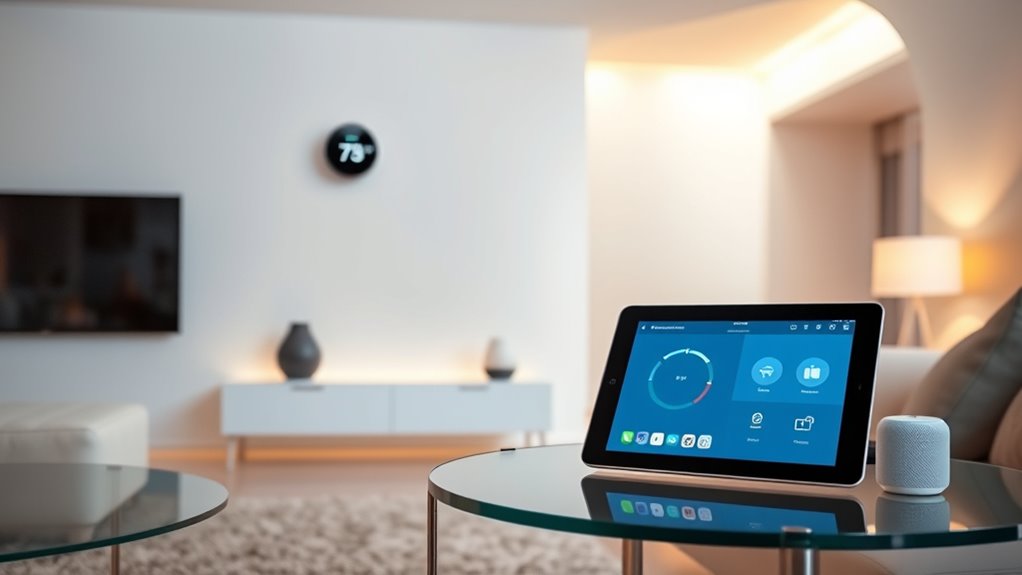

To start your smart home journey without feeling overwhelmed, begin with simple, compatible devices like smart lights or a voice assistant. Focus on automating daily routines, such as scheduling lights or adjusting thermostats, to see immediate benefits. Use voice commands for hands-free control and expand gradually. Keeping it straightforward helps you enjoy convenience and energy savings without complex setups. If you want to learn more about effortless smart home tips, there’s plenty more to explore.
Key Takeaways
- Start with one or two simple devices, like a smart bulb or thermostat, to avoid feeling overwhelmed.
- Use voice assistants to control multiple devices easily with just your voice.
- Create basic routines, such as “Good morning,” to automate multiple actions at once.
- Focus on energy-saving tips that are easy to implement, like scheduling lights to turn off automatically.
- Expand your smart home gradually, adding new devices as you become more comfortable.

Ever wondered how smart homes make everyday living easier? The secret lies in the seamless integration of technology that responds to your needs, conserves energy, and simplifies routines. One of the most user-friendly features is voice command integration. With just a simple voice prompt, you can turn on lights, adjust thermostats, or lock doors without lifting a finger. Imagine waking up and saying, “Good morning,” to activate your coffee maker, open the blinds, and play your favorite playlist—all by voice. This hands-free control not only boosts convenience but also enhances safety, since you can manage your home without rushing around or searching for switches. Plus, voice commands are continually improving, becoming more intuitive and responsive, so you can enjoy a more natural, conversational experience with your smart home devices.
Alongside voice command integration, focusing on energy efficiency tips can help you make smarter choices that benefit both your wallet and the environment. For example, setting your thermostat to a slightly lower temperature during winter or higher during summer can notably cut energy bills. Many smart thermostats learn your schedule and adjust accordingly, ensuring comfort while minimizing waste. You can also schedule lights to turn off automatically when rooms are unoccupied, preventing unnecessary power consumption. Using smart plugs for devices that tend to stay on constantly ensures they’re powered down when not needed, reducing standby energy drain. Incorporating these small but effective energy efficiency tips can make your smart home not only more eco-friendly but also more cost-effective over time. Additionally, understanding data management in smart home systems can help optimize device performance and energy use.
Getting started with voice command integration is straightforward. Most smart home systems support popular voice assistants like Alexa, Google Assistant, or Siri. Once you connect compatible devices, you can create routines that automate multiple actions with a single command. For example, saying “Good night” could turn off all lights, lock doors, and lower the thermostat. As you become more comfortable, you’ll find that voice control becomes second nature, making daily routines faster and more efficient. To maximize energy savings, consider installing smart sensors that detect motion or ambient light, so your home adjusts itself automatically based on activity and natural conditions. These integrations work together to create a smarter, more responsive living environment that adapts to your lifestyle.
In essence, embracing voice command integration and applying simple energy efficiency tips can transform your home into a more convenient, cost-effective, and environmentally friendly space. The key is to start small, focus on one or two features at a time, and gradually expand as you become more comfortable. With a little planning and some smart choices, you’ll enjoy the benefits of a truly intelligent home without feeling overwhelmed.
Frequently Asked Questions
How Secure Are Smart Home Devices Against Hacking?
Smart home devices can be quite secure if you take the right steps. They use encryption protocols to protect your data from hackers, making it harder for intruders to access your network. Regular firmware updates are essential because they fix vulnerabilities and improve security features. By keeping your devices updated and using strong passwords, you markedly reduce the risk of hacking, ensuring your smart home remains safe and protected.
Can I Control Smart Devices Remotely Without Internet?
Yes, you can control smart devices remotely without internet through offline control and local automation. Many smart home systems allow you to manage devices via a local network, like a hub or a Wi-Fi router, without needing internet access. This setup keeps you connected and in control even during outages, ensuring your smart devices respond to commands through direct communication, providing convenience and security without relying on cloud services.
Are Smart Home Systems Compatible With Existing Appliances?
Yes, many smart home systems are compatible with your existing appliances through device compatibility and appliance integration. You can often connect smart devices like bulbs, thermostats, or plugs to your current appliances, making setup straightforward. Just check the specifications of your appliances and the smart system to guarantee compatibility. This way, you can seamlessly integrate your favorite devices without replacing everything, creating a smarter, more connected home.
What Is the Typical Cost of Setting up a Smart Home?
Setting up a smart home typically costs between $200 and $2,500, depending on your needs. The cost breakdown includes devices like smart bulbs, thermostats, and security cameras, plus installation if needed. You should do some budget planning to prioritize essentials and avoid overspending. Keep in mind that starting small and gradually expanding your system helps manage costs and complexity, making your smart home journey manageable and enjoyable.
How Do I Troubleshoot Connectivity Issues With Devices?
Think of your smart devices as a band trying to play in harmony. If a device disconnects, you can perform a quick reset to tune it back up. Check for signal interference from other electronics or thick walls blocking the Wi-Fi. Moving your device closer to the router or restarting your router can restore the connection. Keep your setup streamlined, and your smart home will keep singing smoothly.
Conclusion
Now that you’ve got the basics down, your smart home is like a well-orchestrated symphony, each device playing its part seamlessly. With a little patience and curiosity, you’ll turn your house into a smart sanctuary where technology feels like a trusted partner, not a wild beast. Remember, it’s okay to take small steps—soon, your home will hum with effortless intelligence, making everyday life smoother and brighter, like a sunrise after a storm.