TL;DR

Get business pricing on garage and car supplies
- Business-only prices and quantity discounts
- Tax-exempt purchasing
- Multiple users, one account, clear invoices
Waymo has publicly criticized Tesla’s self-driving approach, arguing that cameras alone are insufficient for safe autonomous driving. This marks a notable disagreement between two leading autonomous vehicle developers. The debate centers on the technological strategies used for self-driving systems.
Waymo has publicly criticized Tesla’s self-driving strategy, asserting that relying solely on cameras is inadequate for ensuring safety and reliability. The statement marks a rare direct critique from Waymo, a leader in autonomous vehicle technology, against Tesla’s approach, which emphasizes camera-based perception as the core of its Autopilot and Full Self-Driving systems.
In a recent public statement, Waymo CEO John Krafcik emphasized that multiple sensor types, including lidar and radar, are essential for robust autonomous driving systems. He contrasted this with Tesla’s approach, which heavily relies on cameras and neural networks to interpret the environment. Waymo’s critique aligns with the broader industry consensus that sensor fusion enhances safety and accuracy.
While Tesla has argued that cameras are sufficient for full autonomy, citing their human-like perception capabilities, Waymo and other industry experts contend that cameras alone cannot reliably perceive all driving conditions, especially in poor weather or low-light scenarios. Tesla has not publicly responded to the specific critique but continues to promote its camera-centric system as a cost-effective solution.
Implications for Autonomous Vehicle Technology Strategies
This public disagreement underscores a fundamental debate within the autonomous vehicle industry about the best technological approach. Waymo’s criticism highlights concerns that Tesla’s reliance solely on cameras might compromise safety, which could influence regulatory perspectives and consumer trust. The debate also impacts investor confidence and the strategic direction of both companies, as industry watchers evaluate which approach will ultimately prove more effective and scalable.
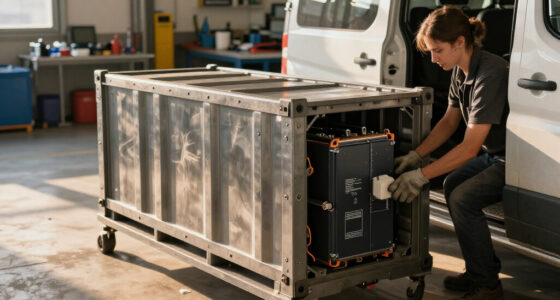
autonomous vehicle sensor fusion kit
As an affiliate, we earn on qualifying purchases.
As an affiliate, we earn on qualifying purchases.
Industry Divergence in Self-Driving Sensor Approaches
The autonomous vehicle industry is divided over sensor technology. Tesla’s approach, championed by CEO Elon Musk, relies primarily on cameras and neural network processing, aiming to reduce costs and mimic human perception. Tesla states that lidar and radar are unnecessary for full autonomy, which they consider an achievable goal with advanced AI.
In contrast, companies like Waymo, Cruise, and others incorporate lidar and radar alongside cameras, arguing that sensor fusion provides redundancy and improves safety. Waymo has been testing its lidar-equipped vehicles for years and has accumulated extensive safety data, which it believes validates its multi-sensor strategy. This disagreement reflects differing philosophies about cost, complexity, and safety in autonomous vehicle development.
“Reliance solely on cameras is not enough for safe autonomous driving. Multiple sensors are essential to handle the complexity of real-world environments.”
— John Krafcik, Waymo CEO
Unclear Impact of Public Criticism on Industry Dynamics
It is not yet clear how industry stakeholders, regulators, or consumers will interpret Waymo’s public critique of Tesla. There is no indication of formal regulatory action or policy changes at this stage, and Tesla has not publicly responded to the specific comments. The long-term impact on Tesla’s market position or on regulatory acceptance of camera-only systems remains uncertain.
Next Steps in Industry and Regulatory Responses
Industry analysts expect ongoing debates over sensor technology to continue, with regulatory bodies possibly scrutinizing safety data from different approaches. Both companies are likely to accelerate testing and public demonstrations to bolster their claims. Further public statements, safety reports, or regulatory filings could clarify the industry’s stance on sensor requirements for autonomous vehicles.
Key Questions
Why does Waymo criticize Tesla’s camera-only approach?
Waymo argues that relying solely on cameras does not provide the redundancy and environmental perception needed for safe autonomous driving, especially in challenging conditions.
What are the main differences between Waymo and Tesla’s self-driving strategies?
Waymo uses a multi-sensor system including lidar, radar, and cameras, while Tesla emphasizes a camera-centric approach relying on neural networks and AI perception.
Could Tesla’s approach be less safe than Waymo’s?
It is currently a matter of debate. Tesla claims its system is safe and effective, but critics like Waymo suggest that cameras alone may not provide sufficient environmental awareness under all conditions.
How might regulators react to these differing strategies?
Regulators may scrutinize safety data and sensor requirements, potentially favoring approaches that demonstrate higher redundancy and safety margins, which could influence future policy decisions.
Will this disagreement affect consumer trust or adoption?
Public perception may be influenced by safety claims and industry debates, but widespread impact depends on actual safety performance and regulatory approval of each approach.
Source: rss
Halloween Picks
halloween
As an affiliate, we earn on qualifying purchases.