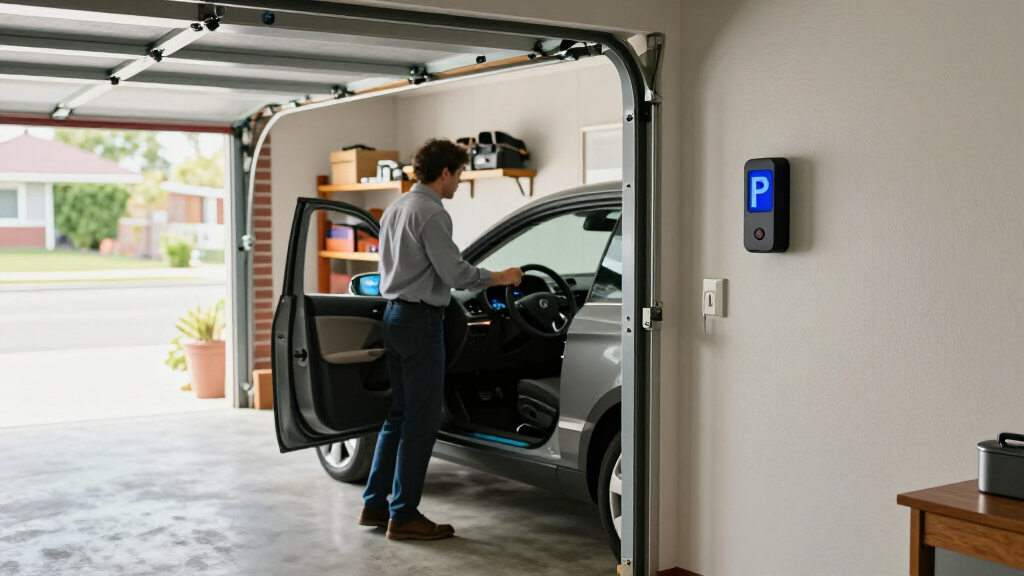
Garage parking sensor systems range from simple laser guides to ultrasonic units with visual alerts, and the right choice depends on your space and how much feedback you want. My best overall pick is the STKR Adjustable Garage Parking Sensor with Ultrasonic Detection and LED Display, which combines distance sensing with an easy-to-read indicator. The MAXSA 37312 Dual Laser is a standout for aligning two vehicles, while the STKR Concepts Garage Side Parking Sensor suits drivers who need a side-clearance warning. The main tradeoffs are setup complexity, power needs, and whether you prefer a projected aiming point or a stop-distance alert. Read on for the full breakdown and a guide to matching a system to your garage.

Get business pricing on garage and car supplies
- Business-only prices and quantity discounts
- Tax-exempt purchasing
- Multiple users, one account, clear invoices
Complete the kit


Key Takeaways
- Ultrasonic sensors with LED displays provide distance feedback rather than a fixed aiming point, making the STKR Adjustable model my best overall pick for drivers who want a visible stopping cue.
- Dual lasers are better suited to repeatable alignment across two parking positions; MAXSA 37312 and VCYOPN offer that approach, while single-laser options serve one vehicle or parking bay.
- Adjustable stop distances matter when vehicles or parking habits change, giving adjustable LED and ultrasonic models more flexibility than a fixed marker.
- Side-clearance sensing solves a different problem from front-wall parking; the STKR Concepts Side Parking Sensor is the focused choice for drivers who need help judging lateral space.
- Simple tennis-ball and laser guides trade feedback for simplicity, while sensor-and-display systems add clearer alerts but call for more setup and attention to power requirements.


| garage parking sensor system | Model | Brand | Power | Weight |
|---|---|---|---|---|
| MAXSA 37312 Dual Laser Garage | 37312 | Maxsa Innovations | AC adapter included; optional AA battery backup, batteries not included | — |
| Adjustable Garage Parking Sens | ZM-206 | — | — | — |
| Armor All Advanced Garage Park | AAC4-1000-BLK | Armor All | — | — |
| Adjustable LED Garage Parking | — | VKQTS | — | 1 ounce |
| LED Garage Parking Sensor with | — | — | 3 AAA batteries, not included, or included USB cable | — |
| SARDVISA Garage Tennis Ball Pa | A4171 | — | — | — |
| CENTAURUS LED Garage Parking A | — | — | — | — |
| VCYOPN Dual Laser Garage Parki | — | — | — | 0.44 lb |
| LogicXYZ Garage Parking Assist | GP5-2540 | LogicXYZ | AC adapter | 13 ounces |
| Sirmpuna Adjustable Ultrasonic | 4001-GPSA | Sirmpuna | 3 AAA batteries (not included) or included AC/DC adapter | 7.8 ounces |
| STKR Concepts Garage Side Park | Side Garage Parking Sensor | STKR Concepts | Four AA batteries or USB-C | 5.6 ounces |
| HappyAlley Adjustable Garage P | YUX0386 | HappyAlley | — | 8.4 ounces |
| MAXSA 37310 Park Right Single | 37310 | — | AC adapter with 9-foot cord; optional 9V battery backup not included | 11.2 ounces |
| STKR Adjustable Garage Parking | 00-382 | STKR Concepts | Four AA batteries or optional USB; batteries, cable, and charger not included | — |
| Fosmon Dual Laser Garage Parki | 51072HOMUS-01 | Fosmon | AC adapter; 9V battery backup supported, battery not included | 8.8 ounces |
More Details on Our Top Picks
MAXSA 37312 Dual Laser Garage Parking Guide for Two Cars
For a garage where two vehicles need separate stopping references, the MAXSA 37312’s two independently adjustable lasers are its defining advantage. Each beam can be aimed toward a different vehicle, helping drivers stop consistently without relying on a floor marker or a single shared warning point. Its motion sensor covers up to 15 feet across a 130-degree area, so the guides can activate as a vehicle enters the garage. Compared with the Armor All Advanced Garage Parking Sensor, which gives one driver staged LED and audio feedback, this MAXSA is better suited to marking two parking positions at once. The tradeoff is setup: it needs a well-chosen mounting spot and careful aiming. It runs from the included AC adapter, while its optional AA backup batteries are not included.
Pros:- Two independently adjustable lasers can guide two vehicles.
- Motion activation switches the laser guides on automatically.
- Detection reaches up to 15 feet across a 130-degree area.
- Includes an AC adapter and supports screw, anchor, or adhesive mounting.
Cons:- Requires careful placement and beam alignment for both parking positions.
- Optional AA backup batteries are not included.
- The laser guides mark positions but do not provide the staged LED and audio feedback of the Armor All sensor.
Best for: Households that park two vehicles in one garage and want an independently aimed stopping guide for each space.
Not ideal for: Drivers who want close-range color or sound warnings as they approach a single stop point, or renters without a suitable mounting location.
- Brand:Maxsa Innovations
- Model:37312
- Vehicle capacity:2 cars
- Detection range:Up to 15 feet
- Detection angle:130 degrees
- Laser adjustment:360 degrees
- Power:AC adapter included; optional AA battery backup, batteries not included
- Mounting:Screws and anchors or adhesive tape
Our verdict“Choose the MAXSA 37312 if you need two separately aimed parking references more than close-range alerts for one vehicle.”
Adjustable Garage Parking Sensor
The Zuomeng ZM-206 suits drivers who want to set a specific stopping distance rather than rely on a broad visual cue. Its nine distance settings cover an adjustable range of 1.0 to 3.9 feet, while Auto and Manual modes offer a choice between automatic operation and user control. The tri-color LED indicators make the approach easier to read than a laser dot alone, such as the one from the MAXSA 37312. That comparison also highlights the difference: MAXSA can guide two vehicles with separate beams, while the Zuomeng is a single-sensor choice focused on adjustable close-range feedback. It can run on two AA batteries or a DC 6V adapter and retains settings in memory, but batteries and the adapter are not listed as included. Its design is intended for indoor garage use, not outdoor parking.
Pros:- Nine settings allow adjustment within a 1.0–3.9-foot stopping range.
- Auto and Manual modes provide different operating choices.
- Tri-color LEDs give a more graduated visual cue than a single laser point.
- Supports battery or DC 6V adapter power and retains settings.
Cons:- Two AA batteries are not included.
- The product data does not specify that a DC adapter is included.
- Designed primarily for indoor garage use and may be less effective outdoors.
Best for: Drivers who park one vehicle in a fixed garage space and want to tune a close stopping point across several distance settings.
Not ideal for: Two-car households seeking separate parking guides, or anyone who needs a sensor intended for outdoor exposure.
- Manufacturer:Zuomeng
- Model:ZM-206
- Adjustable stopping range:1.0–3.9 feet
- Distance settings:9
- Operating modes:Auto and Manual
- Display:Tri-color LED indicators
- Power options:2 AA batteries or DC 6V adapter
- Item weight:9.2 ounces
Our verdict“Pick the Zuomeng if adjustable close-range stopping distance and mode choice matter more than guiding two cars at once.”
Armor All Advanced Garage Parking Sensor with LED Indicator
The Armor All is the strongest fit for drivers who want both a visible signal and a sound that changes as the car nears its stopping point. Its green, yellow, and red indicators pair with beeps that speed up during approach, giving a driver who is watching mirrors or a narrow garage entrance another way to judge distance. The stop point adjusts from 1.5 to 5 feet, a wider specified range than the Zuomeng ZM-206’s 1.0–3.9 feet. Unlike the MAXSA 37312, it does not provide two independently aimed laser guides for a pair of parking spaces; its emphasis is feedback for a vehicle approaching one sensor. The 5-foot power cable and 5.6-foot sensor cable also make outlet and sensor placement part of the installation plan. A 9V backup battery is optional and not included, and AC operation requires an outlet.
Pros:- Green, yellow, and red LEDs communicate changing proximity.
- Beep frequency increases as the vehicle approaches the stop point.
- Stop distance adjusts from 1.5 to 5 feet.
- Includes a 5.6-foot sensor cable and 5-foot AC power cable.
Cons:- AC operation requires access to a standard outlet.
- Optional 9V backup battery is not included.
- Provides a single-sensor feedback approach rather than the MAXSA 37312’s two separate laser guides.
Best for: Drivers who want color-coded distance cues plus audible beeps while parking one vehicle in a garage.
Not ideal for: People who need a dual-car guide, have no nearby outlet, or prefer a parking aid without sound alerts.
- Brand:Armor All
- Model:AAC4-1000-BLK
- Adjustable stop distance:1.5–5 feet
- Indicators:Green, yellow, and red LEDs
- Audio alerts:Beep frequency increases as the vehicle approaches
- Sensor cable length:5.6 feet
- AC adapter cable length:5 feet
- Battery backup:9V battery, not included
Our verdict“Choose the Armor All if audible approach cues are useful and you can place the sensor near a standard outlet.”
Adjustable LED Garage Parking Aid with Red, Yellow, and Green Display
This VKQTS parking aid is a straightforward choice when wall space is limited and the driver wants a clear color sequence rather than a laser target. Its green, yellow, and red display marks safe, approaching, and stop zones, with the warning distance adjustable from 6 inches to 6.5 feet. That broad setting range gives it more flexibility than the Armor All’s stated 1.5–5-foot stop adjustment, though the Armor All adds audible beeps that this model does not list. The VKQTS can use AAA batteries or the included USB cable, and it mounts with screws or an adhesive strip. Its compact dimensions suit a small mounting area, but this is still a fixed wall installation: drivers need to position it carefully for their vehicle and parking line. AAA batteries are not included.
Pros:- Compact wall-mounted design with green, yellow, and red indicators.
- Warning distance adjusts from 6 inches to 6.5 feet.
- Can run from AAA batteries or the included USB cable.
- Offers screw or adhesive-strip installation.
Cons:- AAA batteries are not included.
- Requires a suitable wall location and careful positioning.
- Does not list the audible approach alerts offered by the Armor All sensor.
Best for: Drivers with limited wall space who want adjustable, color-coded visual guidance and a choice of USB or battery power.
Not ideal for: Drivers who need audible alerts, a dual-car setup, or a parking guide that requires no wall mounting or alignment.
- Brand:VKQTS
- Dimensions:4.63 × 3.5 × 1 inches
- Weight:1 ounce
- Warning distance:6 inches to 6.5 feet
- Display:Green, yellow, and red LED indicators
- Power options:AAA batteries, not included, or included USB cable
- Installation:Screws or adhesive strip
Our verdict“Pick this VKQTS model for compact, adjustable LED guidance when visual cues and flexible power matter more than sound.”
LED Garage Parking Sensor with Adjustable Stop Distance
This black ABS parking aid is a practical match for drivers who want to choose between a screw-mounted installation and adhesive placement, with the mounting hardware and strips listed in the package. Its green, yellow, and red signals mark changing proximity, and the red warning distance adjusts from 6 inches to 6.5 feet. That range resembles the VKQTS wall-mounted aid, so the deciding difference is less about the distance settings and more about this model’s specified accessories, including drywall anchors and a separate small sensor. It also offers USB or three AAA battery power, though the batteries are not included. Compared with the Armor All, it does not list beeps or a specific sensor cable length; buyers should expect to rely on visual indicators and careful positioning to match their vehicle’s parking path.
Pros:- Red, yellow, and green lights provide staged visual guidance.
- Red warning distance adjusts from 6 inches to 6.5 feet.
- Supports three AAA batteries or the included USB cable.
- Package lists screws, drywall anchors, and adhesive strips for mounting.
Cons:- Three AAA batteries are not included.
- Requires careful sensor placement to suit the vehicle and parking path.
- No audible alerts are listed, unlike the Armor All Advanced sensor.
Best for: Drivers who want an adjustable LED parking aid with included USB cable, mounting hardware, and both adhesive and screw installation options.
Not ideal for: Drivers who need audible warnings, a two-car laser guide, or a system that does not require positioning and setup.
- Color:Black
- Material:ABS
- Sensor dimensions:4.63 × 3.50 × 1.00 inches
- Small sensor dimensions:1.88 × 1.88 × 0.90 inches
- Red light warning distance:6 inches to 6.5 feet
- Green light detection distance:Within 8 feet
- Power:3 AAA batteries, not included, or included USB cable
- Included mounting items:3 screws, 3 drywall anchors, and 3 adhesive strips
Our verdict“Choose this model if you want a flexible mounting kit and adjustable LED guidance, and do not need sound alerts.”
SARDVISA Garage Tennis Ball Parking Aid – Non-Elastic String Guide
I’d choose the SARDVISA when a fixed visual marker is enough and I don’t need electronic distance readings. Its fluorescent yellow ball hangs from a 13-foot non-elastic string, giving me a clear reference point for where to stop without adding power cords, batteries, or sensors. The non-stretch line helps keep that point consistent once I’ve set the height, unlike a flexible guide that may shift as it is touched. Compared with the VCYOPN Dual Laser Garage Parking Guide, this is simpler and avoids projecting a beam, but it offers no motion activation or adjustable laser aim. Installation does require drilling overhead, so I’d skip it if I rent or don’t want ceiling hardware. It suits drivers who want a low-complexity cue and can park to a repeatable position.
Pros:- Bright fluorescent ball is easy to spot while pulling into the garage.
- Non-elastic braided string helps maintain a consistent stop height.
- Adjustable spring buckles allow height tuning for the vehicle and garage.
- Includes oversized screw hooks for ceiling mounting.
Cons:- Ceiling installation requires drilling, which may not suit renters.
- Provides a visual reference only, not a measured distance or electronic warning.
- A hanging ball may be inconvenient in a garage where people or stored items could bump it.
Best for: Drivers who park the same vehicle in the same garage bay and want a simple, power-free visual stop cue.
Not ideal for: Renters or drivers who need a wall-mounted distance display, since this guide requires ceiling installation and provides no numeric feedback.
- Manufacturer:SARDVISA
- Model:A4171
- String length:13 ft
- String material:Braided nylon, non-elastic
- Color:Fluorescent yellow
- Item weight:7.8 ounces
- Package dimensions:5.2 × 3.98 × 2.52 inches
Our verdict“Choose the SARDVISA if you want a straightforward, power-free ceiling marker and can install it securely overhead.”
CENTAURUS LED Garage Parking Assist Sensor with Adjustable Height Guide and Flashing Stop Sign (Red, 1 Pack)
The CENTAURUS is the pick I’d favor when a driver wants a visible warning at bumper level without installing a ceiling guide. Its weighted base and adjustable flexible rod put the flashing LED stop sign where it can catch a driver’s attention, and the height adjusts up to 53 inches for different vehicles or parking positions. Compared with the ceiling-mounted SARDVISA tennis ball guide, this unit is easier to reposition, but it depends on a 12-volt power source rather than working as a passive marker. The single-unit pack also means a two-car garage may need another unit, while the LogicXYZ Garage Parking Assistant is better suited to drivers who want an actual distance display. I’d pick CENTAURUS for a portable visual alert, not for precise measurement.
Pros:- Weighted base supports portable placement without ceiling mounting.
- Adjustable height up to 53 inches accommodates different vehicle positions.
- Flashing LED stop sign gives a prominent visual warning.
- Can be moved between garage and driveway locations.
Cons:- One sensor is included, so covering multiple parking spots requires additional units.
- Requires a 12V power source, which may call for an external adapter.
- Provides a visual warning rather than a displayed distance measurement.
Best for: Drivers who want a movable, height-adjustable flashing visual warning for one vehicle or parking spot.
Not ideal for: Buyers seeking a distance readout or a ready-to-use setup without access to a 12V power source.
- Manufacturer:CENTAURUS ELECTRONICS
- Part number:HDL-5002S
- Power voltage:12 volts
- Maximum adjustable height:53 inches
- Item weight:2.09 pounds
- Package dimensions:9.02 × 8.5 × 2.6 inches
- Pack quantity:1
Our verdict“Choose CENTAURUS if portability and an adjustable flashing alert matter more than measured distance or a power-free setup.”
VCYOPN Dual Laser Garage Parking Guide
I’d put the VCYOPN Dual Laser on the shortlist for drivers who want a ceiling-mounted aiming cue that activates with motion and shuts off after the vehicle stops. The 360-degree adjustable laser head gives more freedom to align the guide with a particular parking position than the fixed hanging marker on the SARDVISA. It can run from the included AC adapter or three AA batteries, so I can avoid a nearby outlet if I supply the batteries; the LogicXYZ, by comparison, requires AC power but shows distance on an LED display. VCYOPN gives a visual beam rather than a numeric readout, and its ceiling installation is less suitable for renters. The listed specifications describe a dual laser guide, but don’t provide a detection range, so I’d choose it for alignment convenience rather than quantified stopping distance.
Pros:- Motion activation starts the guide when the vehicle approaches.
- Turns off after 30 seconds of inactivity.
- 360-degree adjustable laser head allows aiming to suit the parking bay.
- Supports the included AC adapter or three AA batteries.
Cons:- Ceiling mounting may require installation work and may not suit renters.
- AA batteries are not included.
- Offers a visual laser cue rather than a displayed distance measurement.
Best for: Drivers who want a motion-activated ceiling laser and need the flexibility of AC or battery power.
Not ideal for: Renters, or drivers who want a wall-mounted numeric distance display instead of a projected visual guide.
- Material:ABS plastic
- Color:Gray
- Weight:0.44 lb
- Size:4.3 × 4.0 inches
- Input voltage:110–220 V
- Output voltage:5 V
- Power options:US-standard AC adapter or 3 AA batteries (not included)
- Included mounting items:2 rubber tapes and 3 pairs of screws
Our verdict“Choose VCYOPN if you want an adjustable, motion-activated ceiling laser and are comfortable installing it overhead.”
LogicXYZ Garage Parking Assistant with Ultrasonic Sensors
For drivers who want to know how much space remains before the bumper reaches the wall, I’d rank the LogicXYZ ahead of visual-only guides such as the VCYOPN laser or the SARDVISA hanging ball. Its dual ultrasonic sensors feed a real-time distance display, making it easier to stop consistently when the available clearance is tight. The LED display switches off after 10 seconds without movement, while the included AC adapter avoids battery changes. That convenience comes with two placement constraints: the unit needs an outlet, and the supplied Velcro pads depend on a clean wall surface for a secure hold. Unlike Sirmpuna’s adhesive-or-anchor mounting options, the LogicXYZ description lists Velcro pads only. I’d choose it for a fixed, powered parking bay where a distance number is more useful than a flashing or projected cue.
Pros:- Dual ultrasonic sensors provide real-time distance information.
- LED display makes remaining wall clearance easy to read.
- Velcro pads allow wall mounting without drilling.
- Display turns off after 10 seconds without movement.
Cons:- Requires access to an AC outlet.
- Adhesive mounting depends on a clean, suitable wall surface.
- A numeric display may be less immediately noticeable than the CENTAURUS flashing stop sign.
Best for: Drivers with a fixed garage parking spot, a nearby outlet, and limited bumper clearance who want a live distance reading.
Not ideal for: People who need a portable or battery-powered guide, or whose wall surface won’t hold adhesive mounting pads reliably.
- Brand:LogicXYZ
- Model:GP5-2540
- Sensors:Dual ultrasonic
- Display:LED
- Mounting:Velcro pads
- Power:AC adapter
- Weight:13 ounces
- Dimensions:3.25 × 2.75 × 1 inch
Our verdict“Choose LogicXYZ if a real-time distance display is your priority and your parking spot has a suitable wall and outlet.”
Sirmpuna Adjustable Ultrasonic Garage Parking Sensor Aid
The Sirmpuna makes the most sense when a household wants to tune its stopping point and keep mounting and power choices open. Its ultrasonic sensor covers a stated 6-inch to 6-foot detection range, while tri-color LEDs give a visual cue as the vehicle approaches the calibrated point. That makes it more adaptable than the LogicXYZ’s distance-display approach if a simple color signal is easier to follow, though the LogicXYZ provides a live distance readout. Sirmpuna also offers adhesive pads or drywall anchors and can use the included AC/DC adapter or three AAA batteries. Batteries are not included, so battery operation adds a separate purchase. Compared with the ceiling-mounted VCYOPN laser, this wall-mounted unit avoids overhead alignment, but it still needs careful placement and calibration for the intended vehicle and parking position.
Pros:- Adjustable detection range from 6 inches to 6 feet suits varied stopping distances.
- Tri-color LED indicators give clear visual feedback as the vehicle approaches.
- Mounts with adhesive pads or drywall anchors.
- Runs on the included AC/DC adapter or three AAA batteries.
Cons:- Three AAA batteries are not included.
- Requires correct placement and calibration for the chosen stopping point.
- Unlike the LogicXYZ, it provides color indicators rather than a live numeric distance display.
Best for: Households with different vehicles or garage layouts that want an adjustable stopping range and a choice of wall mounting and power.
Not ideal for: Drivers who need a numeric distance display, or buyers who want battery operation without sourcing AAA batteries separately.
- Brand:Sirmpuna
- Model:4001-GPSA
- Sensor:Ultrasonic
- Indicator:Tri-color LED
- Adjustable detection range:6 inches to 6 feet
- Power:3 AAA batteries (not included) or included AC/DC adapter
- Mounting:Adhesive pads or drywall anchors
- Weight:7.8 ounces
- Package dimensions:5.98 × 5.94 × 2.05 inches
Our verdict“Choose Sirmpuna if you want an adjustable wall-mounted ultrasonic guide with flexible mounting and power options.”
STKR Concepts Garage Side Parking Sensor, Adjustable 4–24 Inches
The STKR Concepts Garage Side Parking Sensor is the most targeted choice here for drivers who need to avoid a close side wall, shelving, or another tight obstacle. Its warning distance adjusts from 4 to 24 inches, a much shorter range than the HappyAlley sensor’s 6-inch-to-6-foot span, so it suits close-clearance guidance better than broad approach monitoring. Green, yellow, and red LEDs provide a visual cue, while the siren adds an audible stop warning when repositioning matters. The clamp-on track mount avoids drilling and wiring, unlike the screw-mount option on the MAXSA 37310 laser guide. That easy installation depends on having a compatible garage door track, though, and the USB-C cable and charger are not included. Choose it for precise side positioning; skip it if you want a laser line or a system for multiple stalls.
Pros:- Adjustable warning distance from 4 to 24 inches suits tight side clearances.
- Green, yellow, and red LEDs pair with a siren for visual and audible guidance.
- Clamps to standard garage door tracks without drilling or wiring.
- Runs on four AA batteries or USB-C power.
Cons:- USB-C cable and charger are not included.
- Track-clamp installation depends on having a compatible garage door track.
- Its short warning range is less suited to monitoring a vehicle’s approach from farther away.
Best for: Drivers parking close to a side wall or storage who want adjustable, audible warnings and a no-drill track mount.
Not ideal for: Buyers without a compatible standard garage door track, or drivers who want a laser parking target rather than LED and siren alerts.
- Brand:STKR Concepts
- Model:Side Garage Parking Sensor
- Adjustable warning distance:4–24 inches
- Alerts:Green, yellow, and red LEDs; siren
- Installation:Clamps to standard garage door tracks; no drilling or wiring
- Power:Four AA batteries or USB-C
- Weight:5.6 ounces
- Dimensions:7 x 4 x 2 inches
- Warranty:1 year
Our verdict“Choose this STKR model for close side-clearance alerts and quick track mounting, but not for laser guidance or long-range detection.”
HappyAlley Adjustable Garage Parking Sensor with LED Display
The HappyAlley Adjustable Garage Parking Sensor stands out for buyers who want a broad stopping-distance range and a choice of mounting methods. Its ultrasonic system detects vehicles from 6 inches to 6 feet, giving it more reach than the STKR side sensor, whose 4–24-inch range is aimed at close clearances. One-click calibration sets the stopping point, and the red, yellow, and green display gives drivers a clear cue as they approach. Adhesive strips suit renters or anyone avoiding holes; screws and anchors offer a more fixed installation. USB or battery power also makes placement less dependent on an outlet. The tradeoff is that detection needs a clear path between sensor and vehicle, and the sensor’s position must work for that path. Pick it for adaptable placement and long-range LED guidance, not if objects regularly block the sensing area.
Pros:- Detection range from 6 inches to 6 feet accommodates different garage depths.
- One-click calibration makes setting a stopping point straightforward.
- Includes both adhesive strips and screws with drywall anchors.
- USB or battery power supports flexible placement.
Cons:- Detection depends on a clear path between the sensor and vehicle.
- The 8.4-ounce unit is heavier than the STKR side sensor.
- LED and ultrasonic guidance does not project a visible laser target onto the vehicle.
Best for: Drivers who need a configurable stopping point, want adhesive or screw mounting, and have an unobstructed sensor-to-vehicle path.
Not ideal for: Garages where shelving, stored items, or other obstacles block the sensor’s path to the vehicle, or buyers seeking a laser guide.
- Brand:HappyAlley
- Model:YUX0386
- Detection range:6 inches to 6 feet
- Display:Red, yellow, and green LED indicators
- Mounting:Adhesive strips or screws and drywall anchors
- Power options:USB or battery
- Weight:8.4 ounces
- Dimensions:6.1 x 6.1 x 2.17 inches
- Included accessories:Power data cable, 3 adhesive strips, 3 screws, 3 drywall anchors, user manual
Our verdict“Choose HappyAlley for adjustable ultrasonic guidance and flexible mounting when the sensor can face an unobstructed vehicle path.”
MAXSA 37310 Park Right Single Laser Garage Parking Guide – Silver
The MAXSA 37310 Park Right takes a different approach from the LED sensors in this lineup: a motion-activated red laser marks a parking reference instead of changing colors as the vehicle approaches. That makes it a practical pick for a driver who wants to line up with a repeatable spot around a wall or stored items. Its 130-degree sensor field detects movement up to 15 feet away, while 360-degree adjustment helps aim the laser where it is useful. Compared with the dual-laser Fosmon 51072HOMUS-01, this MAXSA is explicitly designed for a single-car garage, so it is less suited to guiding two stalls. It includes a 9-foot AC adapter, but battery backup requires a separate 9V battery. The laser stays on for about 15 seconds after motion stops, a shorter hold than Fosmon’s 30-second shutoff.
Pros:- Motion activation turns the laser on automatically.
- 130-degree sensor field detects movement up to 15 feet away.
- 360-degree adjustment helps aim the laser at the desired parking reference.
- Includes a 9-foot AC adapter and supports screw, anchor, or adhesive installation.
Cons:- Designed for a single-car garage rather than two-stall guidance.
- Optional 9V battery backup is not included.
- Laser shuts off about 15 seconds after motion stops, compared with Fosmon’s 30 seconds.
Best for: Single-car garage owners who want a motion-activated laser reference for lining up with a consistent parking position.
Not ideal for: Drivers who need guidance for two parking stalls, prefer color-coded LED warnings, or want battery backup included.
- Manufacturer:Maxsa Innovations
- Model:37310
- Detection range:Up to 15 ft
- Sensor coverage:130-degree field; 360-degree laser adjustment
- Motion activation:Yes; stays on about 15 seconds after motion stops
- Laser class:Class IIIA red
- Power:AC adapter with 9-foot cord; optional 9V battery backup not included
- Weight:11.2 ounces
- Dimensions:10 x 8 x 6 inches
Our verdict“Choose the MAXSA 37310 for an adjustable, motion-activated laser in a single-car garage, but look to a dual-laser guide for two stalls.”
STKR Adjustable Garage Parking Sensor with Ultrasonic Detection and LED Display
At 5 ounces and 3.5 inches wide, this STKR ultrasonic sensor is the compact LED choice in this group. Its green, yellow, and red lights indicate progress toward a preset stopping point, much like HappyAlley’s larger sensor, but the smaller body may be easier to fit where wall space is limited. It mounts with double-sided tape or Velcro, so installation avoids drilling. The listed stop distance is inconsistent: one specification gives 6 inches to 6 feet, while the description says 1 to 4 feet. That uncertainty makes it harder to choose when a precise stopping range matters. Power is another setup task: four AA batteries are not included, and USB use requires a separate cable and charger. Compared with HappyAlley, it is lighter and simpler to mount, but HappyAlley has clearer stated range details and includes mounting hardware and a power data cable.
Pros:- Compact 5-ounce body takes up little wall space.
- Green, yellow, and red LEDs give color-coded stopping guidance.
- Adjustable stopping distance supports different garage setups.
- Double-sided tape or Velcro allows installation without drilling or tools.
Cons:- Product information conflicts on the adjustable range: 6 inches to 6 feet versus 1 to 4 feet.
- Four AA batteries are not included.
- USB cable and charger are also not included.
Best for: Drivers with limited wall space who want a lightweight, no-drill ultrasonic sensor with color-coded parking cues.
Not ideal for: Buyers who need a clearly documented stopping range or want batteries, a USB cable, or a charger included.
- Brand:STKR Concepts
- Model:00-382
- Detection:Ultrasonic
- Display:Green, yellow, and red LED lights
- Listed adjustable stop distance:6 inches to 6 feet; product description also states 1 to 4 feet
- Installation:Double-sided tape or Velcro
- Power:Four AA batteries or optional USB; batteries, cable, and charger not included
- Weight and dimensions:5 ounces; 3.5 x 1.25 x 4.7 inches
- Warranty:1 year
Our verdict“Choose this STKR for compact, tool-free LED guidance, but pick HappyAlley if a clearly stated range and included mounting accessories matter more.”
Fosmon Dual Laser Garage Parking Assist with AC Adapter and Battery Backup
The Fosmon Dual Laser Garage Parking Assist is the clearest fit in this batch for a garage where one guide needs to serve one or two parking positions. Its two independently controlled lasers can create separate visual references, unlike the single-laser MAXSA 37310, which is designed for one car. A 75-degree laser angle and 360-degree adjustment help direct those references toward the vehicles, while motion detection reaches up to 33 feet. The included AC adapter means it can run from wall power, and a 9V backup battery can keep it powered during an outage if you supply the battery. The tradeoff is that this is a laser-positioning system rather than an LED distance display: it offers a visual aiming cue, not the staged green-to-red alerts provided by the HappyAlley sensor. It makes sense for repeatable alignment across stalls, but not for buyers who want an audible or color-coded stop warning.
Pros:- Two individually controlled lasers can guide one or two parking stalls.
- 360-degree adjustment and a laser angle up to 75 degrees allow flexible aiming.
- Motion detection operates within a 33-foot range and the lasers shut off after 30 seconds without motion.
- Includes an AC adapter and supports a 9V battery backup.
Cons:- The 9V backup battery is not included.
- Laser guidance does not provide the staged color alerts offered by the HappyAlley sensor.
- Positioning two laser references may take more setup than mounting a single LED sensor.
Best for: Households parking one or two vehicles in the same garage that want adjustable laser references for repeatable alignment.
Not ideal for: Drivers who prefer ultrasonic distance sensing with staged LED warnings, or buyers who expect the backup battery to be included.
- Brand:Fosmon
- Model:51072HOMUS-01
- Laser angle:Up to 75 degrees
- Laser adjustment:360 degrees
- Motion detection range:33 feet (10 meters)
- Auto shutoff:30 seconds without motion
- Power:AC adapter; 9V battery backup supported, battery not included
- Weight:8.8 ounces
- Dimensions:4.4 x 3.9 x 1.9 inches
Our verdict“Choose Fosmon for adjustable laser guidance across one or two stalls, but choose an LED sensor if you want color-coded distance cues.”
How We Picked
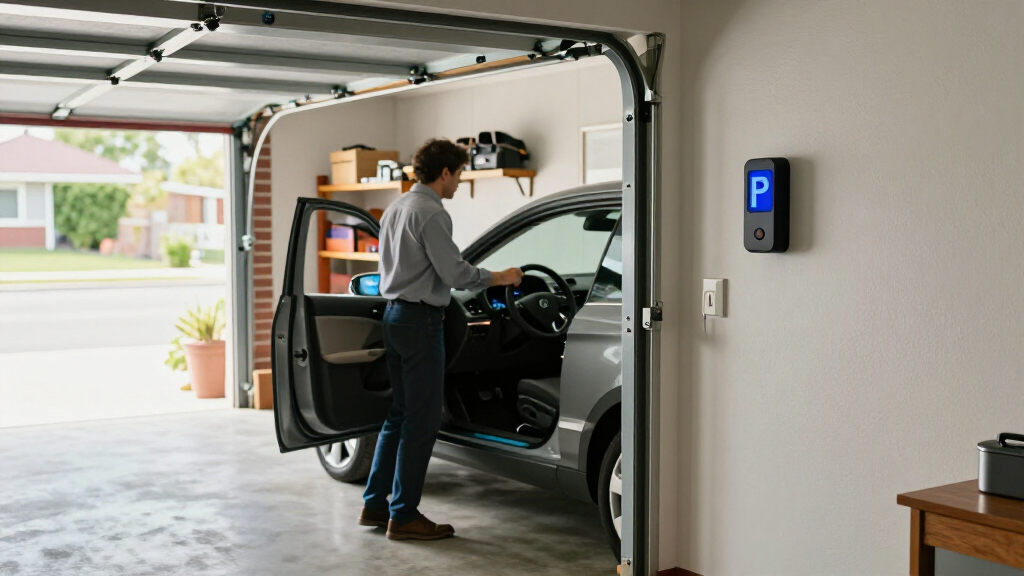
I compared these 15 garage parking aids by how directly they help a driver stop at a repeatable position, how easy their signal is to read from the driver’s seat, and how much adjustment they offer for different vehicles and parking spaces. I also weighed the practical differences between laser alignment, ultrasonic distance sensing, and physical hanging guides, including setup demands, power arrangements, and whether a unit addresses front clearance, side clearance, or multiple parking spots.
The ranking favors systems with useful, understandable feedback and enough flexibility to suit real changes in vehicle position. Models with dual lasers rank well for two-car or repeat-alignment needs; adjustable sensor systems rise when their distance alerts can accommodate changing conditions. Simpler aids remain worthwhile for buyers who want minimal setup, but they rank below options that provide clearer guidance or broader fit. I avoid treating similar product names as proof of identical performance, so buyers should confirm each model’s installation and power details before choosing.
Factors to Consider When Choosing Garage Parking Sensor Systems
The right garage parking aid depends less on the number of features than on the parking mistake you are trying to prevent. Before choosing, check what the device senses, where it must be mounted, and whether its signal is visible from your normal driving position.
Choose the Signal That Matches Your Parking Habit
A laser guide gives you a visual aiming point, which works well if you park in the same position and can see the projected mark clearly. An ultrasonic system instead measures distance and can provide a stop cue, a better fit when you want feedback about how close the vehicle is to a wall or obstacle. A hanging ball is a simple physical reference, but it does not measure distance or adapt to a different vehicle. Avoid buying by feature count alone: decide whether you need alignment, distance warning, or a tactile stopping reference. If glare, lighting, or sightlines make a beam hard to see, a bright indicator may be easier to use.
Measure the Parking Problem Before You Buy
Measure the space from the vehicle’s usual stopping point to the wall, and check whether the concern is front clearance, a side wall, storage, or another obstacle. A front-facing guide cannot solve a side-clearance problem, so a dedicated side sensor may be more useful than a more feature-rich front unit. Account for the vehicle you actually park: a low bumper, tall hood, roof rack, or different car in the same bay can change which sensor height and signal position work. A frequent mistake is mounting a device where it is convenient rather than where the driver can see its indicator. Mark the intended stopping position first, then check that the signal remains visible from the seat.
Treat Adjustability as a Practical Safety Margin
Adjustable stop distance can help when a garage has a narrow margin, when the vehicle changes, or when you want room to walk around the parked car. A fixed guide may be perfectly adequate if one vehicle always parks in one position, but it offers less room to respond to changed circumstances. Do not set the target so close to a wall that a small parking variation leaves no buffer. Consider the part of the vehicle closest to the obstacle, not only the driver’s view of the hood or bumper. After installation, verify the stopping point at a slow pace and make adjustments before relying on it for routine parking.
Check Power and Installation Conditions
Power choices affect where a system can be mounted and how much upkeep it may require. A unit with an AC adapter needs a reachable outlet and a tidy cable route; a battery-powered device avoids that cable but may need battery checks or replacement. Backup power can be useful where a system supports both mains power and batteries, though it adds another setup detail to manage. Laser and sensor units may need careful alignment, while hanging guides typically ask less of the garage wall but still require secure placement. Before buying, confirm the mounting surface, included power method, and any installation steps for the specific model.
Decide Whether You Need One-Car or Multi-Car Guidance
A dual-laser guide can serve two parking positions or help establish repeatable alignment for more than one vehicle, but only if the mounting layout suits both bays. A single guide is simpler when one car uses one space, and a side sensor addresses clearance rather than adding another front stopping point. Think about how vehicles enter and leave: an indicator that works from one approach may be less useful if drivers back into the space from different angles. Shared garages also benefit from a signal that every driver can interpret quickly. Avoid paying for broader coverage that your layout cannot use; focus on the number of parking positions and the direction of the risk.
Pay for Feedback You Will Actually Use
Extra displays and warning signals help only when they are easy to notice and understand from the driver’s seat. For a new driver or a shared household, a clear visual stop cue can reduce guesswork more than a subtle indicator. A simple laser or hanging marker may be the better fit for an experienced driver who wants a repeatable reference without extra electronics. More involved systems can bring added setup and power considerations, so match complexity to the people who will park there. If the garage is noisy or the driver has limited visibility, prioritize a visible cue over alerts that may be hard to perceive. The best value is the aid that solves your specific parking problem without adding features you will ignore.
Frequently Asked Questions
Should I choose a laser guide or an ultrasonic parking sensor?
Choose a laser guide if a visible aiming point is enough to help you stop in the same place each time. Choose an ultrasonic model if you want the device to sense distance and provide a stop cue rather than relying on alignment alone. Lasers depend on a clear line of sight and correct positioning, while sensor systems need suitable mounting and power arrangements. For two consistent parking bays, a dual laser may be more useful than a single sensor. For a driver who prefers a distance alert, an ultrasonic unit with a display is the stronger match.
Can one system work for two vehicles or two parking spaces?
It can, but the layout and the type of guidance matter. A dual-laser model is designed to offer more than one projected guide, while a single-point sensor may only provide a useful cue for one position unless it can be repositioned. Different vehicles may need different stopping distances because their bumpers and lengths vary. Check that each signal can be mounted and seen from the relevant driver’s seat. If both vehicles share one bay at different times, an adjustable system may be easier to adapt than a fixed guide.
How do I choose a safe stopping distance from the wall?
Start by measuring the clearance your vehicle needs, including any overhang, and leave a margin for small differences in how you enter the garage. Do not set the signal at the closest distance the car can physically reach; a buffer helps account for variation in approach and stopping. If more than one vehicle uses the space, set the cue for the vehicle that needs the most room or choose an adjustable system and mark separate settings. Confirm the device’s indication from the driver’s seat at a slow speed. Recheck the stopping point after changing vehicles or moving the sensor.
Will a parking sensor work in a garage without a nearby outlet?
Some systems use batteries, while others depend on an AC adapter or offer a combination of power options. A model with an adapter may be inconvenient if the nearest outlet is far from the mounting point, unless its cable can be routed safely. Battery operation avoids that wiring but adds a need to monitor battery condition. Check the individual product’s power details rather than assuming that similar devices use the same setup. For an outlet-free garage, favor a clearly specified battery-powered option or a non-electronic guide.
Is a side parking sensor necessary if I already have a front parking guide?
A front guide helps control how close the vehicle gets to the wall ahead; it does not necessarily tell you how close the car is to a side wall or stored items. If your main concern is scraping a door, mirror, or side panel, a side-clearance sensor addresses a different risk. In a narrow bay, you may need both types of guidance, but start by identifying which clearance is most difficult to judge. Check whether the side unit’s indicator can be seen while you are maneuvering. A front laser alone is not a substitute for side-distance feedback.
Conclusion
For most drivers seeking clear feedback and adjustment, my best overall choice is the STKR Adjustable Garage Parking Sensor with Ultrasonic Detection and LED Display. The best value in simplicity is the MAXSA 37310 single-laser guide for one consistent parking spot, while the MAXSA 37312 is the better fit when two-car alignment matters. For a more involved setup, consider the Fosmon Dual Laser with its AC adapter and battery backup as my best premium-style pick, after checking that its power and mounting arrangement suit your garage. Beginners who want a direct visual reference can start with a laser or hanging guide; drivers who need help with lateral space should look at the STKR Concepts Side Parking Sensor. Choose by the clearance problem you need to solve, not by the longest feature list.
Columbus Day / Indigenous Peoples' Day Picks
long weekend sales
As an affiliate, we earn on qualifying purchases.