Among these wireless tire pressure monitoring systems, I’d put the GUTA GT30 with 10 sensors first for RV owners who need to monitor more tires, while the Tymate TM12 with six sensors suits a larger setup with fewer sensor positions to cover. The Tenpmas H11 with a detachable bracket is a standout for drivers who value flexible display placement. The main tradeoffs are how many tires a kit can monitor, how its display gets power, and whether the sensor layout fits your vehicle. A four-sensor kit can be a simpler match for a compact RV, but it may not cover every tire on a longer combination. Read on for the full breakdown and guidance on choosing a system that fits your rig.

Get business pricing on garage and car supplies
- Business-only prices and quantity discounts
- Tax-exempt purchasing
- Multiple users, one account, clear invoices
Complete the kit


Key Takeaways
- Sensor count sets the shortlist: The GUTA GT30’s 10 sensors and Tymate TM12’s six sensors offer more coverage options than the many four-sensor kits, but buyers need to match the count to every tire they want monitored.
- Four-sensor models dominate this lineup: Tymate, Masoll, and other brands offer several kits at this count, so fit, display setup, and sensor design matter more than the number alone.
- Display power changes daily convenience: The Avutrel’s solar and USB charging gives it a distinct power approach; buyers should check how they plan to keep any display powered during long trips or parked periods.
- Mounting flexibility is a separate advantage: The Tenpmas H11’s detachable bracket may suit drivers who want more freedom in display placement, while a fixed or simpler setup may be easier to install.
- Pressure range and vehicle fit need checking: Marcala’s stated 0–98 PSI range makes compatibility checks especially relevant; no sensor count or feature can compensate for a range that does not suit the tires.
| GUTA GT30 RV Tire Pressure Monitoring System with 10 Sensors |  | Best for Large RV and Multi-Axle Setups | Sensors included: 10 | Maximum tires supported: 46 | Maximum pressure: 188 psi | VIEW LATEST PRICE | See Our Full Breakdown |
| Tymate M7-3 RV Tire Pressure Monitoring System with 4 Sensors |  | Best for Flexible Everyday Charging | Sensors included: 4 external sensors | Monitoring capacity: Up to 10 tires | Pressure range: 0–87 psi | VIEW LATEST PRICE | See Our Full Breakdown |
| Tenpmas H11 Wireless Tire Pressure Monitoring System with Detachable Bracket |  | Best for Mixed Trailer and Vehicle Setups | Model: H11-1213JH-US5 | Pressure range: 3–87 psi (0.2–6.0 bar) | Display: 3.5-inch screen with 3 brightness levels | VIEW LATEST PRICE | See Our Full Breakdown |
| Tymate TM2 RV Tire Pressure Monitoring System with 4 Sensors |  | Best for a Straightforward Four-Sensor Setup | Model: TM2 | Sensors included: 4 external sensors | Maximum tires monitored: 10 | VIEW LATEST PRICE | See Our Full Breakdown |
| Tymate TM12 RV Tire Pressure Monitoring System with 6 Sensors |  | Best for Higher-Pressure Coverage | Model: TM12 | Sensors included: 6 | Maximum tire support: 12 tires | VIEW LATEST PRICE | See Our Full Breakdown |
| ZYCAPATP Wireless Tire Pressure Monitoring System with 4 External Sensors |  | Best for Solar-and-USB Flexibility | Model: T12 | Pressure range: 0–98 PSI | Sensors included: 4 external sensors | VIEW LATEST PRICE | See Our Full Breakdown |
| Tirpresmos TY09 Wireless Tire Pressure Monitoring System | 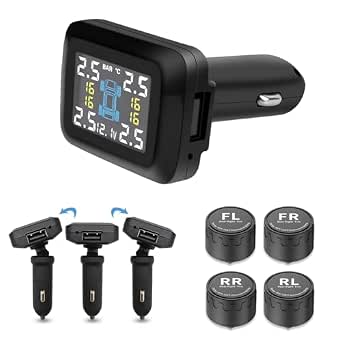 | Best for Simple Passenger-Car Setups | Model: TY09 | Pressure range: 0–98 PSI | Measured range: 7–87 PSI | VIEW LATEST PRICE | See Our Full Breakdown |
| Masoll RV Tire Pressure Monitoring System with 4 Sensors |  | Best Value for Four-Wheel RVs | Model: M14+MZS2 | Sensors: 4 | Maximum tire pressure: 99 PSI | VIEW LATEST PRICE | See Our Full Breakdown |
| Tymate TM3 RV Tire Pressure Monitoring System with 4 Sensors |  | Best for Expandable RV and Trailer Coverage | Model: TM3 | Sensors included: 4 external sensors | Maximum tires monitored: 10 | VIEW LATEST PRICE | See Our Full Breakdown |
| Tymate TM8 RV Tire Pressure Monitoring System with 4 Sensors |  | Best Compact Pick for Short Vehicles | Sensors: 4 | Tire capacity: Up to 4 tires | Pressure range: 0–87 PSI | VIEW LATEST PRICE | See Our Full Breakdown |
| Avutrel Tire Pressure Monitoring System with Solar and USB Charging |  | Best for Flexible Charging | Brand: Avutrel | Model: TY01 | Sensors: 4 external sensors | VIEW LATEST PRICE | See Our Full Breakdown |
| Masoll M13 Tire Pressure Monitoring System with 4 Sensors |  | Best for Simple Solar-Powered Setup | Brand: Masoll | Model: M13+MZS3 | Sensors included: 4 | VIEW LATEST PRICE | See Our Full Breakdown |
| Masoll RV Tire Pressure Monitoring System with 4 Sensors |  | Best for Longer RV Signal Reach | Brand: Masoll | Model: XM-2+RP12+MZS3 | Included sensors: 4 | VIEW LATEST PRICE | See Our Full Breakdown |
| Marcala Tire Pressure Monitoring System with 4 Sensors, 0–98 PSI | 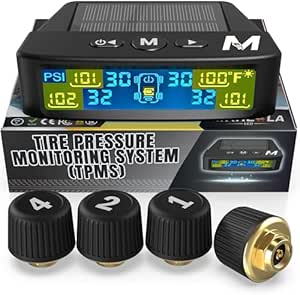 | Best for Cars and Motorcycles | Brand: Marcala | Model: V2-4-Sensor | Sensors included: 4 | VIEW LATEST PRICE | See Our Full Breakdown |
| Tymate TM7 RV Tire Pressure Monitoring System with 4 Sensors |  | Best Compact, Plug-In Display | Brand: Tymate | Model: TM7 | Sensors: 4 | VIEW LATEST PRICE | See Our Full Breakdown |
| wireless tire pressure monitoring system | Model | Pressure range | Sensors included |
|---|---|---|---|
| GUTA GT30 RV Tire Pressure Mon | — | — | 10 |
| Tymate M7-3 RV Tire Pressure M | — | 0–87 psi | 4 external sensors |
| Tenpmas H11 Wireless Tire Pres | H11-1213JH-US5 | 3–87 psi (0.2–6.0 bar) | — |
| Tymate TM2 RV Tire Pressure Mo | TM2 | — | 4 external sensors |
| Tymate TM12 RV Tire Pressure M | TM12 | 0–144 psi | 6 |
| ZYCAPATP Wireless Tire Pressur | T12 | 0–98 PSI | 4 external sensors |
| Tirpresmos TY09 Wireless Tire | TY09 | 0–98 PSI | — |
| Masoll RV Tire Pressure Monito | M14+MZS2 | — | — |
| Tymate TM3 RV Tire Pressure Mo | TM3 | 0–144 PSI | 4 external sensors |
| Tymate TM8 RV Tire Pressure Mo | — | 0–87 PSI | — |
| Avutrel Tire Pressure Monitori | TY01 | — | — |
| Masoll M13 Tire Pressure Monit | M13+MZS3 | — | 4 |
| Masoll RV Tire Pressure Monito | XM-2+RP12+MZS3 | 0–145 PSI | — |
| Marcala Tire Pressure Monitori | V2-4-Sensor | 0–98 PSI | 4 |
| Tymate TM7 RV Tire Pressure Mo | TM7 | — | — |
More Details on Our Top Picks
GUTA GT30 RV Tire Pressure Monitoring System with 10 Sensors
The GUTA GT30 is the capacity pick here: its ten included sensors can be assigned across as many as 46 tires, far beyond the 10-tire ceiling of the Tymate M7-3 and TM2. Its 188 psi range also suits higher-pressure applications that exceed those Tymate models’ 87 psi limit. Pressure and temperature alerts, along with warnings for leaks, missing signals, and low sensor batteries, give operators several ways to catch trouble. The rechargeable monitor can run for up to 12–14 days after a four-hour charge, while replaceable CR2032 sensor batteries are specified for up to four years. The tradeoff is fit: metal valve stems are recommended, and long or signal-blocked rigs may need a booster. For ordinary four-tire use, this is more system than necessary.
Pros:- Ten sensors are included, with capacity to monitor up to 46 tires.
- 188 psi maximum pressure supports applications beyond the 87 psi range of the Tymate M7-3 and TM2.
- Alerts cover pressure, temperature, leaks, missing sensor signals, and low sensor batteries.
- Rechargeable monitor and replaceable sensor batteries reduce reliance on disposable power.
Cons:- Metal valve stems are recommended; rubber stems are not suitable for the intended setup.
- Long distance or signal interference may call for a separate signal booster.
- Its unusually high tire capacity adds complexity that smaller rigs may never use.
Best for: Owners of large RVs, multi-axle trailers, or other vehicles with many tires who need high pressure capacity and broad tire coverage.
Not ideal for: Drivers monitoring a standard car or small RV who do not need more than four sensors or the 46-tire expansion capacity.
- Sensors included:10
- Maximum tires supported:46
- Maximum pressure:188 psi
- Maximum tire temperature:185°F
- Monitor battery life:12–14 days after a four-hour charge
- Sensor battery:Replaceable CR2032; up to 4 years
- Alarm threshold range:+25% to -15% of reference pressure
- Recommended valve stems:Metal
Our verdict“Choose the GT30 if you need to monitor a large, high-pressure multi-tire setup; smaller vehicles are better served by a simpler system such as the Tymate M7-3.”
Tymate M7-3 RV Tire Pressure Monitoring System with 4 Sensors
The Tymate M7-3 is a practical middle ground for RV owners who want several ways to keep the monitor powered without moving up to the broader coverage of the GUTA GT30. Its four external sensors can monitor up to ten tires, and the display accepts solar, USB, or 12V power. That flexibility helps when the vehicle is parked outside, connected to USB, or underway, though the 12V adapter is not included. The LCD adjusts its backlight automatically, reducing the need to change settings as cabin light shifts. Its 0–87 psi range and ±3 psi accuracy are better matched to typical RV pressures than higher-pressure setups. The main ongoing compromise is sensor upkeep: CR1632 cells may need replacement after about half a year, and the stated sensor lifespan is up to two years.
Pros:- Four external sensors support monitoring for up to ten tires.
- Solar, USB, and 12V charging give the display flexible power options.
- Automatic backlight adjustment adapts the LCD to changing cabin light.
- Pressure, temperature, leak, and low-sensor-voltage alarms address common monitoring needs.
Cons:- The 12V cigarette lighter adapter is not included.
- CR1632 sensor batteries may need replacement after about half a year.
- Its 87 psi ceiling rules it out for higher-pressure tire setups.
Best for: RV owners monitoring up to ten tires who want solar and USB charging options alongside an in-vehicle power source.
Not ideal for: Drivers with high-pressure tires above 87 psi or buyers who want long sensor-battery intervals and a 12V adapter included.
- Sensors included:4 external sensors
- Monitoring capacity:Up to 10 tires
- Pressure range:0–87 psi
- Measurement accuracy:±3 psi
- Charging methods:Solar, USB, or cigarette lighter adapter
- Sensor battery:CR1632; up to half a year of use
- Display:LCD with automatic backlight adjustment
- Recommended valve stem:Metal
Our verdict“Pick the M7-3 for flexible monitor charging and standard RV pressure ranges, but choose the GUTA GT30 if you need far more tire capacity or higher-pressure coverage.”
Tenpmas H11 Wireless Tire Pressure Monitoring System with Detachable Bracket
The Tenpmas H11 makes sense for drivers who alternate between a two-wheel trailer and a four-wheel vehicle. Its selectable two-wheel and four-wheel modes, plus separate front and rear alarm thresholds, let the alerts better reflect different axle requirements. That configuration is more adaptable than the Tymate M7-3’s listed feature set, while the M7-3 offers monitoring capacity up to ten tires. The H11’s 3.5-inch adjustable display, six alarm types, solar and USB-C charging, and automatic sleep-and-vibration wake provide a useful balance of visibility and power management. The limitation is signal reach: trailer sensors must remain within 19.7 feet of the monitor, a shorter stated distance than the TM12’s 50-foot range. It also requires initial charging and manual startup, so it is not a fully hands-off setup.
Pros:- Supports both two-wheel trailer and four-wheel vehicle modes.
- Separate front and rear alarm thresholds allow more tailored alerts.
- The 3.5-inch display has three brightness levels and audible and visual alarms.
- Solar and USB-C charging pair with automatic sleep and vibration wake.
Cons:- Sensors must be within 19.7 feet of the monitor, limiting placement on longer rigs.
- Initial charging and manual startup are required.
- The listed pressure range stops at 87 psi, below the GUTA GT30’s 188 psi ceiling.
Best for: Drivers who switch between two-wheel trailers and four-wheel vehicles and want separate front and rear pressure alert settings.
Not ideal for: Owners of long trailers or large RVs whose sensor placement may exceed the 19.7-foot distance limit.
- Model:H11-1213JH-US5
- Pressure range:3–87 psi (0.2–6.0 bar)
- Display:3.5-inch screen with 3 brightness levels
- Operating modes:Two-wheel and four-wheel
- Sensor distance limit:19.7 ft
- Charging:Solar panel and USB-C
- Battery:Included lithium-polymer battery
- Weight:7.4 oz
Our verdict“Choose the H11 if you need flexible two-wheel and four-wheel modes with axle-specific alerts, but select the TM12 or GT30 when longer reach or higher pressure capacity matters more.”
Tymate TM2 RV Tire Pressure Monitoring System with 4 Sensors
The Tymate TM2 stands out for a comparatively simple setup: its four external sensors arrive pre-labeled and paired, so owners have less sensor-matching work than with an unconfigured system. Like the M7-3, it monitors up to ten tires within a 0–87 psi range and offers solar, USB, or 12V charging; its color LCD adds adaptive backlighting. The TM2’s alert list includes pressure changes, fast leaks, temperature, low sensor battery, and signal loss, making it a clear fit for RV and trailer monitoring. There are limits: the stated reading accuracy has an approximately 3 psi margin of error, and the 12V adapter is not included. For trailers at least 36 feet long, a repeater is recommended, so the TM12’s stated 50-foot transmission range may suit some longer setups better.
Pros:- Four sensors arrive pre-labeled and paired with the monitor.
- Monitors up to ten tires and supports vehicle and trailer use.
- Color LCD has an adaptive backlight, with solar, USB, and 12V charging options.
- Alerts cover pressure, fast leaks, high temperature, low sensor battery, and signal loss.
Cons:- A repeater is recommended for towing trailers at least 36 feet long.
- The 12V charging adapter is not included.
- Pressure readings have an approximately 3 psi margin of error.
Best for: RV owners who want a four-sensor system that arrives paired and labeled, with multiple monitor charging options.
Not ideal for: Owners of long trailers who want to avoid a repeater, or drivers whose tire pressures exceed 87 psi.
- Model:TM2
- Sensors included:4 external sensors
- Maximum tires monitored:10
- Pressure detection range:0–87 psi
- Pressure reading accuracy:Approximately 3 psi margin of error
- Sensor battery:CR1632; up to 6 months per battery
- Transmission frequency:433.92 MHz
- Charging:Solar, USB, or 12V socket; adapter not included
Our verdict“Choose the TM2 for a labeled, pre-paired four-sensor setup on a standard RV, but look at the TM12 if your rig needs a longer stated transmission range or pressure coverage above 87 psi.”
Tymate TM12 RV Tire Pressure Monitoring System with 6 Sensors
The Tymate TM12 is the strongest fit here for RV owners who need more than four sensors and pressure headroom beyond the 87 psi ceiling shared by the M7-3 and TM2. Six included sensors cover up to twelve tires, and the 0–144 psi range suits higher-pressure setups without reaching the GT30’s much broader 188 psi range or 46-tire capacity. Its stated 50-foot transmission range gives it a clearer fit for larger rigs than the Tenpmas H11, whose sensor distance limit is 19.7 feet; a repeater can extend the TM12 range to 100 feet or more. Pre-programmed sensors and automatic pressure calibration reduce setup work, while USB-C and solar charging power the color display. The tradeoffs are solar dependence on available light and the possible need for a repeater in signal-blocked layouts.
Pros:- Six sensors support monitoring across up to twelve tires.
- The 0–144 psi range exceeds the 87 psi limit of the Tymate M7-3 and TM2.
- Stated 50-foot transmission range can extend to 100 feet or more with a repeater.
- Pre-programmed sensors, automatic pressure calibration, USB-C, and solar charging simplify setup and display power.
Cons:- A repeater may be needed on large RVs or in signal-blocked installations.
- Solar charging output depends on available light.
- Metal valve stems are recommended for sensor stability and safety.
Best for: Owners of larger RVs with higher-pressure tires who need six sensors, coverage for up to twelve tires, and a longer stated signal range.
Not ideal for: Drivers with only a few standard-pressure tires who do not need six sensors or a 144 psi range.
- Model:TM12
- Sensors included:6
- Maximum tire support:12 tires
- Pressure range:0–144 psi
- Transmission range:50 ft; extendable to 100+ ft with repeater
- Sensor water resistance:IP67
- Display power:USB-C or solar charging
- Weight:12.3 oz
Our verdict“Pick the TM12 for a higher-pressure RV that needs six sensors and longer reach, while the GT30 is the better match for even more tires or pressures above 144 psi.”
ZYCAPATP Wireless Tire Pressure Monitoring System with 4 External Sensors
The ZYCAPATP T12 pairs four-wheel pressure and temperature monitoring with six alert modes, so drivers can get warnings for leaks, abnormal readings, and sensor problems without adding sensors for a trailer. Its solar and USB-C charging gives the display two ways to stay powered, unlike the Tirpresmos TY09, which depends on a car charger. The IP67-rated external sensors suit exposed use on SUVs, RVs, trucks, and Jeeps.
The tradeoff is the display’s sleep-mode data interruption: when the main unit sleeps, it stops receiving readings. That can make it a weaker choice for drivers who want continuous monitoring without checking the unit’s wake behavior. Its 0–98 PSI range also falls short of the Tymate TM3’s 144 PSI ceiling, making the TM3 a better fit for higher-pressure setups or vehicles with more than four tires.
Pros:- Monitors pressure and temperature across four wheels in real time.
- Six alerts cover pressure, temperature, leakage, sensor disconnection, and low sensor battery.
- Display supports both solar and USB-C charging.
- IP67-rated external sensors are designed for outdoor exposure.
Cons:- The main unit stops receiving data when it enters sleep mode.
- Its 98 PSI maximum is lower than the Tymate TM3’s 144 PSI range.
Best for: SUV, Jeep, truck, and four-wheel RV owners who want external sensors, multiple alert types, and solar or USB-C charging.
Not ideal for: Drivers who require uninterrupted readings while the display is asleep, or owners of high-pressure tires that exceed its 98 PSI range.
- Model:T12
- Pressure range:0–98 PSI
- Sensors included:4 external sensors
- Alarm modes:6
- Sensor protection:IP67
- Display charging:Solar and USB-C
- Material:ABS
- Dimensions:6.18 × 5.12 × 1.81 inches
Our verdict“Choose the T12 for flexible display charging and four-wheel coverage if its sleep-mode behavior and 98 PSI limit fit your setup.”
Tirpresmos TY09 Wireless Tire Pressure Monitoring System
The TY09 is the most straightforward fit here for a driver who wants four-wheel pressure and temperature alerts without solar charging or an RV-focused tire expansion plan. Its sensors arrive pre-paired, and the adjustable-angle display helps position readings where they are easier to see. Configurable thresholds let drivers tune alerts to their preferred pressure limits; the Masoll M14+MZS2 also offers four-wheel monitoring, but adds solar charging and broader vehicle compatibility.
The TY09’s main limitation is power: the monitor has no built-in battery and must connect to a car charger. It is also not recommended for trailers or medium-to-large vehicles, so it is a poor match for buyers needing longer-range RV coverage. Its stated measured range tops out at 87 PSI, despite a listed pressure range of 0–98 PSI, which buyers with higher-pressure tires should factor into their choice.
Pros:- Pre-paired IP67-rated sensors simplify setup.
- Audible and visual alerts respond to abnormal pressure or temperature.
- Adjustable display angle helps with dashboard placement.
- Supports PSI or BAR and °F or °C readings.
Cons:- The monitor has no built-in battery and requires a car charger.
- Not recommended for trailers or medium-to-large vehicles.
- The stated measured range is 7–87 PSI, below the listed 98 PSI pressure-range ceiling.
Best for: Drivers of smaller passenger vehicles who want pre-paired sensors, adjustable display positioning, and audible and visual alerts.
Not ideal for: RV and trailer owners, medium-to-large vehicle drivers, and anyone who wants a monitor that operates without a car-charger connection.
- Model:TY09
- Pressure range:0–98 PSI
- Measured range:7–87 PSI
- Sensing distance:19.7 feet
- Sensor protection:IP67
- Alarm types:6
- Monitor power:Car charger
- Display:Adjustable angle
- Units:PSI or BAR; °F or °C
Our verdict“Pick the TY09 for a smaller car and a simple charger-powered setup, but choose a more RV-capable system for towing or larger vehicles.”
Masoll RV Tire Pressure Monitoring System with 4 Sensors
The Masoll M14+MZS2 is a practical choice for drivers who want four-wheel monitoring, six alarm types, and solar or USB charging in one system. Its stated ±1.5 PSI accuracy gives buyers a specific accuracy figure to compare with the Tymate TM8 and TM3, both listed at approximately ±3 PSI. Pre-paired sensors also reduce setup work, while selectable PSI/BAR and °C/°F units make the display easier to adapt to personal preferences.
Its 99 PSI ceiling covers many four-wheel vehicles, including pickups and RVs, but this is not the best match for longer trailers: a signal booster is required beyond 38 feet. Sensor batteries are replaceable CR1632 cells, with a stated life of up to two years, so eventual maintenance is part of ownership. Unlike the Tymate TM3, this kit is described for four tires rather than expansion to ten.
Pros:- Four-wheel pressure and temperature monitoring with six alarm types.
- Listed pressure accuracy is ±1.5 PSI.
- Solar and USB charging provide two monitor-power options.
- Pre-paired sensors support a simpler initial setup.
Cons:- Trailers longer than 38 feet require a signal booster.
- Replaceable sensor batteries need periodic replacement.
- Four-sensor coverage is less expandable than the Tymate TM3’s stated capacity of ten tires.
Best for: Owners of sedans, pickups, vans, and four-wheel RVs who value a stated accuracy figure and dual solar/USB monitor charging.
Not ideal for: Drivers towing trailers longer than 38 feet who do not want to add a signal booster, or buyers needing coverage for more than four tires.
- Model:M14+MZS2
- Sensors:4
- Maximum tire pressure:99 PSI
- Pressure accuracy:±1.5 PSI
- Sensor battery:Replaceable CR1632; up to 2 years
- Monitor charging:Solar and USB
- Display units:PSI/BAR and °C/°F
- Vehicle compatibility:Sedan, SUV, MPV, van, pickup, RV, and other four-wheel vehicles
- Signal booster requirement:Required for trailers longer than 38 feet
Our verdict“Choose the Masoll for accurate, four-wheel monitoring in a range of everyday vehicles, provided your trailer does not need a booster.”
Tymate TM3 RV Tire Pressure Monitoring System with 4 Sensors
The TM3 has the broadest stated tire coverage in this group: it can monitor up to 10 tires despite including four external sensors. That makes it a stronger starting point for a tow vehicle and trailer than the four-tire Masoll M14+MZS2 or the TM8, which is limited to four tires. Its 0–144 PSI range also supports higher-pressure setups, while six alarms and a color LCD keep pressure, temperature, and sensor warnings visible.
Power options are another advantage: the display accepts solar, USB-C, or a cigarette-lighter connection, though the adapter is not included. Buyers should account for sensor maintenance too: the CR1632 cells are listed for up to six months of operation, and sensor lifespan is up to two years. For longer tow combinations, a repeater is recommended at 36 feet or more; the listed ±3 PSI accuracy is also less precise than the Masoll’s ±1.5 PSI figure.
Pros:- Can monitor up to 10 tires with additional coverage beyond the included four sensors.
- 0–144 PSI range accommodates higher-pressure tire setups.
- Color LCD supports solar and USB-C charging.
- Six alarm modes cover pressure, temperature, leaks, and signal issues.
Cons:- A repeater is recommended for tow vehicles with trailers at least 36 feet long.
- Cigarette-lighter adapter is not included.
- CR1632 sensor batteries are listed for up to six months of operation, and accuracy is approximately ±3 PSI.
Best for: RV owners and trailer drivers who want the option to monitor more than four tires and need a pressure range up to 144 PSI.
Not ideal for: Drivers seeking a four-tire-only system with less sensor upkeep, or owners who do not want to buy a separate cigarette-lighter adapter or consider a repeater for long rigs.
- Model:TM3
- Sensors included:4 external sensors
- Maximum tires monitored:10
- Pressure range:0–144 PSI
- Pressure accuracy:Approximately ±3 PSI
- Display:Color LCD with automatic backlight adjustment
- Charging options:Solar, USB-C, or cigarette lighter; adapter not included
- Sensor battery:CR1632; up to 6 months of operation
- Wireless frequency:433.92 MHz
Our verdict“Choose the TM3 when expandable tire coverage and a high pressure ceiling matter more than simpler four-wheel operation or longer sensor-battery intervals.”
Tymate TM8 RV Tire Pressure Monitoring System with 4 Sensors
The TM8 suits buyers who want a compact, four-tire display without the broader expansion focus of the Tymate TM3. Its color LCD, windshield mounting, and solar charging keep core readings accessible, while six alert types cover pressure changes, rapid air loss, high temperature, low sensor battery, and lost signal. USB and 12V charging add alternatives when sunlight is limited, though the cigarette-lighter adapter is not included.
This system’s fit is deliberately narrower: it is recommended for vehicles under 20 feet, and its 0–87 PSI range is lower than both the TM3’s 144 PSI and the Masoll M14+MZS2’s 99 PSI. That makes the TM8 a better match for shorter vehicles than larger RVs or higher-pressure tires. Its listed ±3 PSI pressure accuracy and metal-valve-stem requirement are practical limits buyers should weigh before installation.
Pros:- Compact color display supports windshield mounting.
- Solar, USB, and 12V charging options provide flexibility.
- Six alarm modes cover tire readings and sensor faults.
- Listed sensing distance is 36 feet.
Cons:- Recommended only for vehicles under 20 feet.
- 87 PSI maximum is lower than the TM3’s 144 PSI and the Masoll’s 99 PSI.
- Requires metal valve stems, and the cigarette-lighter adapter is not included.
Best for: Drivers of vehicles under 20 feet who want a compact, windshield-mounted display and four-tire monitoring.
Not ideal for: Owners of longer RVs or tow combinations, drivers needing more than four tire positions, and buyers whose tires may exceed 87 PSI.
- Sensors:4
- Tire capacity:Up to 4 tires
- Pressure range:0–87 PSI
- Measurement accuracy:±3 PSI
- Temperature accuracy:±3°F
- Sensing distance:36 feet
- Display:Color LCD; windshield mounted
- Charging:Solar, USB, or cigarette lighter; adapter not included
- Recommended vehicle length:Under 20 feet
Our verdict“Pick the TM8 for a short vehicle and a compact four-tire setup, but choose the TM3 for higher pressure or expanded trailer coverage.”
Avutrel Tire Pressure Monitoring System with Solar and USB Charging
The Avutrel TY01 is a practical pick for drivers who want a four-tire wireless monitor without relying on a single power source. Its solar and USB charging give you alternatives when sunlight is limited or the display needs a wired charge, while five alarm modes cover pressure problems, leaks, and high tire temperature. The automatically adjusted color display is a simpler approach than the Masoll RV system’s four selectable brightness levels, but may suit drivers who prefer the screen to adapt on its own. Avutrel is designed for four-wheeled vehicles, including sedans, vans, off-road vehicles, and commercial vehicles. The tradeoff is that its external sensors are exposed at the wheels, and the product data gives no pressure range or accuracy figures for shoppers who need to check those limits against their tires.
Pros:- Solar and USB charging provide two ways to power the display.
- Monitors tire pressure and temperature in real time.
- Five alarm modes cover leaks, abnormal pressure, and high temperature.
- Includes four external sensors for a four-wheel setup.
Cons:- External sensors remain exposed at the wheels.
- Designed for four-wheeled vehicles rather than motorcycles or larger multi-axle configurations.
- The provided specifications do not state a pressure detection range or accuracy.
Best for: Drivers of four-wheeled vehicles who want solar and USB charging options plus alerts for both pressure and temperature.
Not ideal for: Owners of motorcycles, multi-axle towing setups, or buyers who need a stated pressure range and accuracy before choosing a monitor.
- Brand:Avutrel
- Model:TY01
- Sensors:4 external sensors
- Alarm modes:5
- Charging:Solar and USB
- Display:Automatically adjusted color display
- Compatibility:Four-wheeled vehicles
Our verdict“Choose the Avutrel if you want flexible solar or USB charging for a four-wheeled vehicle and do not need published pressure-range figures.”
Masoll M13 Tire Pressure Monitoring System with 4 Sensors
The Masoll M13 makes its case with automatic reference-pressure calibration: rather than asking drivers to set a fixed pressure threshold, it alerts when readings rise 25% above or fall 15% below the learned reference. That can simplify setup for owners who want a clear warning system, though the percentage thresholds may not match every driver’s preferred alert points. Its 0–87 PSI range and stated 1.5 PSI accuracy make its intended limits easier to evaluate than the Avutrel TY01, whose supplied data lists no range or accuracy. Solar charging, auto wake-and-sleep, and an automatically backlit color LCD keep the display routine straightforward. This model fits cars, pickups, RVs, and trailers under 38 feet; longer trailers may need a signal booster, which is not included in the listed package details.
Pros:- Automatically calibrates a reference pressure for its alert thresholds.
- Solar charging is paired with auto wake-up and sleep.
- Color LCD adjusts its backlight for changing light conditions.
- Published 0–87 PSI range and 1.5 PSI accuracy help define its operating limits.
Cons:- A signal booster is recommended for trailers longer than 38 feet.
- The sensor warranty is six months, shorter than the one-year monitor warranty.
- The 87 PSI ceiling may exclude higher-pressure tire applications.
Best for: Car, SUV, pickup, or shorter-trailer owners who prefer solar charging and automatic pressure-reference setup.
Not ideal for: Owners of trailers longer than 38 feet who want a booster included, or drivers who need pressure support above 87 PSI.
- Brand:Masoll
- Model:M13+MZS3
- Sensors included:4
- Pressure detection range:0–87 PSI
- Pressure accuracy:1.5 PSI
- Alarm thresholds:25% above or 15% below reference pressure
- Charging:Solar
- Compatible vehicles:Sedan, SUV, pickup truck, RV, and travel trailer under 38 ft
- Warranty:1 year for monitor; 6 months for sensors
Our verdict“Pick the M13 for a solar-powered, automatically calibrated system on a car or shorter trailer that stays within its 87 PSI limit.”
Masoll RV Tire Pressure Monitoring System with 4 Sensors
For an RV where sensor-to-display distance is a concern, this Masoll package has a clear advantage: it includes a signal booster and specifies transmission distance up to 120 feet. Its 0–145 PSI range also gives it more headroom than the Masoll M13, which tops out at 87 PSI. The system tracks pressure and temperature, with visual and audio alerts for high or low pressure, high temperature, fast leaks, sensor loss, and low sensor voltage. Factory-paired sensors reduce setup steps, while the four-level brightness adjustment lets drivers tune the color LCD rather than relying only on automatic dimming as on the Marcala. The tradeoffs are a relatively large display and a monitor that requires power; buyers should also check that four sensors and the 145 PSI ceiling fit their RV configuration.
Pros:- Includes a booster and specifies transmission distance up to 120 feet.
- 0–145 PSI range accommodates higher-pressure tires than the Masoll M13.
- Visual and audio alerts cover pressure, temperature, leaks, sensor loss, and low sensor voltage.
- Factory-paired sensors simplify setup.
Cons:- The monitor requires a power connection.
- The listed display dimensions make it less compact than the Tymate TM7.
- Four included sensors may not cover every multi-axle RV configuration.
Best for: RV owners who need a bundled signal booster, a stated reach up to 120 feet, and pressure monitoring up to 145 PSI.
Not ideal for: Drivers seeking a compact, battery-independent display or RV owners whose tire pressures exceed 145 PSI or whose setup needs more than four sensors.
- Brand:Masoll
- Model:XM-2+RP12+MZS3
- Included sensors:4
- Pressure range:0–145 PSI
- Transmission distance:Up to 120 ft
- Display:Color LCD with 4 brightness levels
- Alarms:High/low pressure, high temperature, fast leakage, sensor loss, and low sensor voltage
- Booster:Included; IP69 waterproof and dustproof
- Warranty:1 year
Our verdict“Choose this Masoll system when your RV needs the included booster and 145 PSI capacity, and a powered display is acceptable.”
Marcala Tire Pressure Monitoring System with 4 Sensors, 0–98 PSI
The Marcala stands apart from the RV-focused Masoll systems by supporting one to four tires and listing motorcycles and three-wheel vehicles among its compatible applications. Its 0–98 PSI range and stated 1 PSI accuracy give everyday vehicle owners useful operating boundaries, while solar and USB charging offer flexibility similar to the Avutrel TY01. The color LCD auto-dims, and six alarm modes add more alert categories than Avutrel’s five. Its IP67 sensors are built for exposure to water and dust, and the listed lifetime replacement policy may appeal to drivers who want ongoing sensor support. The main limit is reach: the signal range is up to 26 feet, an extender may be needed for some setups, and Marcala does not recommend this system for towing or large RVs.
Pros:- Supports one to four tires, including motorcycles and three-wheel vehicles.
- Stated 1 PSI accuracy and a 0–98 PSI pressure range.
- Solar and USB charging pair with an auto-dimming color display.
- IP67 sensors and a lifetime replacement policy are specified.
Cons:- Not recommended for towing setups or large RVs and campers.
- Signal range is limited to up to 26 feet, and some setups may need an extender.
- The 98 PSI maximum excludes higher-pressure tire applications.
Best for: Car, van, SUV, or motorcycle owners who need monitoring for one to four tires and want a compact display with solar and USB charging.
Not ideal for: Drivers towing a trailer or operating a large RV, especially when the sensor-to-display distance may exceed 26 feet.
- Brand:Marcala
- Model:V2-4-Sensor
- Sensors included:4
- Pressure range:0–98 PSI
- Accuracy:1 PSI
- Signal range:Up to 26 feet
- Sensor protection:IP67 waterproof
- Charging:Solar and USB
- Compatible tire count:1–4
Our verdict“The Marcala is a strong fit for smaller road vehicles and motorcycles, but not for towing or large-RV monitoring.”
Tymate TM7 RV Tire Pressure Monitoring System with 4 Sensors
The Tymate TM7 is the most compact choice in this group, with a display measuring 2.28 x 1.97 x 3.15 inches and a cigarette-lighter power connection that avoids a separate charging routine. Its color LCD has an adjustable backlight, and two USB ports add useful charging access at the dashboard. The 0–144 PSI range is close to the Masoll RV system’s 145 PSI ceiling, while the Masoll has the advantage of an included booster and a stated 120-foot transmission distance. Tymate instead recommends a repeater for trailers 36 feet or longer, so longer rigs may need an additional component. Four sensors and six alert types cover common tire and sensor conditions, but the recommended use of metal valve stems is a fitment requirement buyers should plan around.
Pros:- Compact display takes up little dashboard space.
- Cigarette-lighter power avoids a separate monitor-charging routine.
- Two USB ports add charging access in the vehicle.
- 0–144 PSI range and six alert types cover a broad set of monitoring needs.
Cons:- A repeater is recommended for trailers 36 feet or longer.
- Metal valve stems are recommended for sensor stability and safety.
- The display depends on a cigarette-lighter socket for power.
Best for: RV and vehicle owners who want a small, plug-in display, two USB charging ports, and pressure coverage up to 144 PSI.
Not ideal for: Owners of trailers 36 feet or longer who want a repeater included, or drivers who cannot use metal valve stems with the sensors.
- Brand:Tymate
- Model:TM7
- Sensors:4
- Pressure accuracy:±1.5 PSI
- Temperature accuracy:±3°F
- Pressure detection range:0–144 PSI
- Power:Cigarette lighter socket
- USB ports:2
- Display dimensions:2.28 x 1.97 x 3.15 inches
Our verdict“Choose the TM7 for a compact, plug-in setup on a vehicle or shorter RV, but plan for a repeater on longer trailers.”

How We Picked
I ranked these systems around the decisions that affect RV use: tire coverage, pressure compatibility, display practicality, and setup demands. Sensor count matters because a system must cover the tires a driver wants to monitor, not just the main wheels. I also weighed the listed power and mounting details, including Avutrel’s solar and USB charging and Tenpmas’s detachable bracket, as these can change where and how a display works for a particular cab.
The GUTA GT30 leads for broader coverage because its 10-sensor configuration gives it the clearest role for rigs with more monitoring points. The six-sensor Tymate TM12 follows as a middle ground, while four-sensor systems rank according to the particular fit or convenience detail named for each model. I do not treat similar product names as proof of identical performance, and buyers should confirm current specifications, sensor compatibility, and pressure limits before purchase. Since the supplied product details do not establish comparative alert performance or build durability, the ranking focuses on stated configuration and practical buyer fit rather than unverified claims.
Factors to Consider When Choosing Wireless Tire Pressure Monitoring Systems
Before choosing a wireless TPMS, I’d work from the vehicle outward: identify every tire that needs monitoring, check the tire pressure range, then decide how the display will fit into your routine. These choices prevent common mismatches that a longer feature list cannot fix.
Match Sensor Count to Every Tire You Want to Monitor
Count the tires on the vehicle and any trailer, then decide whether you want readings from all of them or only a subset. A kit with four sensors may fit a smaller setup, but it can leave positions uncovered on a larger RV or a vehicle-and-trailer combination. More sensors create coverage options, but they can also mean more setup and more components to keep track of. Do not assume spare tires are included in the monitoring plan unless the kit supports them and you intend to fit a sensor. The practical goal is a sensor plan that matches your travel setup, not the largest number on the box.
Check Pressure Range Against Your Tire Requirements
Compare the system’s supported pressure range with the pressure requirements for your tires, using the vehicle and tire guidance rather than guesswork. A mismatch can make a system unsuitable even if its wireless display and sensor count look appealing. The Marcala listing specifies 0–98 PSI, which makes a range check particularly relevant for buyers considering it. Also check whether the displayed units and alert settings work for the way you maintain tire pressure. Avoid setting thresholds based on a general rule; tire load and vehicle guidance affect the correct target.
Plan Display Power for Your Travel Routine
A display that suits frequent driving may not suit a vehicle that sits parked for long stretches, so consider when and how you expect to use it. The Avutrel listing names both solar and USB charging, giving it a different power approach from systems whose listed details do not specify those options. Solar charging depends on light and placement, while USB charging depends on access to a suitable power source. Check what happens when the vehicle is stored, the display is shaded, or a trip runs longer than usual. A charging method is useful only if it fits your dashboard and travel habits.
Choose a Display Position You Can Read Without Distraction
Think about where the monitor can sit so you can glance at it without blocking your view or reaching awkwardly. The Tenpmas H11’s detachable bracket is a specific feature to assess if display placement is a priority. Before buying, check what mounting surfaces are available and whether the display can be positioned where its alerts and readings are easy to notice. A convenient mount does not replace safe driving habits; it should support quick checks rather than draw attention from the road. If you prefer a permanent, simple setup, bracket flexibility may matter less than straightforward installation.
Account for Sensor Installation and Ongoing Checks
Wireless does not mean maintenance-free: sensors still need to be fitted correctly, and the system should be checked before a trip. Confirm how the sensors attach to your valves and whether your wheels or valve stems suit that design. Ask how sensor batteries are handled and what replacement or service steps the maker specifies, since ongoing upkeep can affect convenience. Keep the sensors matched to their intended tire positions when setting up the system. A kit that is easy to install but awkward to service may be a poor fit for someone who travels often.
Buy for Your Rig, Not for a Similar Model Name
Several products here share a brand name and a four-sensor configuration, but that alone does not establish that they use the same display, alerts, or included accessories. Compare the exact model number and current listing details before choosing between Tymate TM2, TM3, TM7, TM8, and the other variants. Look for the specified sensor count, pressure range, power method, mounting hardware, and any stated vehicle compatibility. A model’s name or number is not a reliable substitute for checking the package details. This step is especially useful when comparing near-neighbor options that appear similar at a glance.
Frequently Asked Questions
Is a four-sensor TPMS enough for my RV and trailer?
It depends on how many tires you want to monitor and which ones the system is designed to cover. A four-sensor kit may suit a smaller setup, but a larger RV or a vehicle towing a trailer can have more positions than the kit supports. Count the tires first, including any positions you want covered beyond the main wheels, then compare that total with the kit’s supported sensor count. The GUTA GT30 offers 10 sensors and the Tymate TM12 offers six, giving buyers more coverage choices in this lineup. Confirm the exact supported layout before buying rather than assuming extra sensors can be added.
Should I choose solar charging or USB charging for the display?
Choose based on where the display will sit and how the vehicle is used, not on the charging method alone. Solar can reduce reliance on a cable when the display receives suitable light, while USB gives you a direct charging option when power is available. The Avutrel listing names both solar and USB charging, but buyers should still confirm how those methods work in the intended mounting location. Consider parked storage, shaded dashboards, and long driving days as well as ordinary trips. If the display will often sit without light or access to power, check the maker’s stated runtime and charging instructions before deciding.
How do I know whether a TPMS pressure range suits my tires?
Start with the pressure guidance for your vehicle and tires, then compare it with the monitoring system’s stated range and alert settings. Do not rely on the system’s maximum range as a recommended tire pressure; those are different figures. Marcala lists a 0–98 PSI range, so buyers should verify that this range and its alert options suit their use. If you run a heavy RV, trailer, or a setup with different tire requirements, check each axle and tire position rather than assuming one setting covers everything. Ask the manufacturer or seller if the published specifications do not answer the compatibility question.
Can I move a wireless TPMS between my RV and another vehicle?
Possibly, but portability depends on the system’s sensor count, vehicle layout, pressure requirements, and setup procedure. A four-sensor kit may be easier to reassign between smaller vehicles, while a kit with more sensors may better suit a larger fixed setup. Check whether the sensors can be identified by position and whether changing vehicles requires new pairing or alert settings. Also verify that the pressure range and sensor fit work for both vehicles; a shared display does not guarantee compatible tires or valves. If you switch vehicles often, favor clear setup instructions and keep a record of each vehicle’s intended settings.
Is the Tenpmas H11 detachable bracket worth choosing over a simpler display mount?
It may be a better fit if your cab layout makes a fixed display position inconvenient or hard to read. The H11’s detachable bracket gives placement flexibility that is not specified for every model in this roundup. That feature matters less if your dashboard already has a clear, secure spot for a monitor. Before choosing, check how the bracket attaches, whether it suits your intended surface, and whether moving the display is part of your routine. I’d prioritize a mount that keeps the monitor visible without obstructing the driver’s view over flexibility for its own sake.
Conclusion
For best overall coverage, I’d start with the GUTA GT30 if your RV setup can make use of its 10 sensors; the Tymate TM12 is the more measured choice when six positions are enough. For best value by practical fit, compare the four-sensor Tymate TM2, TM3, TM7, and TM8 against your exact requirements rather than paying for unused sensors. The best premium-style feature pick in this lineup is the Avutrel for buyers who specifically want solar and USB display charging, while the best beginner-friendly direction is a four-sensor kit that matches a smaller vehicle and has a straightforward mounting plan. For specific display-placement needs, consider the Tenpmas H11’s detachable bracket; for a broader tire layout, favor higher sensor capacity. Before choosing any model, confirm pressure range, sensor fit, and the exact included configuration for your vehicle.