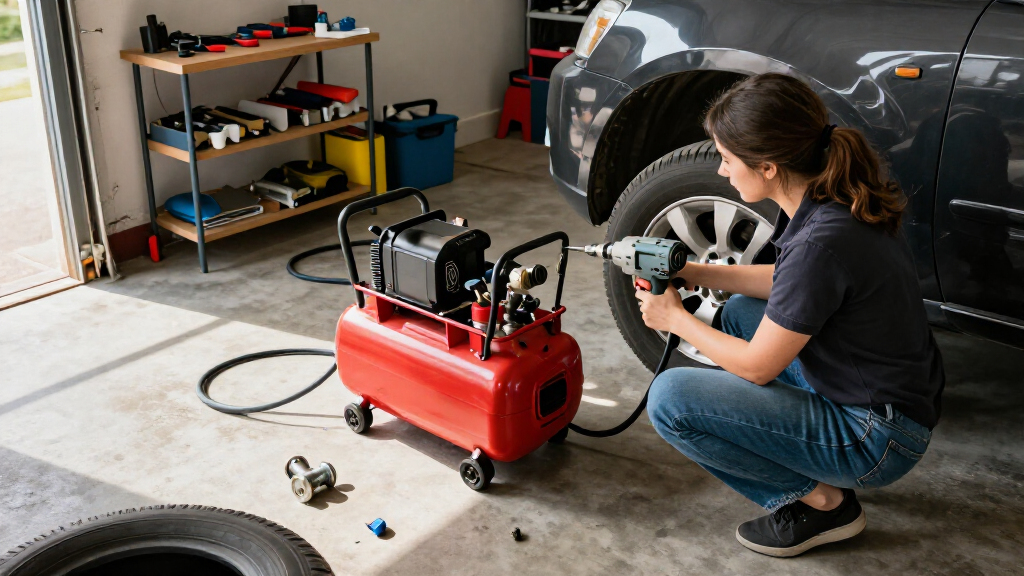
For most home garages, I’d start with the Klutch 20-Gallon Portable Air Compressor as the best overall balance of capacity and mobility; the Klutch 29-Gallon is the standout for longer air-tool sessions, while the Craftsman 6-Gallon Pancake is a simpler fit for occasional inflation and brad nailing. The main tradeoff is between a larger tank that can support longer bursts and a compact unit that takes less space and is easier to move. Oil-free designs across this lineup reduce routine lubrication, but tank size alone does not tell you how well a compressor can sustain a tool: match airflow output to the tool’s requirements. Read on for the full breakdown, plus guidance on choosing by workload, power, and garage layout.

Get business pricing on garage and car supplies
- Business-only prices and quantity discounts
- Tax-exempt purchasing
- Multiple users, one account, clear invoices
Complete the kit


Key Takeaways
- The Klutch 20-Gallon is the most balanced pick: it offers more stored air than the pancake and 8-gallon options while remaining portable, unlike the larger 29-gallon tank.
- The Klutch 29-Gallon favors capacity over easy repositioning: its 175 PSI rating and larger tank suit buyers prioritizing reserve, but the 120V power supply does not by itself establish that it can run every demanding air tool continuously.
- The two 6-gallon pancake models target quick, intermittent tasks: Craftsman emphasizes a straightforward compact format, while ECOMAX adds accessories that may be useful to a new setup.
- The wall-mount Craftsman solves a space problem, not every air-demand problem: its retractable 30-foot hose keeps the floor clearer, though fixed placement limits where the compressor can go.
- Tank size and horsepower are not substitutes for airflow data: buyers should verify delivered CFM at the required pressure against their tools before choosing any model for sustained use.
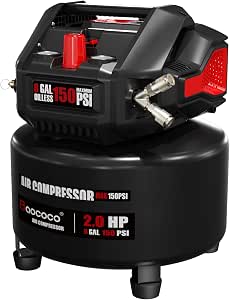


| garage air compressor | Tank capacity | Motor power | Maximum pressure | Noise level |
|---|---|---|---|---|
| 8-Gallon Portable Oil-Free Air | 8 gallons | 2 HP | 150 PSI | — |
| RyanTek 15-Gallon Oil-Free Air | 15 gallons | 2 HP | 125 PSI | 66 dB at 4 m |
| Klutch 29-Gallon Oil-Free Air | 29 gallons | 2.5 HP | 175 PSI | 81 dB |
| Craftsman 6-Gallon 150 PSI Oil | 6 gallons | 1 HP | 150 PSI | 82 dB |
| ECOMAX 6-Gallon 150 PSI Oil-Fr | 6 gallons | 1.5 HP | 150 PSI | 75 dB |
| CRAFTSMAN 1.5 HP Oil-Free Wall | 0.5 gallons | 1.5 HP | 125 PSI | 73 dB |
| Klutch 20-Gallon Portable Air | 20 gallons | 2 HP | 175 PSI | 80 dB |
More Details on Our Top Picks
8-Gallon Portable Oil-Free Air Compressor, 2 HP
I’d choose this 8-gallon compressor for a garage where storage space and occasional-use flexibility matter more than running air-hungry tools. Its 150 PSI maximum and oil-free pump suit tire inflation, nailers, air brushing, and small paint jobs, while the automatic shut-off adds a useful safeguard. At 2.8 SCFM at 90 PSI, though, it has less working airflow than the RyanTek 15-Gallon, which is rated at 4.5 CFM at the same pressure. That gap matters for tools that need a sustained supply of air, not just short bursts. The smaller tank is easier to accommodate, but it also means less reserve between compressor cycles. I’d pick it for intermittent DIY work and skip it as a primary compressor for demanding pneumatic tools.
Pros:- 8-gallon tank offers a useful reserve without taking up as much room as the larger vertical models.
- Oil-free pump avoids routine oil changes.
- 150 PSI maximum pressure supports a range of intermittent garage tasks.
- Automatic overpressure shut-off adds a protective operating feature.
Cons:- 2.8 SCFM at 90 PSI may not keep demanding pneumatic tools supplied with air.
- Smaller tank provides less reserve than the RyanTek 15-Gallon or Klutch 29-Gallon.
- Requires regular checks and cleaning, despite its oil-free design.
Best for: DIYers with limited garage space who mainly inflate tires, use nailers, or handle occasional small paint and air-brushing jobs.
Not ideal for: Garage users running air-hungry tools for extended periods; its 2.8 SCFM at 90 PSI and 8-gallon tank limit sustained airflow.
- Tank capacity:8 gallons
- Motor power:2 HP
- Maximum pressure:150 PSI
- Airflow:2.8 SCFM at 90 PSI; 3.8 SCFM at 40 PSI
- Power source:Corded electric
- Voltage and frequency:120 V, 60 Hz
- Pump type:Oil-free
- Automatic shut-off:Yes
Our verdict“Choose this compact 8-gallon model for occasional garage jobs, not sustained work with high-demand air tools.”
RyanTek 15-Gallon Oil-Free Air Compressor, 2 HP
The RyanTek’s strongest case is the balance between useful airflow and quieter operation: it delivers 4.5 CFM at 90 PSI and is specified at 66 dB at 4 m. That makes it a more capable choice for repeated nailing, painting, and general home-shop tasks than the 8-Gallon Portable compressor, whose 90-PSI airflow is 2.8 SCFM. Its 15-gallon vertical tank, wheels, and handle help move it around a garage, although 68.3 pounds is still a substantial lift over steps or into a vehicle. The 125 PSI ceiling is lower than the 150 PSI options in this roundup, including the Craftsman pancake model. I’d favor the RyanTek when noise and stronger airflow matter more than maximum pressure or easy one-handed portability.
Pros:- 4.5 CFM at 90 PSI provides more working airflow than the 8-Gallon Portable compressor.
- Specified 66 dB noise level is lower than the 81–82 dB figures listed for the Klutch 29-Gallon and Craftsman pancake models.
- Vertical tank, wheels, and handle aid movement around a workshop.
- Oil-free twin-cylinder pump avoids routine oil changes.
Cons:- At 68.3 pounds, it is not an easy compressor to carry.
- 125 PSI maximum is lower than several other models in this roundup.
- Corded operation requires access to a suitable power connection.
Best for: Home-garage users who want better airflow for repeated nailing or painting and prefer a quieter-running compressor with wheels.
Not ideal for: Buyers who need a lightweight compressor to carry frequently or want the higher 150 PSI ceiling available on the Craftsman and 8-Gallon Portable models.
- Tank capacity:15 gallons
- Motor power:2 HP
- Airflow:4.5 CFM at 90 PSI
- Maximum pressure:125 PSI
- Noise level:66 dB at 4 m
- Weight:68.3 pounds
- Pump type:Oil-free, twin-cylinder
- Voltage:110 V
Our verdict“Pick the RyanTek if you want stronger airflow and a quieter listed noise level in a wheeled home-garage compressor.”
Klutch 29-Gallon Oil-Free Air Compressor, 2.5 HP, 120V, 175 PSI
For buyers who need a larger air reserve and stronger stated output, the Klutch is the most work-oriented option here: its 29-gallon tank and 5.1 CFM at 90 PSI outpace the RyanTek 15-Gallon’s 4.5 CFM and tank capacity. That gives it a better fit for longer stretches of pneumatic work, while its 175 PSI maximum is the highest listed among these five products. Mobility is a tradeoff, not a selling point: at 127 pounds, it is far less convenient to reposition than the RyanTek or the portable 8-gallon model, even with flat-free tires. Its 81 dB noise rating also makes it a poor pick for noise-sensitive garages. I’d shortlist it for a dedicated workshop with room to park it, rather than a shared or frequently rearranged space.
Pros:- 29-gallon tank provides more stored air than the RyanTek 15-Gallon or 8-Gallon Portable models.
- 5.1 CFM at 90 PSI is the highest stated airflow in this five-product group.
- 175 PSI maximum pressure exceeds the other listed models here.
- Flat-free tires, a quick-connect coupler, and a tank drain support workshop handling and upkeep.
Cons:- 127-pound weight makes it difficult to move despite its tires.
- 81 dB noise rating may be unsuitable for noise-sensitive garages.
- Its large vertical footprint needs a dedicated storage and operating area.
Best for: Garage owners with a dedicated compressor area who run pneumatic tools regularly and want a larger tank and higher listed airflow.
Not ideal for: Users who need to carry or frequently reposition their compressor, or who work in a noise-sensitive garage; it weighs 127 pounds and is rated at 81 dB.
- Tank capacity:29 gallons
- Motor power:2.5 HP
- Maximum pressure:175 PSI
- Airflow:5.1 CFM at 90 PSI
- Noise level:81 dB
- Weight:127 pounds
- Dimensions:23.2 × 21.1 × 45.3 inches
- Power source and voltage:Corded electric, 120 V
Our verdict“Choose the Klutch for a stationary garage setup that needs the strongest stated airflow and largest tank in this group.”
Craftsman 6-Gallon 150 PSI Oil-Free Pancake Air Compressor (CMXECXA02106410)
The Craftsman makes sense when compact storage and straightforward portability matter more than tank capacity. At 30.8 pounds, its carry handle and pancake form make it easier to lift and stow than the 68.3-pound RyanTek, and its dual quick-couplers let two compatible connections stay attached. The tradeoff is modest output: 2.6 SCFM at 90 PSI is below both the RyanTek 15-Gallon and Klutch 29-Gallon, so this is better suited to nailers, tire inflation, and short bursts than sustained air-tool use. Its 82 dB rating is also relatively loud for a small compressor. Compared with the ECOMAX pancake, the Craftsman has a clearly stated airflow figure, while the ECOMAX includes a hose and accessories. I’d favor this model for buyers who already have their own fittings and value a compact, simple setup.
Pros:- Compact 6-gallon pancake form is easier to store than the larger vertical compressors.
- 30.8-pound weight and carry handle make it more manageable to lift than the RyanTek 15-Gallon.
- Dual quick-couplers allow two tool connections.
- Oil-free motor and 150 PSI maximum suit routine DIY garage tasks.
Cons:- 2.6 SCFM at 90 PSI is lower than the RyanTek and Klutch airflow figures.
- 82 dB noise level may be intrusive in an attached or shared garage.
- The 6-gallon tank offers less air reserve than the larger models.
Best for: DIYers who need a small compressor for nailers and tire inflation, want dual couplers, and can lift a 30.8-pound unit.
Not ideal for: Users running air-hungry tools for long stretches or anyone prioritizing quieter operation; its airflow is limited and its noise level is 82 dB.
- Tank capacity:6 gallons
- Motor power:1 HP
- Maximum pressure:150 PSI
- Airflow:2.6 SCFM at 90 PSI
- Weight:30.8 pounds
- Noise level:82 dB
- Dimensions:15.8 × 16.4 × 17 inches
- Voltage and power source:120 V, corded electric
Our verdict“Pick the Craftsman for a compact, clearly specified pancake compressor for intermittent garage tasks and two connected tools.”
ECOMAX 6-Gallon 150 PSI Oil-Free Pancake Air Compressor with Accessories
The ECOMAX is aimed at the buyer who wants a ready-to-start bundle, not just a bare compressor: its listed kit includes a 25-foot hose, tire gauge, air chuck, blow gun, nozzle, and fittings. That can reduce the need to gather basic accessories before handling tires or cleanup jobs. Unlike the Craftsman 6-Gallon pancake, however, its airflow specification is listed as 3 cubic inches per minute at 90 PSI, a unit and figure that do not provide a useful basis for comparing compressor output with the other models. I would verify that rating with the seller or manufacturer before relying on it for tool selection. The 6-gallon tank and 150 PSI maximum suggest a compact, intermittent-use role, but the unclear output claim makes it harder to recommend for sustained pneumatic work.
Pros:- Includes a 25-foot hose and accessories for inflation and blow cleaning.
- 6-gallon pancake tank and flip-up handle suit portable, intermittent garage use.
- Oil-free pump avoids routine oil changes.
- Dual gauges and quick couplers support at-a-glance pressure checks and tool connections.
Cons:- Listed airflow of 3 cubic inches per minute at 90 PSI is unclear and not directly comparable with the other models.
- 6-gallon capacity is less suited to sustained tool use than the RyanTek or Klutch tanks.
- At 34.17 pounds, it is heavier than the Craftsman 6-Gallon pancake.
Best for: Garage owners who need a compact compressor kit for tire inflation and blow-cleaning and want a hose and basic accessories included.
Not ideal for: Buyers choosing a compressor for air-tool performance; the listed airflow unit is unusual and should be clarified before purchase.
- Tank capacity:6 gallons
- Maximum pressure:150 PSI
- Motor power:1.5 HP
- Listed airflow:3 cubic inches per minute at 90 PSI
- Weight:34.17 pounds
- Noise level:75 dB
- Hose length and diameter:25 feet; 0.25 inch
- Power source and voltage:Corded electric, 120 V
- Pump type:Oil-free
Our verdict“Choose the ECOMAX for its included hose and accessories when your work is mostly inflation and cleanup, but verify airflow before buying for air tools.”
CRAFTSMAN 1.5 HP Oil-Free Wall-Mount Air Compressor with 30 ft Retractable Hose
The wall-mount design makes this CRAFTSMAN a fit for garages where floor space matters more than stored air capacity. Its 30-foot hose reaches around a vehicle or across a workbench without moving the compressor, while the oil-free motor limits routine upkeep. At 2.3 CFM and 125 PSI, it suits tire inflation and intermittent jobs such as nailing or small repair tasks, but the 0.5-gallon tank is a clear constraint: tools that draw air steadily will make it cycle often. Compared with the Klutch 20-Gallon Portable Air Compressor, this model is lighter and easier to keep out of the way, but it cannot match that unit’s larger reserve or 4.2 SCFM at 90 PSI. I’d choose it for quick, occasional garage work, not sustained spraying or demanding pneumatic tools.
Pros:- Wall-mountable form keeps the compressor off the garage floor.
- 30-foot hose provides useful reach around vehicles and work areas.
- Oil-free motor reduces routine maintenance.
- 125 PSI supports tire inflation and intermittent pneumatic tasks.
Cons:- 0.5-gallon tank offers little reserve, so the compressor may cycle frequently during tool use.
- Corded electric operation requires a suitable outlet and limits placement.
- Its airflow is a poor fit for extended spraying or other continuous-demand work.
Best for: Garage owners with limited floor space who mainly inflate tires and run pneumatic tools in short bursts.
Not ideal for: DIYers who need sustained airflow for spraying or other air-hungry tools, since its 0.5-gallon tank and 2.3 CFM output limit longer work.
- Motor power:1.5 HP
- Maximum pressure:125 PSI
- Tank capacity:0.5 gallons
- Airflow:2.3 CFM
- Hose length:30 feet
- Noise level:73 dB
- Weight:21 pounds
- Power and pump:120 V corded electric; oil-free
Our verdict“Choose this CRAFTSMAN for compact, occasional garage jobs where a long hose and clear floor space matter more than sustained airflow.”
Klutch 20-Gallon Portable Air Compressor, 2 HP, 120V
Among these two picks, the Klutch 20-Gallon is the more capable choice when a garage job needs a larger air reserve. Its 4.2 SCFM at 90 PSI and 20-gallon tank suit nailing and spraying better than the CRAFTSMAN wall-mount unit, whose half-gallon tank favors brief bursts. The 175 PSI maximum and oil-free pump add flexibility without the regular oil checks associated with an oil-lubricated pump. Rubber wheels, a handle, and vibration-reducing feet help with moving and positioning it, but 90 pounds is still a substantial load, and 80 dB makes it the louder option. I’d rank it for buyers who need more reserve and accept a larger, noisier machine; the compact CRAFTSMAN is easier to tuck away but is not a substitute for this airflow capacity.
Pros:- 20-gallon tank provides far more stored air than the CRAFTSMAN wall-mount model.
- Delivers 4.2 SCFM at 90 PSI for more capable tool use.
- Rubber wheels and an ergonomic handle aid movement around the garage.
- Oil-free pump and thermal overload protection reduce routine upkeep and add protection during operation.
Cons:- At 90 pounds, it is heavy to lift or maneuver over steps.
- 80 dB noise level may be intrusive in an attached or shared garage.
- Its wheeled footprint requires more storage space than a wall-mounted compressor.
Best for: Home mechanics and DIYers who use nailers or spray equipment and want a larger air reserve from a 120 V compressor.
Not ideal for: People with limited storage, frequent stair or solo handling needs, or a strong preference for quieter garage equipment.
- Motor power:2 HP
- Voltage:120 V
- Tank capacity:20 gallons
- Maximum pressure:175 PSI
- Airflow at 90 PSI:4.2 SCFM
- Maximum airflow:5.2 CFM
- Noise level:80 dB
- Weight:90 pounds
- Pump and warranty:Oil-free; 2-year warranty
Our verdict“Pick the Klutch 20-Gallon when longer tool sessions and greater air reserve outweigh noise, weight, and storage demands.”

How We Picked
I ranked these garage air compressors around the jobs buyers are likely to do at home: inflating tires, using nailers, blowing off a workbench, and running air tools in bursts. I compared the stated tank capacity, pressure, motor information, power requirements, portability, mounting style, and included accessories, while giving weight to how each design fits a real garage. A larger tank can reduce how often the motor cycles, but it does not prove that a compressor can keep up with a high-demand tool; airflow figures and duty-cycle guidance matter too.
The Klutch 20-Gallon leads for its middle-ground role: more reserve than compact units without the 29-gallon model’s larger footprint. The 29-gallon Klutch follows for buyers who value capacity, while the smaller Craftsman and ECOMAX pancake models rank for portability and occasional tasks rather than sustained tool use. The 8- and 15-gallon options fill intermediate capacity needs, and the wall-mount Craftsman earns a distinct place for space-conscious garages. Where the listed specifications do not establish airflow or duty cycle, I treat that as a point buyers should confirm rather than assume.
Factors to Consider When Choosing Garage Air Compressors
I’d choose a compressor by working backward from the tools and the garage, rather than picking the biggest tank or highest pressure number. These factors help reveal whether a compact, portable, or fixed setup will serve you better.
Match Airflow to the Tool, Not Just Tank Size
Check each air tool’s required CFM at its stated PSI, then compare that figure with the compressor’s delivered airflow at the same pressure. A tank stores air for short bursts, but it cannot make up indefinitely for a pump that supplies air too slowly. Nailers and inflation tasks often allow pauses, while tools such as sanders may demand steadier output. A common mistake is comparing advertised maximum PSI alone; pressure tells you how hard air can be delivered, not how much air is available over time. If airflow data is missing, ask the manufacturer for it before buying for a sustained-use tool. For occasional use, a larger tank can make brief bursts more comfortable, but it is not a replacement for adequate CFM.
Choose Tank Capacity for Your Work Rhythm
Think about whether your jobs involve quick bursts or repeated runs with little time between them. Smaller tanks can be easier to store and move, but the motor may cycle more often during repeated use. A larger tank supplies a deeper reserve and can reduce cycling for intermittent work, yet it takes more garage space and may be harder to reposition. Buyers sometimes pay for capacity they rarely use, or choose a compact tank for a workload that keeps the pump running. List your most frequent tasks and how long each lasts before comparing tank sizes. For continuous-use tools, prioritize pump output and duty-cycle information along with tank capacity.
Plan Around Your Garage Layout and Portability
Measure the intended storage spot, the path from storage to the work area, and the clearance needed to connect hoses. Portable compressors make sense when work shifts between a car, bench, and driveway, but a larger tank can make frequent moving less appealing. A wall-mounted design can free floor space and keep a hose within reach, though it commits you to a fixed work zone and a suitable mounting surface. Do not overlook hose length: a longer hose can extend reach, but the hose diameter and fittings can affect air delivery. Also check where the drain, controls, and intake sit so routine access is not blocked by a wall or shelf. The best layout is often the one that makes setup easy enough that the compressor actually gets used.
Check Electrical Fit Before Bringing It Home
Confirm the compressor’s voltage, amperage requirements, plug type, and startup demands against the circuit you plan to use. A 120V label does not mean every household circuit will handle the compressor comfortably, especially if other equipment shares it. Long or undersized extension cords can contribute to voltage drop and poor motor starts, so follow the manufacturer’s instructions for wiring and cord use. Buyers should also check whether the garage has a suitable grounded outlet near the intended location. If a compressor repeatedly trips a breaker, that may point to a circuit mismatch rather than a defective unit. Sort out power access before choosing a location or relying on a particular model.
Compare Noise, Maintenance, and Included Extras
Oil-free pumps reduce the need for oil changes, but they still need sensible care: drain condensation from the tank, keep the intake clear, and inspect fittings and hoses. Noise can shape where and when you work, so look for a published decibel figure rather than guessing from motor size or tank capacity. Accessories may help a beginner get started, yet they should not outweigh the compressor’s ability to meet the tool’s airflow needs. Check what is included, such as a regulator, hose, or inflation fittings, and confirm that the connections suit your existing tools. Also review the warranty and availability of replacement parts, since service access matters more as a compressor becomes a regular workshop fixture. A quieter or better-supported model may be worth choosing over extra capacity you do not need.
Frequently Asked Questions
Can a 120V garage compressor run an impact wrench or paint sprayer?
It depends on the tool’s airflow demand and the compressor’s delivered CFM at the tool’s working pressure, not on 120V alone. Many impact wrenches use air in bursts, while some paint sprayers need steadier airflow and can expose a small compressor’s limits quickly. Compare the tool’s specifications with the compressor’s published output and check its duty-cycle guidance. If the manufacturer does not provide matching airflow data, contact them before buying for that job. A larger tank may help with short bursts, but it will not sustain a tool when the pump cannot replenish air fast enough.
Is a 6-gallon pancake compressor enough for a home garage?
It can be a sensible fit for tire inflation, blowing off surfaces, and intermittent nailer use, especially when storage space and easy carrying matter. It is less suited to long, repeated runs with air-hungry tools because the pump may need to catch up often. Check the tool’s CFM requirement and the compressor’s output before treating a compact tank as a general-purpose solution. The Craftsman and ECOMAX pancake models in this lineup are best approached as compact task-focused choices, not as substitutes for higher-output shop equipment. If your planned work is varied, a larger portable model may offer more flexibility.
Should I choose a larger tank or a higher-PSI compressor?
Choose based on what your tools require: tank capacity affects stored-air reserve, while PSI is the pressure available at the outlet. Many tools need a specific working pressure but also depend on adequate airflow, so neither a large tank nor a high maximum PSI guarantees good performance. A bigger tank can make short tasks less interrupted, while higher pressure can matter for tools designed to operate at that level. Compare the tool’s pressure and CFM requirements with the compressor’s output specifications. If the job involves sustained air use, prioritize matching airflow and duty cycle rather than chasing a larger PSI number.
Is a wall-mounted compressor a good choice if I work in different parts of the garage?
A wall-mounted unit can keep floor space open and make a fixed work area tidy, particularly when a retractable hose reaches the jobs you do most often. It is less convenient when you regularly move between a driveway, bench, and other corners of the garage. Hose reach is only part of the decision: confirm that the hose and fittings suit your tools, and choose a mounting location with access to power and routine service points. A portable compressor is usually more adaptable when work locations change. The wall-mounted Craftsman is most appealing when saving floor space matters more than moving the compressor.
What should I verify before buying a compressor for a tool I already own?
Read the tool’s required PSI and CFM, including whether its airflow figure assumes continuous use or intermittent bursts. Then compare those figures with the compressor’s delivered CFM at the relevant pressure, not just its maximum pressure or horsepower. Check the compressor’s duty cycle, electrical requirements, outlet type, and whether your garage circuit can support startup. If specifications are incomplete, request clarification from the manufacturer instead of estimating from tank size. This check can prevent a mismatch that leaves a compressor running constantly or a tool performing below its intended level.
Conclusion
For one compressor to cover a mix of home-garage tasks, I’d choose the Klutch 20-Gallon Portable as the best overall pick, provided its airflow matches the tools you plan to run. The 8-Gallon Portable Oil-Free is my best value direction for buyers who want more reserve than a pancake unit without moving up to a large tank; verify its output against your tools before purchase. For a best premium, capacity-first choice, the Klutch 29-Gallon makes sense when space is available and longer bursts matter more than easy repositioning. Beginners with occasional inflation and nailing jobs may prefer the Craftsman 6-Gallon Pancake, while the ECOMAX is worth comparing if its included accessories suit a new setup. Choose the wall-mount Craftsman for a fixed, space-saving work area, or the RyanTek 15-Gallon when you want an intermediate tank size; in either case, confirm airflow and electrical fit before deciding.