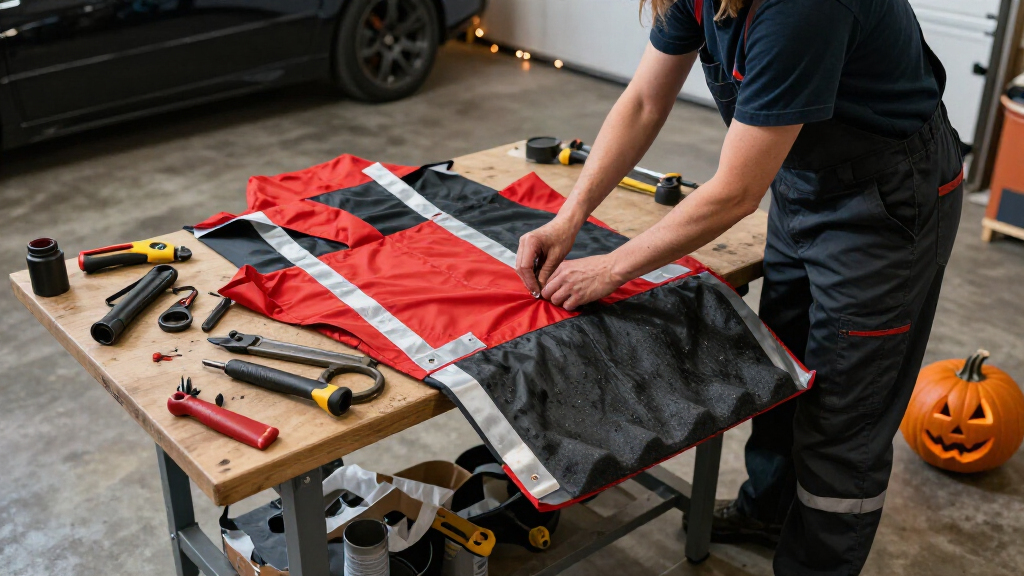

Create a recognizable automotive Halloween costume, such as a race car driver, traffic signal, mechanic, or cardboard car. This guide is for beginners making a costume for a party, school event, or trick-or-treating. Plan for about 2–4 hours of work, plus any paint or glue drying time. You will finish with a costume that fits, allows easy movement, and has no sharp or obstructive parts.

Get business pricing on garage and car supplies
- Business-only prices and quantity discounts
- Tax-exempt purchasing
- Multiple users, one account, clear invoices

Adult Inflatable Police Car Costume
- ✔ Fabric: 100% polyester
- ✔ Care: Wipe with a damp cloth
- ✔ Recommended height: 160–185 cm (5’3"–6’1")

Halfjuly Inflatable Traffic Cone Costume for Adults
- ✔ Material: Polyester fiber
- ✔ Fit: Fits most adults
- ✔ Included: Inflatable costume, fan, battery box, reversible STOP/GO sign

VZQI Adult Traffic Cone Costume with Reflective Strips
- ✔ Material: Polyester with internal filling
- ✔ Care instructions: Hand wash only
- ✔ Size: Adult one size
Difficulty: Beginner | Time: 2–4 hours, plus drying time
What You’ll Need
Tools & Materials:
- Comfortable base clothing, such as a T-shirt and trousers
- Cardboard or lightweight foam board for a car body, if making one
- Scissors and a craft knife for adult use
- Ruler, pencil, and masking tape
- Non-toxic paint, markers, or colored paper
- Glue or double-sided tape
- Reflective tape or bright trim
- Optional: cap, toy steering wheel, or mechanic accessories
Knowledge:
- Basic measuring, cutting, and gluing
- Ability to try on the costume and check movement
Choose a design that suits the wearer’s age, event, and weather. Use a stable work surface, keep craft knives away from children, and let paint or glue dry fully before wearing the costume.
Adult Inflatable Police Car Costume
When we want the costume itself to say “automotive,” this police car has the strongest case. Its inflatable vehicle shape makes the theme more immediate than either traffic cone, which represents road equipment rather than a car. A stated height range of 160–185 cm also gives us a clearer fit reference than Halfjuly’s “most adults” guidance or VZQI’s one-size design.The tradeoff is the equipment that gives it that volume. A built-in blower and battery box are included, but we supply the power: four AA batteries or a USB power bank, neither of which comes with the costume. That makes setup more involved than wearing VZQI’s padded cone, and the need to keep the blower running may be inconvenient where power access is limited. Halfjuly shares this powered-inflatable drawback, but its reversible sign offers more visual play; the police car wins when a recognizable vehicle matters most.
Pros:
- The police car silhouette makes the automotive theme immediately clear.
- Lists a specific recommended adult height range of 160–185 cm.
- Can use four AA batteries or a USB power bank.
- Includes the suit, built-in blower, and battery box.
Cons:
- Batteries and USB power bank are not included.
- Requires a power source to remain inflated.
Best for: Adults within the stated height range who want an unmistakable car costume for a party, cosplay, or performance.
Not ideal for: Anyone who wants a costume with no power setup, or whose height falls outside the listed range.
Bottom line: Choose this when a clear vehicle shape matters more than avoiding powered inflation.
“Choose this when a clear vehicle shape matters more than avoiding powered inflation.”
Halfjuly Inflatable Traffic Cone Costume for Adults
Halfjuly turns a familiar road marker into a costume with a small interactive twist: its STOP/GO sign reverses, giving us two messages to use at a party or parade. That extra detail makes it more expressive than the VZQI cone, whose appeal rests on its fixed orange form and silver strips. Compared with the police car, however, it communicates traffic control rather than a specific vehicle, so it suits a broader road-theme interpretation of automotive Halloween.The roomy inflatable design is described as wearable over everyday clothes, and the included fan and battery box handle the inflation hardware. We still need to bring four AA batteries or a portable power bank. There’s also a small setup detail to get right: the fan ring must be securely tightened before use. This is a stronger pick than VZQI for movement-oriented events according to its design description, but it retains the powered-costume dependency shared with the police car.
Pros:
- Reversible STOP/GO sign adds a changeable visual feature.
- Roomy design is intended to fit over everyday clothing.
- Includes the inflatable costume, fan, and battery box.
- Suitable for parties, parades, Halloween, and other events.
Cons:
- Four AA batteries or a portable power bank must be supplied separately.
- The fan ring needs to be securely tightened before use.
Best for: Adults who want a lighthearted road-themed costume with a reversible sign for parties, parades, and Halloween events.
Not ideal for: Anyone looking for a recognizable car-shaped suit or a costume that can be worn without external power.
Bottom line: Pick Halfjuly for the most playful road-sign design, provided we’re prepared to power and set up the fan.
“Pick Halfjuly for the most playful road-sign design, provided we’re prepared to power and set up the fan.”
VZQI Adult Traffic Cone Costume with Reflective Strips
VZQI takes the road-cone idea in a different direction: it uses a padded polyester form rather than an inflatable shell. That means no blower or battery box is listed, a practical distinction from both the police car and Halfjuly. Its bright orange body, wide base, and two silver reflective strips make the road-marker theme straightforward, while face and arm openings leave room for visibility and gestures.We pay for that simpler setup in space and movement. The base measures about 34.2 inches across, and the product description warns that the wide shape can limit mobility. Halfjuly’s inflatable design is presented as roomy enough to move in, so it is the more sensible cone for a parade or a busy gathering; VZQI is better when a static, sculptural look is the priority. Its one-size format also offers less sizing guidance than the police car’s stated height range, and hand washing calls for more care than the police car’s damp-cloth cleanup.
Pros:
- Padded construction does not list a fan or power requirement.
- Two silver reflective strips accent the bright orange cone shape.
- Face and arm openings allow visibility and gestures.
- No inflation hardware setup is listed.
Cons:
- Wide base may restrict walking and movement.
- One size may not suit every wearer.
- Hand wash only.
Best for: Adults who prefer a padded, fan-free traffic cone look and expect to spend most of the event in open space.
Not ideal for: People who need easy movement in a crowded venue or want fit guidance beyond a one-size label.
Bottom line: Choose VZQI when avoiding powered inflation matters more than compact movement or adjustable fit guidance.
“Choose VZQI when avoiding powered inflation matters more than compact movement or adjustable fit guidance.”
As an Amazon Associate we earn from qualifying purchases.
Before You Start
Decide whether you want a wearable car shape or an outfit inspired by automotive work. A car body made from cardboard can block peripheral vision or catch on objects, so keep it short, light, and open around the arms and legs. Do not cover the face, restrict breathing, or attach anything that drags on the ground. If the costume will be worn outdoors at night, use bright colors and reflective details.
Step-by-Step Instructions
Step 1: Choose an automotive design
Choose one clear idea: race car driver, mechanic, traffic signal, road sign, or a small cardboard car. Write down the main colors and two or three details people will recognize, such as a racing number, checkered flag pattern, tool belt, or colored signal circles.
Tip:For young children or crowded events, a simple outfit over regular clothes is easier to move in than a large box costume.
Check: You can describe the costume in one sentence and name the details that identify it.
Step 2: Gather materials and measure the wearer
Lay out the base clothes and costume materials. If using a box, measure the wearer’s width and height while standing in the clothes they will wear underneath. Mark openings that leave the arms, legs, and head free, with enough space to turn and sit.
Tip:Allow room for a warm layer if the costume will be worn outdoors. Keep the box light; remove excess flaps and avoid heavy decorations.
Check: The materials are ready, and the planned costume will fit over the intended clothing.
Step 3: Make the main costume shape
Cut the cardboard into a front and back panel or a shallow box shape for a car costume, then tape the panels together. Cut generous arm and head openings, and keep the bottom above the knees. For an outfit costume, assemble the base clothes and add a vest, cap, or apron as the main shape.
Tip:An adult should handle craft knives. Cover cut cardboard edges with masking tape so they do not scrape skin or snag clothing.
Check: The costume holds its shape without sharp exposed edges, and the wearer can step through it without help.
Step 4: Add recognizable automotive details
Paint or attach the key design details. Add windows, wheels, a grille, or a racing number to a car body; add a checkered pattern or team colors to a driver outfit; or place three large red, yellow, and green circles on a traffic signal costume. Secure loose pieces with glue or tape.
Tip:Use lightweight paper or felt for decoration. Avoid real tools, glass, small detachable pieces for young children, and anything that could poke another person.
Check: Someone unfamiliar with the project can identify the theme from the main details.
Step 5: Improve visibility and comfort
Add reflective tape or bright trim to the front, sides, and back if the costume will be worn near roads or after dark. Check that the wearer’s face remains visible and that the costume does not cover ears, block sight, or interfere with shoes.
Tip:Reflective accents help others see the wearer, but they do not replace adult supervision or safe pedestrian routes.
Check: The costume is easy to see, and the wearer can hear and look around normally.
Step 6: Try on the costume and adjust the fit
Have the wearer put on the full costume with the shoes and layers planned for the event. Ask them to walk, turn, raise both arms, sit, and climb a step. Shorten or reposition any part that catches, swings into the face, or restricts movement.
Tip:Test the costume while an adult supervises, especially if the wearer is a child or the costume includes a large body panel.
Check: The wearer can move comfortably, see in all directions, and remove the costume quickly if needed.
Step 7: Pack repair supplies and prepare for the event
Let paint and glue dry completely. Pack a small repair kit with masking tape, safety pins, and spare reflective tape. Before leaving, check that decorations are firmly attached, the wearer has comfortable shoes, and any battery-powered accessory has a secure cover over its battery compartment.
Tip:Keep light-up accessories simple and use products made for costume wear. Do not attach flame effects or use candles.
Check: The costume is dry, secure, and ready to wear, with basic supplies available for quick repairs.
Common Mistakes to Avoid
- Making the cardboard body too large or heavy. — Use a shallow shape, trim excess material, and test walking and turning before decorating.
- Covering the wearer’s face or limiting vision. — Keep the head opening clear and check that the wearer can look side to side and hear normally.
- Using decorations with sharp, heavy, or loose parts. — Choose lightweight materials, cover cut edges, and secure decorations before the fitting.
- Skipping the full costume fitting. — Try on the complete outfit with planned layers and shoes, then walk, sit, and raise both arms.
Troubleshooting
Problem: The costume shifts or tips while walking.
Solution: Lighten the body shape, widen the openings if needed, and secure it with soft shoulder straps or fabric ties that can be released quickly.
Problem: Cardboard edges rub or scratch.
Solution: Cover every cut edge with masking tape or soft fabric trim, then try the costume on again.
Problem: Paint or glue is still wet near event time.
Solution: Set the costume in a ventilated area and follow the product’s drying instructions. If it remains tacky, remove the wet decoration or wear a simpler version.
Problem: The costume is hard to see outdoors.
Solution: Add reflective tape to several sides and use bright outer clothing. Choose well-lit routes and keep the wearer with a supervising adult.
What Success Looks Like
The finished costume clearly reads as an automotive character or object, fits over the planned clothing, and stays in place during walking and sitting. The wearer can see, hear, breathe, and move freely; edges and decorations are secure; and outdoor costumes include bright or reflective details.
Next Steps
After the event, remove tape and accessories before storing the costume so the cardboard does not bend under weight. Keep reusable clothing and props in a labeled box, and recycle or reuse clean cardboard where local rules allow. Repair loose parts before wearing the costume again.
Frequently Asked Questions
What is the easiest automotive Halloween costume to make?
A mechanic or race car driver outfit is usually simplest: use comfortable clothes and add a cap, checkered details, a racing number, or a lightweight tool belt. It avoids the restricted movement that a large cardboard body can cause.
How do I make a cardboard car costume safer for a child?
Keep it lightweight and above the knees, leave broad openings for the head and arms, tape over cut edges, and supervise a movement test. Keep the child’s face clear and use reflective details outdoors.
Can I use real tools as costume accessories?
Use lightweight toy or cardboard versions. Real tools can be heavy or sharp and may injure the wearer or someone nearby.
How can I make the costume visible at night?
Use bright fabric or paint and add reflective tape to the front, sides, and back. Reflective details improve visibility, but choose lit walking routes and stay with a supervising adult.