TL;DR

Get business pricing on garage and car supplies
- Business-only prices and quantity discounts
- Tax-exempt purchasing
- Multiple users, one account, clear invoices
The Drive’s review of the 2026 Toyota RAV4 Woodland plug-in hybrid found that its electric range came within two miles of Toyota’s 49-mile estimate, with smooth performance and modest capability on dirt roads. The Woodland’s off-road equipment adds little over other RAV4 PHEV trims, so its case rests more on styling and use needs than trail performance. The review says a home Level 2 charger is key to making regular electric driving practical.
The 2026 Toyota RAV4 Woodland PHEV pairs plug-in hybrid power with rugged styling and a small increase in ground clearance, but a review by The Drive’s Cy Soliman found its strongest case is everyday electric driving rather than serious off-roading. In testing, the Woodland came within two miles of Toyota’s claimed 49 miles of electric range; the review also found its dirt-road ability adequate for light use, not demanding trails.
Toyota offers the RAV4 plug-in hybrid in four grades: SE, XSE, Woodland and GR Sport. The Woodland is rated at 49 miles of electric-only range and 94 MPGe combined, compared with 52 miles and 96 MPGe for the SE and XSE. It has 8.5 inches of ground clearance and approach and departure angles of 20 and 24 degrees. The SE and XSE have 8.1 inches of clearance and angles of 19 and 23 degrees. Soliman notes that the Woodland’s extra clearance comes from its all-terrain tires, not a change to the suspension.
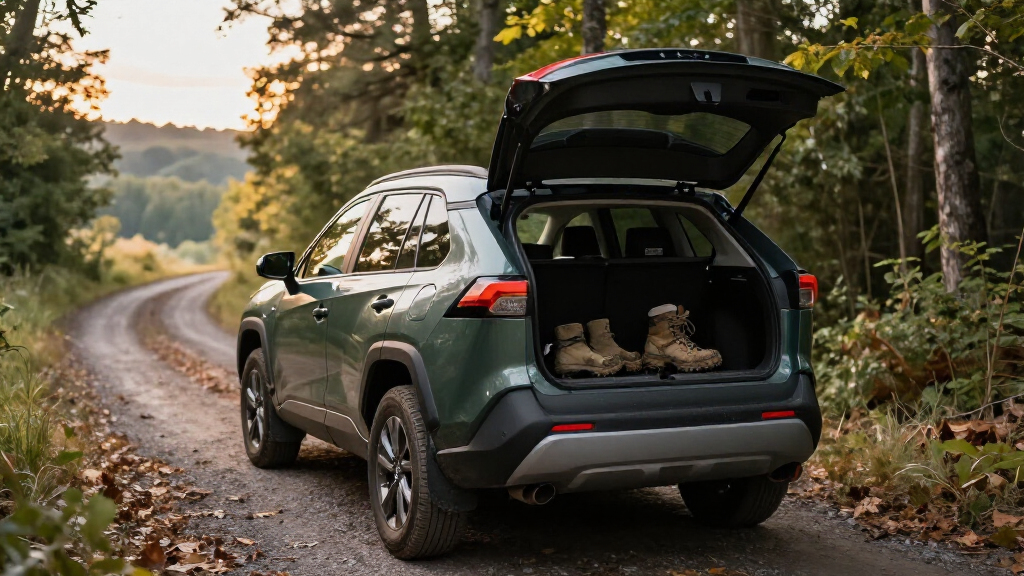
The Woodland’s exterior and cabin distinguish it from other grades, with roof rails, fender cladding, all-terrain tires and a unique front fascia. Inside, it has patterned soft-touch trim with red-orange accents, heated SofTex-trimmed seats and Woodland-branded all-weather mats. The broader cabin layout is familiar RAV4 PHEV equipment, including a 10.5-inch touchscreen and 12.3-inch digital gauge cluster.
Toyota rates the plug-in hybrid system at 324 horsepower, combining a 2.5-liter four-cylinder engine with front and rear electric motors; the rear motor provides electronic on-demand all-wheel drive. Soliman describes the vehicle’s acceleration and the handoff between electric and gasoline power as smooth, despite a reported curb weight of 4,500 pounds. On a desert route near Apple Valley, California, the Woodland handled loose dirt, uneven ground and light brush. The review did not test it on terrain demanding substantial articulation or low-range gearing.
Electric Range, Not Trail Gear, Makes the Case
The Woodland’s review matters to shoppers weighing whether its outdoors-oriented trim merits a higher price within the RAV4 PHEV range. Its 49-mile electric rating trails the SE and XSE by three miles, while its added clearance is limited to 0.4 inch and comes with only one extra degree in each cited approach and departure angle. Those differences make the Woodland a preference-sensitive choice, not an obvious capability upgrade for every buyer.
For drivers with regular short trips and a place to charge, the reported real-world range could cover many commutes and errands without using gasoline. Soliman estimates about 585 miles of combined range with a full battery and tank. That figure and the review’s driving impressions are not guarantees for every owner: actual range and efficiency depend on conditions and use. The practical value also depends on charging access, since slow household charging can limit how readily drivers replenish the battery.
The review’s central trade-off is straightforward: buyers get plug-in convenience and Woodland-specific styling, but the evidence provided does not show a major advantage on demanding trails. Shoppers focused on efficiency may prefer the SE or XSE; those who value the Woodland’s look and light-duty dirt-road ability may see its compromises differently.
Level 2 home electric vehicle charger
As an affiliate, we earn on qualifying purchases.
As an affiliate, we earn on qualifying purchases.
How Woodland Differs From Other PHEVs
The Woodland is one of four RAV4 plug-in hybrid grades for the 2026 model year. Compared with the SE and XSE, its stated advantages are a modest increase in ground clearance and slightly improved approach and departure angles, plus distinctive equipment and styling. Its stated electric range and combined efficiency are lower. The supplied material does not give a full price breakdown for all four trims, so it does not establish the exact cost of choosing Woodland over another PHEV grade.
Soliman tested the vehicle on a desert route in California and found its all-terrain tires and clearance useful on loose and uneven surfaces. The review also cites Senior Editor Caleb Jacobs’ separate first-drive assessment: “All the Woodland has going for it in terms of off-roading is Dunlop all-terrains, a trail drive mode that helps manage traction and split torque, and downhill assist control that grinds and jerks like Toyota’s Crawl Control of yore.” Jacobs characterized it as more suited to getting to a trail than taking drivers deep onto one. That is an attributed assessment, not a formal capability rating.
““The plug-in hybrid capability is what really sets it apart.””
— Cy Soliman, The Drive reviewer
Price and Long-Term Results Remain Open
The supplied source headline refers to a $48,000 RAV4, but the review material provided does not state the Woodland’s full transaction price, destination charge, options or how the figure was calculated. It also does not provide a complete comparison of purchase costs across the four PHEV grades, so the value of the Woodland’s equipment cannot be assessed from price alone.
The reported range and charging times come from one reviewer’s testing and projections. The review describes real-world electric range as within two miles of Toyota’s 49-mile claim, but the supplied material does not specify all test conditions, such as weather, speed or route. It also does not provide independent long-term reliability, ownership-cost or broader off-road test results. Individual fuel and electric use will vary.
Compare Trims and Charging Plans
Prospective buyers can compare the Woodland with the SE and XSE using the current window sticker and Toyota’s specifications, including the actual price of each vehicle and equipment differences. They should also consider whether their regular driving fits within the available electric range and whether they can charge at home. According to Soliman’s report, a Level 1 household outlet took an estimated 15 hours for a full charge, while a Level 2 charger was estimated at 2.5 to 3 hours. The review says DC fast charging can take the battery from 10% to 80% in around 35 minutes when a suitable charger is available.
No additional test, pricing update or follow-up is specified in the source material. The next useful evidence for buyers would be confirmed trim pricing and more testing across varied routes and conditions; until then, the review supports treating the Woodland as a plug-in hybrid with light-duty dirt-road capability, not a dedicated off-road vehicle.
Key Questions
How far can the 2026 RAV4 Woodland PHEV travel on electricity?
Toyota’s stated electric-only range for the Woodland is 49 miles. The Drive reviewer reported real-world range within two miles of that estimate during the review, but results vary with driving and conditions.
How does Woodland range compare with other RAV4 PHEV trims?
The Woodland is rated at 49 miles of electric range and 94 MPGe combined. The SE and XSE are rated at 52 miles and 96 MPGe combined, according to the supplied review.
Is the Woodland suitable for serious off-roading?
The review found it handled loose dirt, uneven terrain and light brush. It did not test demanding trails, and the reviewer described the vehicle’s off-road ability as limited compared with a dedicated trail vehicle.
How long does it take to charge the Woodland PHEV?
The reviewer estimated 2.5 to 3 hours for a full charge on Level 2, about 15 hours on Level 1, and around 35 minutes for a 10% to 80% DC fast-charge session. These are figures reported in the review; charging time depends on equipment and conditions.
Does the supplied review confirm a $48,000 price?
The source headline refers to a $48,000 RAV4, but the supplied review text does not detail the Woodland’s price, fees or options. Buyers should check the current listing and window sticker for a specific vehicle.
Source: rss
Halloween Picks
halloween
As an affiliate, we earn on qualifying purchases.