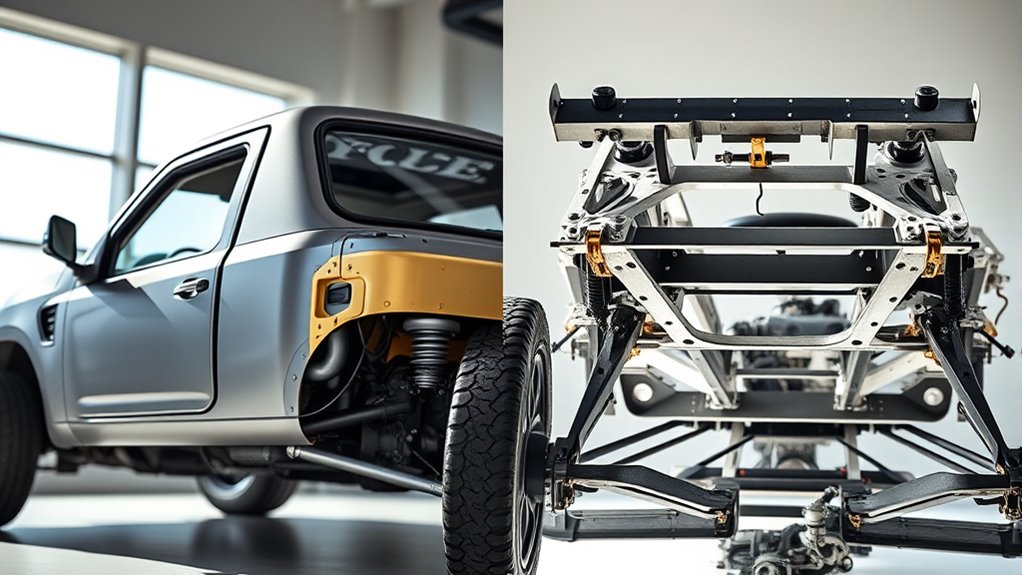

Unibody construction integrates the body and frame into a single unit, offering better crash protection, smoother rides, and higher fuel efficiency, making it ideal for city driving and daily use. Body-on-frame vehicles are sturdier for off-road, towing, or heavy-duty tasks and are typically cheaper upfront. If you’re weighing safety, cost, and performance, understanding these differences helps you choose what suits your needs best—more details will help you make a smarter decision.
Key Takeaways
- Unibody vehicles offer superior crash protection by evenly distributing impact forces across the structure.
- Body-on-frame designs are more durable and better suited for off-road, towing, and heavy-duty tasks.
- Unibody construction typically results in higher initial manufacturing costs but provides better fuel efficiency and handling.
- Body-on-frame vehicles are generally cheaper to produce initially and preferred for rugged, demanding environments.
- The choice depends on safety priorities, intended use, and budget, with unibody emphasizing safety and comfort.
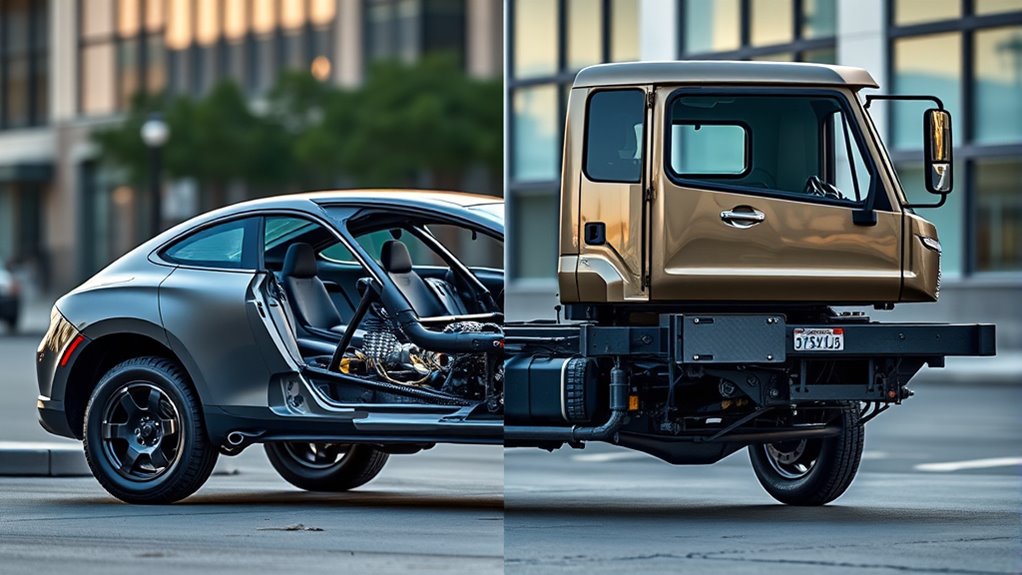
When choosing a vehicle platform, understanding the difference between unibody and body-on-frame construction is essential, as each offers distinct advantages depending on your needs. If you prioritize vehicle safety, unibody structures tend to provide better crash protection. Since unibody designs integrate the body and frame into a single, cohesive unit, they distribute collision forces more evenly across the entire structure. This results in improved crashworthiness, especially in frontal and side-impact collisions, which can be vital if you’re concerned about passenger safety. On the other hand, body-on-frame vehicles, with their separate body mounted on a rigid frame, often don’t absorb impact as efficiently. This can lead to more deformation during an accident, potentially compromising safety but providing certain benefits in specific scenarios. Additionally, high-performance projectors require precise calibration and robust contrast ratios to deliver optimal image quality, similar to how vehicle safety depends on structural integrity.
Unibody structures offer superior crash protection by distributing impact forces evenly across the entire vehicle.
Manufacturing costs also play a significant role in determining which platform suits you best. Generally, unibody construction involves more sophisticated manufacturing processes and precise assembly, which can increase initial production costs. However, these vehicles often benefit from economies of scale, making them more affordable for consumers over time. They’re also lighter, leading to better fuel efficiency and lower operating costs, which can offset the higher manufacturing expenses. Conversely, body-on-frame vehicles are typically cheaper to produce initially because their manufacturing processes are more straightforward and less complex. This cost advantage makes them appealing for manufacturers producing trucks, SUVs, and off-road vehicles where durability and ruggedness are more critical than manufacturing costs.
Beyond safety and costs, your intended use influences the right choice. Unibody vehicles excel in urban driving, offering a smooth ride, better handling, and quieter operation, making them ideal for daily commuting and family use. They tend to be more maneuverable and responsive, which adds to comfort and driving enjoyment. Body-on-frame vehicles, on the other hand, shine in off-road conditions, towing, and hauling. Their robust frame provides the strength needed for tough terrains, heavy loads, and rugged environments. If your lifestyle involves frequent off-road adventures or heavy-duty work, a body-on-frame vehicle offers durability and resilience that unibody models might lack.
In essence, your safety priorities, budget, and intended use should guide your decision. Unibody vehicles are the safer, more efficient choice for everyday city driving, while body-on-frame models deliver toughness and capability for demanding situations. Recognizing these differences helps you select the platform that aligns with your needs, ensuring you get the best combination of safety, cost-effectiveness, and performance.

BOBBERCYCLE Compatible with Harley Davidson Sportster 1986-2003 4.33" / 110mm 1-Piece Aluminum Front Fender
As an affiliate, we earn on qualifying purchases.
As an affiliate, we earn on qualifying purchases.
Frequently Asked Questions
Which Type Is More Environmentally Friendly to Manufacture?
You’ll find unibody vehicles tend to be more environmentally friendly to manufacture because they use fewer materials and often incorporate sustainable materials, reducing resource consumption. Plus, their manufacturing emissions are generally lower due to streamlined processes and lighter designs. In contrast, body-on-frame construction typically involves more materials and complex assembly, resulting in higher manufacturing emissions. So, if eco-friendliness matters, unibody is usually the better choice for greener production.
How Does Maintenance Differ Between the Two?
Have you considered how maintenance differs between these types? You’ll find that unibody frames tend to require less repair complexity due to their integrated construction, making routine maintenance quicker. In contrast, body-on-frame vehicles often need more effort because of their separate frame, which can affect frame rigidity and complicate repairs. Doesn’t that mean you’d want a vehicle that offers easier upkeep and better durability?
Are There Specific Safety Features Unique to Each Framework?
You’ll find that unibody vehicles often prioritize collision safety with crumple zones and reinforced structures, enhancing crashworthiness. In contrast, body-on-frame vehicles excel in durability and towing, offering different safety features like robust frames that absorb impacts better in certain collisions. Your choice impacts crashworthiness; unibody designs tend to provide better overall crash safety, while body-on-frame vehicles may excel in specific crash scenarios, especially off-road or heavy-duty uses.
What Is the Impact on Vehicle Resale Value?
You might notice that your vehicle’s resale value often hinges on its framework, with unibody models typically holding market demand better, leading to less resale depreciation. When you choose a unibody, you’re more likely to enjoy higher resale prices because they appeal to urban buyers and families. Conversely, body-on-frame vehicles can depreciate faster due to their niche market appeal, impacting your overall resale value and future market demand.
How Do They Compare in Off-Road Performance?
You’ll find that body-on-frame vehicles excel in off-road performance thanks to their suspension differences and higher ground clearance. Their rugged frame absorbs shocks better on rough terrains, giving you more stability. Unibody vehicles, with their lower ground clearance and different suspension, tend to handle off-road conditions less effectively. If you’re serious about off-road adventures, a body-on-frame design offers the durability and clearance you need to navigate tough terrains confidently.
Conclusion
Ultimately, choosing between unibody and body-on-frame is like selecting a dance partner—each has its own rhythm and style. If you prioritize agility and refinement, the unibody glides smoothly through life’s twists and turns. But if rugged strength and durability are your tune, the body-on-frame stands tall like a sturdy oak in a storm. Whichever path you take, trust your instincts to steer you toward the vehicle that moves to your unique heartbeat.