TL;DR

Get business pricing on garage and car supplies
- Business-only prices and quantity discounts
- Tax-exempt purchasing
- Multiple users, one account, clear invoices
BMW will expand its use of lower-cost lithium iron phosphate batteries in selected Neue Klasse electric vehicles, CEO Milan Nedeljkovic said during the company’s third-quarter earnings call. BMW has not named the models or timing, and it has not said whether any battery savings will reduce vehicle prices.
BMW plans to add lithium iron phosphate batteries to selected vehicles in its Neue Klasse electric-car lineup, CEO Milan Nedeljkovic said during the company’s third-quarter earnings call. The move could give buyers a lower-cost battery option, but BMW has not named the models or said whether the change will lower sticker prices.
Nedeljkovic said BMW will use LFP chemistry selectively, matching it to vehicles and buyers for whom its balance of cost and range makes sense. Most Neue Klasse cars use cylindrical nickel-manganese-cobalt (NMC) cells, which he described as better suited to delivering greater range. He did not give a timetable for adding LFP to models beyond the example already available in China.
That Chinese-market example is the entry-level, long-wheelbase iX3 30L, which has a 77-kilowatt-hour LFP battery. The more expensive iX3 40L and 50L use NMC packs. BMW cites a claimed range of 630 kilometers, or 391 miles, for the 30L on the CLTC test cycle. That figure should not be treated as directly comparable with EPA or WLTP estimates, which use different testing procedures.
BMW has also confirmed a compact, Europe-focused Neue Klasse EV for 2028, but has not said it will use LFP. A smaller, more affordable model could be a fit for the chemistry because of its lower material costs and typically lower energy density. That remains an inference, not a confirmed product plan.
A Lower-Cost Choice Within BMW’s Lineup
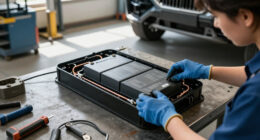
LFP gives automakers a way to offer a lower-priced battery configuration without requiring buyers to choose a different vehicle. Its cathode uses iron and phosphate rather than the nickel and cobalt used in NMC cells, which can reduce material costs. LFP cells are also generally associated with long service life and thermal stability, though battery performance varies by design and application.
The trade-off is lower energy density, which can mean less range for a given battery size or a heavier pack for a target range. That makes LFP more attractive for vehicles where buyers prioritize price and everyday driving needs over maximum range. Whether BMW offers a price difference alongside a stated range trade-off remains unconfirmed.
Battery chemistry alone does not determine a car’s final price. Vehicle equipment, production costs, market positioning and other factors also matter. BMW’s premium branding may keep its EVs priced above some mainstream alternatives even if it uses less expensive cells.
Products Worth Considering

VANTRUE POWER JS3 3250A Car Jump Starter with 160 PSI Air Compressor

NOCO Boost GB150 3000A 12V Lithium Jump Starter

NOCO Boost GB250 5250A 12V Lithium Jump Starter
As an affiliate, we earn on qualifying purchases.
China Offers an Early Example
BMW’s Chinese iX3 lineup already shows how the company can pair different battery chemistries within one model family: LFP in the entry-level 30L and NMC in the higher-priced 40L and 50L. The 30L’s reported range uses China’s CLTC procedure, which generally produces higher figures than EPA and WLTP testing. BMW has not announced equivalent LFP versions for other markets.
Mercedes-Benz offers a relevant comparison in its electric CLA lineup: the source report describes an 85-kWh NMC option and an entry-level version with a 58-kWh LFP pack. That shows how two chemistries can serve different price-and-range priorities within one model line, but it does not establish what BMW will do.
BMW is also broadening its cell supply arrangements. The company announced that Samsung SDI will supply Gen6 cells from Europe and LG Energy Solution will supply cells from the United States, with supply expected to start toward the end of the decade. CATL and EVE Energy are also part of BMW’s European cell-supply network. The announced agreements do not specify that those suppliers will provide LFP cells, so they should not be read as confirmation of BMW’s LFP sourcing plan.
“We will add the LFP technology in our vehicles, but we will be very specific in which vehicle and for which purpose.”
— BMW CEO Milan Nedeljkovic
Models, Prices and Timing Remain Open
BMW has not identified which Neue Klasse models will receive LFP batteries, when those versions will launch, or whether the chemistry will be offered outside China. The 2028 compact EV is a possible candidate based on its intended market position, but BMW has not confirmed its battery type.
The company also has not promised that lower cell costs will translate into lower vehicle prices. It has not provided specifications for future LFP packs, including their capacity, range, charging performance or availability by market. The supplier announcements likewise do not identify which battery chemistries the contracted cells will use. Those details will be needed to assess the practical savings and trade-offs for buyers.
Watch for Model and Pack Details
The next firm indicators are likely to come when BMW announces specific Neue Klasse models, battery specifications and market availability. The company’s confirmed plan for a compact electric model in 2028 gives buyers a future product milestone to watch, but does not confirm that model will use LFP.
As BMW releases details, the key points will be the pack’s usable capacity and independently comparable range, its price relative to an NMC version, and whether LFP configurations are offered in Europe or the United States. Until then, lower prices remain a possibility, not a BMW commitment.
Key Questions
What has BMW confirmed about LFP batteries?
CEO Milan Nedeljkovic said BMW will add LFP technology to selected vehicles. He did not identify the models or provide a launch date outside China.
Will LFP make BMW EVs cheaper?
LFP cells can have lower material costs than NMC cells, but BMW has not promised lower vehicle prices. Cell costs are only one part of a car’s final price.
Which BMW already uses an LFP battery?
The Chinese-market iX3 30L uses a 77-kilowatt-hour LFP pack. BMW lists a claimed 630-kilometer range on the CLTC cycle; that figure is not directly comparable with EPA or WLTP estimates.
Could BMW’s compact 2028 EV use LFP?
It is a possible candidate because it is a smaller, Europe-focused model intended for a more affordable segment. BMW has not confirmed its battery chemistry.
How does LFP differ from NMC?
LFP uses iron and phosphate in its cathode and generally has lower energy density than NMC, which uses nickel and cobalt. LFP can offer a lower-cost option, while NMC can be better suited to higher-range applications.
Source: insideevs.com