
Battery maintainers and chargers serve different purposes; chargers deliver high current to quickly restore depleted batteries, making them ideal for urgent or long-term recovery. Maintainers provide a gentle, steady trickle charge to prevent overcharging and keep batteries in good condition during storage or infrequent use. Choosing the right tool depends on your needs—if you want fast power-up, go for a charger; if long-term care, a maintainer. Continue to explore to find out which suits your situation best.
Key Takeaways
- Chargers deliver high current for quick battery recharging, while maintainers supply a low, steady trickle to prevent overcharging.
- Chargers are suited for rapid recovery after deep discharges, whereas maintainers are ideal for long-term battery preservation during storage.
- Using a charger regularly can restore depleted batteries quickly; maintainers keep batteries topped off without risking damage.
- Chargers may overcharge if left connected, but maintainers prevent overcharging and sulfation during extended inactivity.
- Proper selection depends on usage patterns: chargers for quick recharges, maintainers for long-term maintenance and storage.
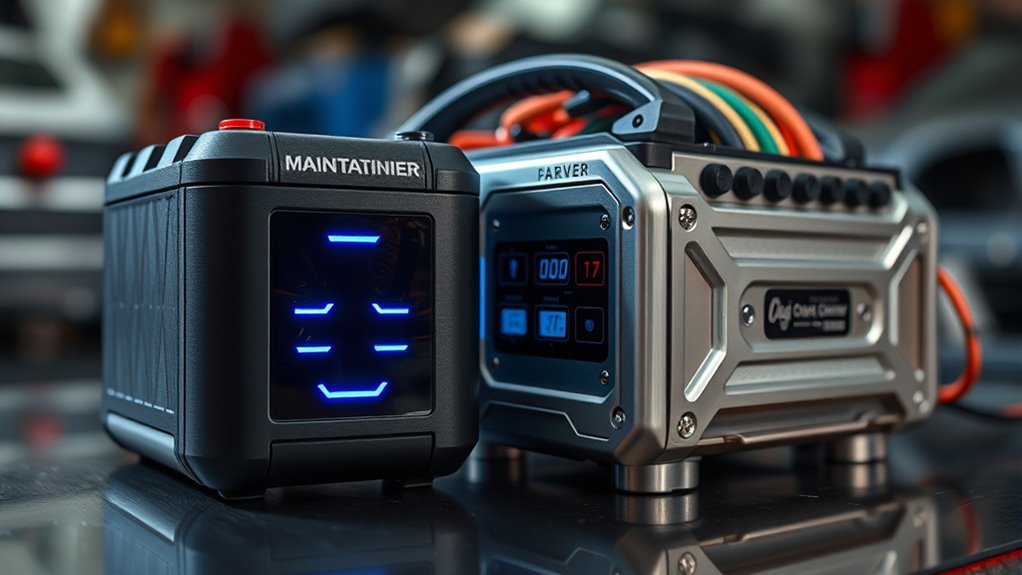
When it comes to keeping your vehicle’s battery charged and healthy, understanding the difference between battery maintainers and chargers is essential. Both tools serve the purpose of keeping your battery in good shape, but they do so in different ways. A charger delivers a high current to quickly restore a depleted battery, making it ideal when your vehicle has been drained or sits unused for a long time. In contrast, a maintainer provides a low, steady charge to keep the battery topped off without overcharging, which is especially useful for vehicles that aren’t driven daily or are stored for long periods.
If you own an electric vehicle or are considering harnessing renewable energy, like solar power, the distinction becomes even more relevant. Solar power systems often include battery storage to store excess energy generated during sunny days. In this context, a battery maintainer can ensure your storage batteries stay healthy over time, preventing sulfation and capacity loss. This is critical for electric vehicles, as their batteries are complex and require proper maintenance to maximize lifespan and performance. Using a maintainer with solar-powered setups helps avoid unnecessary degradation, which can be costly to repair or replace.
Chargers, on the other hand, are more suited for situations where you need to quickly restore a dead or severely drained battery. They can be used periodically, especially in emergency cases or when your vehicle has been left unused for weeks. However, if you leave a charger connected for an extended period, it might overcharge the battery, leading to damage. That’s where a maintainer’s gentle, continuous trickle charge becomes advantageous, as it prevents this risk and keeps your battery in prime condition without constant supervision.
When choosing between a maintainer and a charger, think about your vehicle’s usage patterns. If you drive regularly or need a quick recharge, a charger makes sense. If your vehicle sits idle or you’re integrating solar power with energy storage, a maintainer is the better choice. It’s also worth noting that some modern battery systems, especially those in electric vehicles, benefit from specialized chargers that are compatible with their advanced battery management systems.
Ultimately, understanding the difference helps you make smarter decisions to extend your battery’s life, whether it’s in a traditional car, an electric vehicle, or a solar-powered setup. Proper maintenance with the right tool ensures you’re not wasting energy, and your vehicle remains reliable and ready to go whenever you need it. Additionally, choosing the right maintenance method can help prevent battery sulfation, a common issue that reduces capacity over time and is especially relevant for stored batteries.
Frequently Asked Questions
Can a Battery Maintainer Damage My Vehicle’s Electronics?
A battery maintainer won’t damage your vehicle’s electronics if you use it properly. It’s designed for electronics safety and maintains your battery without overcharging. Just guarantee the maintainer is compatible with your vehicle’s battery type for maintenance compatibility. Always follow the manufacturer’s instructions, avoid leaving it connected for long periods unnecessarily, and double-check connections. This way, you protect your electronics while keeping your battery healthy.
How Long Should I Leave a Battery Maintainer Connected?
You should leave a battery maintainer connected for up to two weeks without worry, as long as you follow proper charging safety. About 80% of vehicle owners forget to check their battery, risking damage over time. To guarantee the best maintenance frequency, check the maintainer periodically, especially if temperatures fluctuate. This keeps your battery healthy and prevents unnecessary wear, saving you money and avoiding breakdowns.
Are Battery Chargers Suitable for All Types of Batteries?
Not all battery chargers are suitable for every battery chemistry. You need to check if the charger matches your battery type, such as AGM, gel, or lithium-ion, because incompatible chargers can damage your battery. Also, consider the charging speed; a fast charger might be convenient but could harm sensitive batteries. Always select a charger designed specifically for your battery’s chemistry to guarantee safety and longevity.
What’s the Difference in Cost Between Maintainers and Chargers?
The cost comparison between maintainers and chargers shows that maintainers generally have higher pricing differences due to their specialized, continuous maintenance features. Chargers tend to be more affordable upfront, making them suitable for quick, occasional use. You’ll find that maintainers are an investment for long-term battery health, while chargers are more budget-friendly for short-term needs. Overall, expect maintainers to cost more, reflecting their advanced technology and ongoing care capabilities.
Do Battery Maintainers Work With Deep-Cycle Batteries?
Imagine you own a boat with a deep-cycle battery. Yes, battery maintainers work with deep-cycle batteries, provided they’re compatible. They help keep the battery topped off without overcharging, which is vital for long-term health. For peak performance, you should check the maintainer’s deep cycle compatibility and perform maintenance weekly or biweekly, depending on usage. This guarantees your deep-cycle battery remains reliable and ready when you need it.
Conclusion
In the end, choosing between a maintainer and a charger depends on your needs. For example, if you store your car for winter, a maintainer keeps the battery healthy without overcharging. But if you need quick power, a charger is your best bet. Think of it like this: using the right tool guarantees your battery lasts longer and performs better. So, assess your situation and pick what keeps your batteries happiest and most reliable.