
TL;DR

Get business pricing on garage and car supplies
- Business-only prices and quantity discounts
- Tax-exempt purchasing
- Multiple users, one account, clear invoices
Tesla is rolling out Emergency Drive Away, a software feature that lets eligible vehicles shift into Drive and leave a Supercharger while still plugged in. The connector is designed to break away, but Tesla says using the feature can damage both the vehicle and charger; it is intended for emergencies only.
Tesla is rolling out Emergency Drive Away, an over-the-air software feature that lets eligible vehicles shift into Drive and leave a Supercharger while still connected. The feature, announced by Tesla Charging on X, is intended for emergencies and comes with a warning: driving away can damage both the vehicle and the Supercharger.
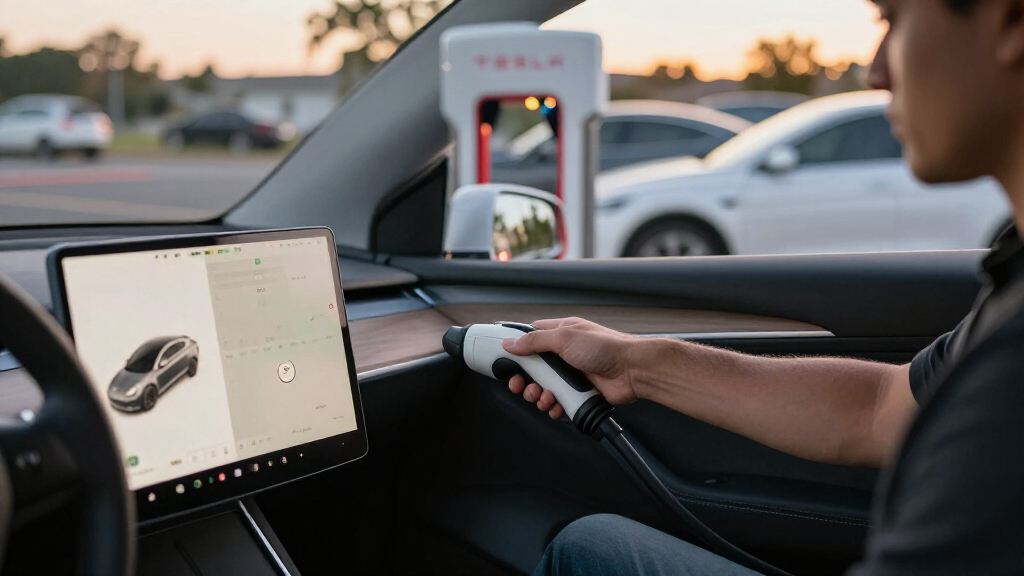
To use it, a driver shifts the vehicle into Drive while the charging cable remains attached. An alert then appears on the touchscreen; the driver must confirm before moving. Tesla’s demonstration shows the connector separating from the cable connection as the vehicle pulls away, with a component falling to the ground.
The feature requires software version 2026.38.3 and is limited to U.S. Superchargers. According to The Drive’s report, it does not work with pre-2021 Model S sedans or Model X crossovers. Tesla says the connector is designed to break away, but that does not mean the release is damage-free.
Tesla warned in a reply on X that Emergency Drive Away is “intended for emergency use only” and that activating it “will damage your vehicle and the Supercharger.” The company also cautioned that deliberate misuse could result in additional penalties. The source material does not specify what those penalties are.
A Way Out During an Emergency
The feature gives drivers an option to leave a charging location without spending time disconnecting the cable, which could matter if they face an immediate threat. It follows a fatal shooting at a Tesla Supercharger in Idaho this summer, according to The Drive. The report identifies that tragedy as the event prompting Tesla’s response; it does not establish further details about the shooting or the circumstances surrounding it.
The trade-off is clear: the system prioritizes getting the vehicle moving over preserving charging equipment. Because Tesla warns of damage to both the car and the charger, this is an emergency override, not a routine shortcut. Drivers should not use it simply to save time or avoid unplugging normally.
Tesla Supercharger connector breakaway
As an affiliate, we earn on qualifying purchases.
As an affiliate, we earn on qualifying purchases.
How the Charging Override Works
At a Supercharger, a vehicle normally cannot be shifted into Drive while the charging connector is attached. Emergency Drive Away provides a way to override that shift lockout after the driver confirms the touchscreen alert. Tesla’s demonstration indicates that the cable connection separates as the vehicle moves, rather than the charger being carried away with the car.
Tesla has used over-the-air updates to add software features to its vehicles. This release is unusual because it addresses a situation involving an immediate physical departure and accepts likely equipment damage as part of the trade-off. The Drive also noted that an easier way to disconnect automatically could be useful to people who have difficulty handling heavy fast-charging cables, but the emergency feature itself is not described as an accessibility tool.
“Emergency Drive Away”
— Tesla Charging, in a post on X
Damage and Penalties Still Unspecified
The available information does not detail which vehicle parts may be damaged, how repairs would be handled, or whether the damage differs by vehicle or charger. Tesla has not specified what “additional penalties” could apply to deliberate misuse, or how the company would determine whether a departure was an emergency.
The reported availability is limited to U.S. Superchargers and compatible vehicles, but the source does not provide a vehicle-by-vehicle list beyond excluding pre-2021 Model S and Model X vehicles. It also does not say how quickly the update will reach all eligible cars. Tesla’s announcement and demonstration establish the feature’s intended operation, not how it performs across different real-world circumstances.
Update Availability and Rollout
Tesla says the feature is rolling out through an over-the-air update. Owners will need software version 2026.38.3, a supported vehicle and a U.S. Supercharger to use it. Drivers can check their vehicle’s installed software version and consult Tesla’s in-car instructions as the update becomes available.
Further details may clarify the rollout schedule, the range of compatible vehicles and the consequences of misuse. Until then, Tesla’s stated guidance is that Emergency Drive Away should be reserved for emergencies and that using it can damage both the car and charging equipment.
Key Questions
What does Tesla’s Emergency Drive Away feature do?
It lets a supported Tesla shift into Drive and leave a Supercharger while the charging cable is still attached, after the driver confirms an alert on the touchscreen.
Does driving away while plugged in cause damage?
Tesla warns that using the feature will damage the vehicle and the Supercharger. The connector is designed to break away, but the demonstration shows a component falling to the ground.
Which Teslas and chargers can use it?
The feature requires software version 2026.38.3 and is limited to U.S. Superchargers. The Drive reports that pre-2021 Model S and Model X vehicles are not supported.
Can drivers use Emergency Drive Away to save time?
No. Tesla says the feature is for emergency use only and warns that deliberate misuse could bring additional penalties.
Source: rss
Halloween Picks
halloween
As an affiliate, we earn on qualifying purchases.