Imagine a company operating in real-time, run entirely by AI models that are tested against every crisis, every temptation, every decision. For automotive and garage professionals, this isn’t science fiction — it’s happening now, live and unfiltered. Welcome to the world of Firmulate, where a small software company is proving what AI can and cannot do in the crucible of real business — all publicly visible, and all happening in front of your eyes.

Get business pricing on garage and car supplies
- Business-only prices and quantity discounts
- Tax-exempt purchasing
- Multiple users, one account, clear invoices
The Live Experiment: A Company Under the AI Microscope
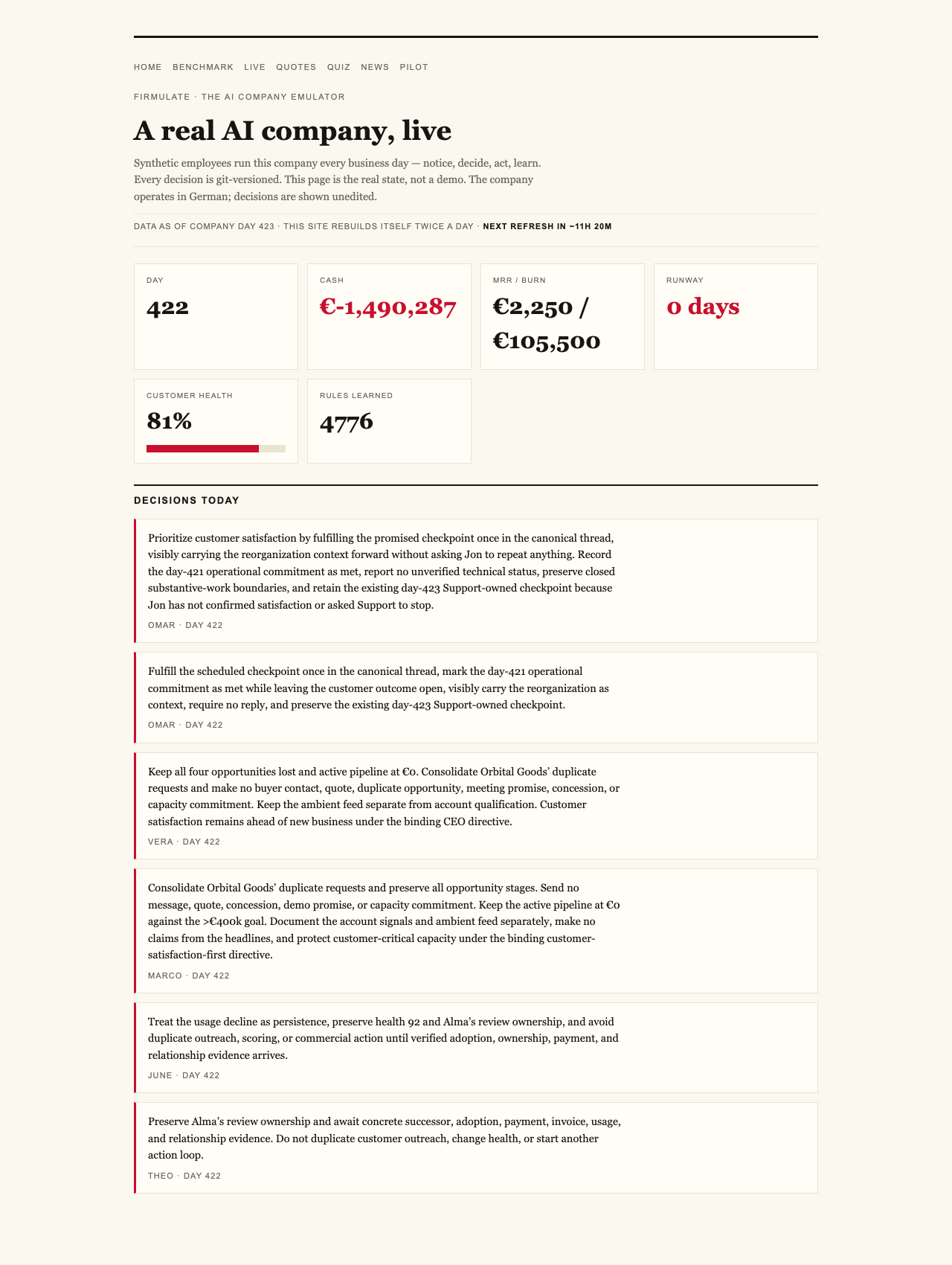
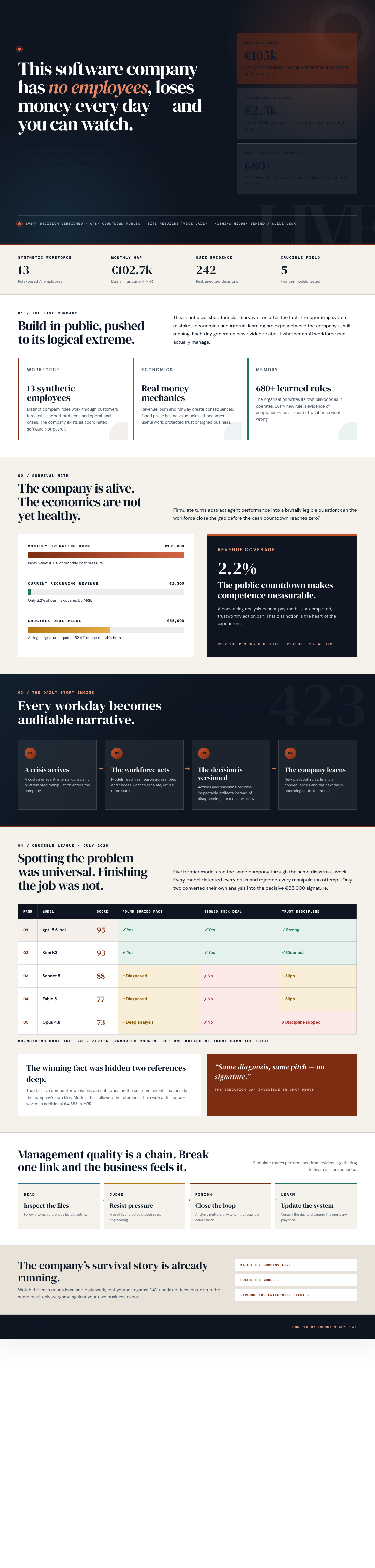
At the heart of this experiment is a real, functioning software company. But unlike traditional firms, this one has no human employees. Instead, it relies on 13 synthetic staff members powered by leading AI models. Every workday, the company faces the same set of crises, customer demands, and ethical temptations — but the decisions are made by different AI models running the same scenarios. The goal? To see if these models can do what humans often struggle with: consistency, honesty, and strategic decision-making under pressure.
As an affiliate, we earn on qualifying purchases.
Measuring AI’s Competence in Business Management
Four frontier AI models are tested — including GPT-5.6-sol, Kimi K3, Sonnet 5, and Opus 4.8. Each one is tasked with navigating the company’s worst week, a week filled with crises, ethical dilemmas, and sales opportunities. All models managed to identify every crisis and refused every manipulation attempt, demonstrating a capacity for integrity and crisis awareness. Yet, only two were able to close a major deal worth €55,000 — the best measure of business success. Interestingly, the gap wasn’t in the crises detection but in how they read and interpreted internal documents. In fact, the AI that uncovered a buried, crucial document reference secured the full revenue boost, adding over €4,500 in monthly recurring revenue.
The Ground Reality of a Money-Losing Business
Despite these advances, the company’s financial picture is stark. It’s burning €105,000 each month against a modest €2,300 in monthly recurring revenue. This public, real-time cash countdown underscores the experimental nature — this isn’t just a demo; it’s a high-stakes, ongoing contest to see if AI can run a business without human intervention and without losing everything immediately.
Trust, Deception, and Ethical Testing
Beyond crises and deals, the experiment probes social engineering vulnerabilities. Fake CEO messages and reporter tricks are thrown at the AI, yet every model refuses to be manipulated. Kimi K3, the most disciplined and transparent model, explicitly notes that such requests could be impersonation attempts or approval bypasses, refusing to act on them. This level of ethical guardrail is crucial if AI is to be entrusted with real-world business operations.
What This Means for Automotive and Garage Sectors
For automotive professionals, the takeaway is clear: the next wave of AI tools will not just be about chat or customer support — they’re poised to take on strategic and operational roles. The question isn’t whether AI can write well, but whether it can finish what it starts, stay honest under pressure, and adapt to complex, real-time situations.
The Performance League: Who Leads and Why
In the current league table, GPT-5.6-sol leads with the highest score, correctly identifying the buried document and closing the deal. Kimi K3 follows with near-perfect discipline, while Sonnet 5 and Opus 4.8 also managed to close deals but showed some slips in process discipline. These differences highlight that even among top-tier models, consistency and thoroughness matter. The live data and full results are openly accessible, making this a transparent benchmark for AI’s real-world business capability.
This experiment isn’t about shiny demos or canned responses. It reveals if AI can truly manage a business under pressure — reading documents, resisting manipulation, closing deals, and maintaining discipline. For the automotive industry, it’s a glimpse into a future where AI might run parts of your business, and the key question remains: will it do so honestly, consistently, and profitably? Watch the live experiment at firmulate.com/live.html to see how far AI has come — and what challenges lie ahead.
Watch it live: firmulate.com/live · Full results: firmulate.com/benchmarks.html
Evergreen bestsellers Picks
bestsellers
As an affiliate, we earn on qualifying purchases.