TL;DR

Get business pricing on garage and car supplies
- Business-only prices and quantity discounts
- Tax-exempt purchasing
- Multiple users, one account, clear invoices
Articulated buses use a pivoting joint between front and rear sections so a long vehicle can turn on city streets. The supplied report describes designs ranging from early buses with vertical-only articulation and rear-wheel steering to modern layouts, including rear-engine buses whose powertrain and joint require coordinated engineering. It does not identify a new technical announcement; the piece is an engineering explainer prompted by a preserved 1987 trolley bus at the Illinois Railway Museum.
A 1987 MAN SG-T310 articulated trolley bus displayed at the Illinois Railway Museum has renewed a practical question about a familiar transit vehicle: how can a bus bend without its rear section simply following as a rigid extension? The answer is a pivoting joint between two bus sections, with the joint, steering arrangement and drivetrain designed to let the long vehicle turn while remaining connected and usable as one bus.
The Autopian’s report follows a visit to the Illinois Railway Museum’s annual Bus Day, where visitors could ride 13 buses. One was King County Metro No. 4020, a MAN SG-T310 built in 1987. The museum says it holds a large collection of preserved buses, many of which run and drive, and operates regular bus service on site.
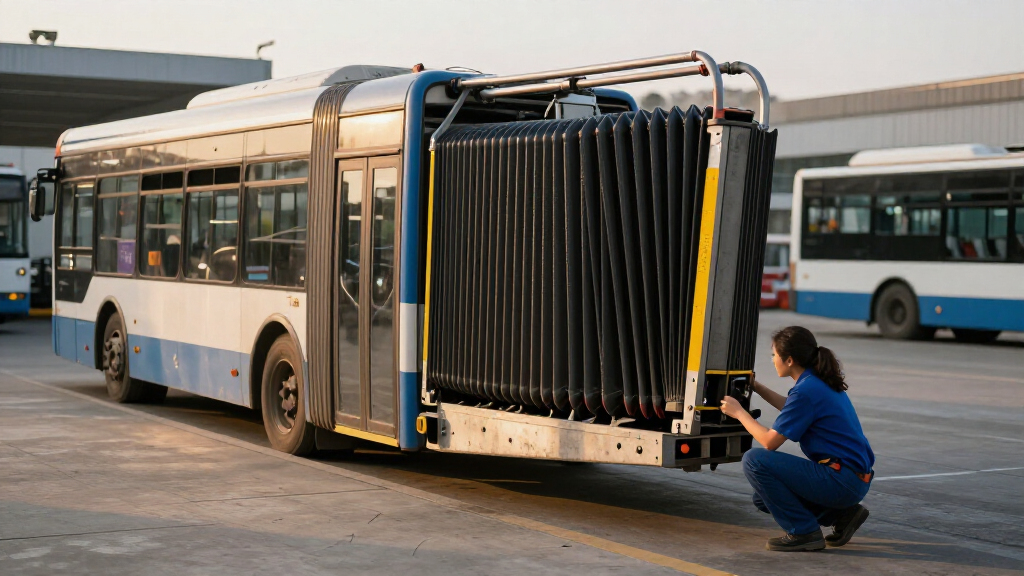
In a conventional articulated layout, the vehicle is made of a front section and a rear section joined by an articulating connection. The connection allows the sections to change angle as the bus corners. A flexible, accordion-like covering spans the gap, enclosing the passage between sections while accommodating the movement. This arrangement increases passenger capacity without making the bus taller, as a double-decker would, or requiring one very long rigid body.
The design is not identical across all generations. The report describes early examples that could articulate vertically but not horizontally, relying on rear-wheel steering to make turns. Later articulated buses use a joint that permits horizontal movement through corners. The report also raises the added challenge of rear-engine buses: the position of the engine and driven wheels has to work with the joint and the vehicle’s steering behavior. The source material does not specify the detailed mechanism used on every modern model.
More Capacity Within City Streets
Articulation addresses a basic transit trade-off: operators want to carry more people per vehicle, but a longer rigid bus becomes harder to maneuver. Splitting the body at a joint allows a bus to carry a larger passenger load while following turns more effectively than an equally long rigid vehicle. That can let transit agencies move more riders with one vehicle and driver, though the report provides no operating-cost figures or comparison of capacity across specific models.
The engineering also shapes the passenger experience. Riders can move between the front and rear sections through the covered connection, while the bus turns as a linked vehicle rather than as two separate units. Because steering, joint movement and power delivery differ by design, an articulated bus is not simply a standard bus with an extra section attached; its layout must account for how the sections track through a turn.
As an affiliate, we earn on qualifying purchases.
From Early Joints to Modern Buses
The report traces articulated bus concepts to the early decades of motor transport, when builders sought ways to carry more passengers efficiently. It identifies a Dutch Ford Model T from the early 1920s as an early example it could find. A separate approach used a bus or truck to tow a passenger trailer, but the report distinguishes those vehicles from true articulated buses because the trailer was not connected to the main unit by a passenger passage.
In 1937, Italy’s Alfa Romeo produced the 110 AM-Macchi, which the report describes as having vertical-only articulation. The design allowed the sections to move relative to one another over changes in road height. Baltimore put the Twin Coach Super-Twin into service in 1938, according to the report. Like the Alfa Romeo, it used vertical articulation and rear-wheel steering to negotiate turns. The report says its straight floor was a benefit of that arrangement. These examples show that the familiar flexible middle developed through more than one engineering solution.
The Illinois Railway Museum event provides a setting to see such vehicles in operation, rather than only as historical objects. The museum’s collection includes trolley buses and motor buses, and its annual event gives visitors rides on preserved vehicles. The featured MAN trolley bus connects that history to a continuing design question: how to combine extra passenger space with the ability to operate on ordinary streets.
““Just how do articulated buses actually work?””
— The Autopian report
Details Vary by Bus Design
The supplied report does not provide technical drawings, engineering specifications or a full account of how the featured MAN SG-T310’s joint, steering and rear-engine layout operate. It also does not establish that every articulated bus uses the same configuration. The precise way a particular vehicle behaves depends on its design, so the historical examples should not be treated as specifications for all current buses.
The source presents the museum visit and bus history as an explainer, not as an announcement of a new vehicle, engineering breakthrough or policy change. It gives no fleet-wide reliability, maintenance, capacity or cost data, and does not compare articulated buses with other transit options on those measures.
Further Detail Depends on the Model
No new technical milestone or follow-up announcement is identified in the report. Readers seeking a precise account of a particular bus would need its manufacturer documentation or vehicle-specific engineering material, especially for details about the joint, steering system and powertrain. The report’s immediate next step is explanatory: it uses the museum’s preserved buses and the featured MAN trolley bus to show that articulated designs have evolved through different solutions.
Key Questions
What makes an articulated bus bend?
A joint between the front and rear sections lets them change angle as the bus turns. A flexible covering closes the passenger passage across the joint.
Does every articulated bus use the same joint?
No. The report describes early buses with vertical-only articulation and rear-wheel steering, as well as later designs that turn horizontally at the joint. Details depend on the vehicle model.
Why use an articulated bus instead of a longer rigid bus?
A jointed bus can add passenger capacity while remaining more maneuverable through city turns than a very long rigid vehicle. It also adds capacity without increasing the bus’s height.
Which bus prompted the report?
The report features King County Metro No. 4020, a 1987 MAN SG-T310 articulated trolley bus shown at the Illinois Railway Museum’s Bus Day.
Source: hn
Halloween Picks
halloween
As an affiliate, we earn on qualifying purchases.