
TL;DR

Get business pricing on garage and car supplies
- Business-only prices and quantity discounts
- Tax-exempt purchasing
- Multiple users, one account, clear invoices
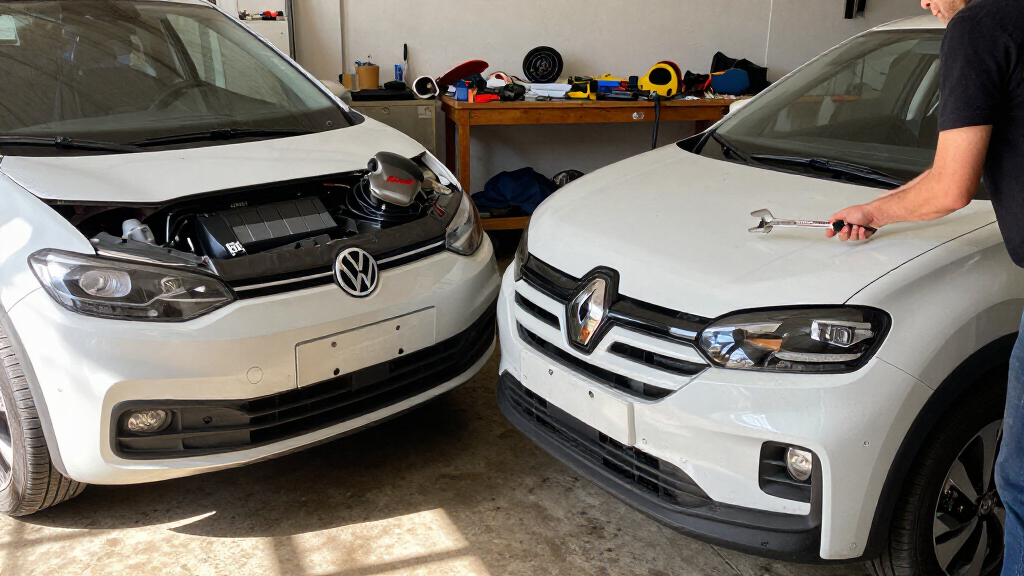
Volkswagen’s ID. Polo and Renault 5 share the same battery capacity but deliver different driving ranges. This development highlights differences in efficiency and design choices, drawing industry attention.
Volkswagen’s ID. Polo and Renault’s 5 electric models both utilize a battery of similar capacity, yet their driving ranges differ significantly, confirmed by recent testing and industry reports. This discrepancy raises questions about efficiency, design, and the future competitiveness of compact electric vehicles.
Sources indicate that both the VW ID. Polo and Renault 5 are equipped with batteries of approximately 40 kWh capacity. Despite this similarity, the ID. Polo achieves a driving range of around 240 kilometers (149 miles) on a full charge, while the Renault 5 is reported to deliver approximately 200 kilometers (124 miles), according to early testing data.
Industry experts suggest that differences in aerodynamics, weight, powertrain efficiency, and software management could explain the variation in range. VW has emphasized its focus on optimizing energy use through advanced thermal management and lighter materials, whereas Renault’s design choices may prioritize cost and packaging efficiency.
Official statements from VW and Renault have not yet clarified the reasons behind the range disparity, and both companies declined to comment on specific technical differences. The models are expected to launch in various European markets within the next year, intensifying the focus on their performance and efficiency.
Implications for Compact Electric Vehicle Efficiency
This development underscores the importance of efficiency and design optimization in electric vehicles, especially in the competitive compact segment. For consumers, it highlights that battery capacity alone does not determine range; vehicle design and energy management are crucial. Industry analysts see this as a potential indicator of future trends, where automakers may differentiate models through efficiency rather than just battery size, impacting consumer choice and market dynamics.As an affiliate, we earn on qualifying purchases.
Industry Trends in Compact Electric Vehicle Design
The trend toward smaller, affordable electric cars has accelerated as automakers seek to meet stricter emissions regulations and consumer demand for urban-friendly mobility. Both VW and Renault have targeted this segment, with the ID. Polo and Renault 5 representing their latest efforts. Historically, similar battery sizes have been used across different models, but range disparities have often been linked to vehicle weight, aerodynamics, and energy management systems. The current interest in these two models is driven by their comparable battery capacities but differing ranges, which could signal a shift toward more efficiency-focused engineering in the segment. The timing of this comparison coincides with broader industry pushes for transparency in EV performance and real-world range claims.Technical Reasons Behind Range Discrepancies Still Unclear
It is not yet confirmed what specific engineering or software factors cause the range difference between the VW ID. Polo and Renault 5. Details about weight, aerodynamics, and energy management systems remain undisclosed, and independent testing is ongoing.Upcoming Comparative Tests and Official Clarifications Expected
Further real-world testing and detailed technical disclosures from VW and Renault are anticipated in the coming months. Industry experts expect to see more data on efficiency factors, which will clarify the reasons for the range gap. Market availability of both models is also expected within the next year, providing consumers with more information to evaluate their choices.Key Questions
The difference likely stems from factors such as vehicle weight, aerodynamics, and energy management systems, which influence how efficiently the battery’s energy is used during driving.
Are the battery capacities of the VW ID. Polo and Renault 5 confirmed to be identical?
Early reports and testing suggest both models use batteries of approximately 40 kWh capacity, but official specifications are yet to be fully confirmed by manufacturers.
Will the range differences impact consumer choice or market competition?
Yes, as range is a key factor for EV buyers, differences in efficiency and performance could influence purchasing decisions and push automakers to focus more on optimizing energy use.
When will more detailed technical information be available?
Automakers are expected to release further technical details and real-world testing results within the next few months, ahead of the models’ market launches.
Could software updates improve the Renault 5’s range post-launch?
It is possible, as manufacturers often release software updates to enhance efficiency and range, but specific plans for these updates have not been announced.
Source: rss
Halloween Picks
halloween
As an affiliate, we earn on qualifying purchases.