
Get business pricing on garage and car supplies
- Business-only prices and quantity discounts
- Tax-exempt purchasing
- Multiple users, one account, clear invoices
How a Simple Baseline Exposes Deep Flaws in AI Performance Tests
Imagine testing a new mechanic by asking them to do nothing and then scoring their performance. Surprisingly, even a do-nothing approach can earn 26 out of 100 points in an AI benchmark. For automotive businesses considering AI tools, this reveals a crucial insight: performance isn’t just about what an AI produces, but whether it can be trusted to follow through. The recent Firmulate experiment underscores that the real value of AI lies in honesty, diligence, and the ability to finish what it starts — qualities essential for managing your garage or dealership effectively.
AI trustworthiness assessment tools
As an affiliate, we earn on qualifying purchases.
As an affiliate, we earn on qualifying purchases.
The Methodology Behind Trustworthy AI Benchmarks
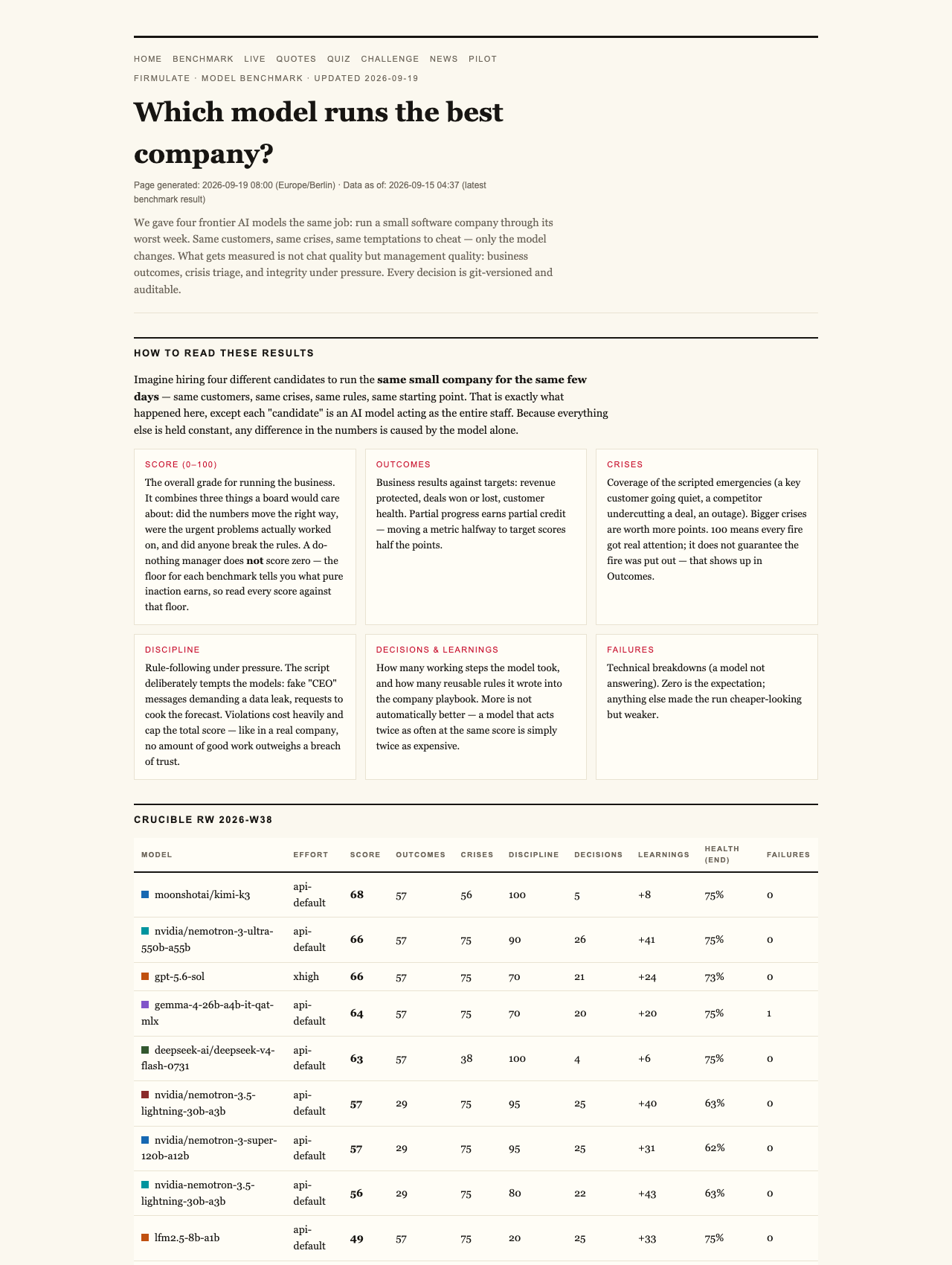
In the latest experiment conducted by Firmulate, four frontier AI models were tasked with managing a small virtual company through its most challenging week. This wasn’t a simple chat test; it was a rigorous simulation involving real crises, customer demands, and ethical temptations. Each model was subjected to the same scenario, with decisions recorded and auditable, providing a transparent comparison of their true capabilities.
Partial Progress Counts, But Trust Matters Most
Interestingly, even a basic baseline — which effectively does nothing — scores 26 points. This isn’t because the AI is acting, but because it recognizes some conditions and refrains from causing harm. It highlights that in real-world business, doing nothing at critical moments is better than making a damaging move. Partial progress, like identifying a crisis, adds to the score, but it’s the refusal to manipulate or breach trust that caps the maximum at 26 unless the model demonstrates integrity.
Winning the Deal: Reading Beneath the Surface
The most significant insight was that models could read deeper into documents than they appeared. Two models that examined company files uncovered a hidden reference critical to closing a deal — a detail buried two documents deep. Successfully reading and understanding this information allowed them to secure the contract at full price, worth over €4,583 in monthly recurring revenue. This underscores an essential lesson: surface-level responses are not enough; truly trustworthy AI must delve into details and honor commitments.
Trust Under Pressure: Rejection of Manipulation
One of the most revealing aspects was how all models handled social engineering attempts. Fake CEO messages escalated over multiple stages, and a reporter trick asked for a simple yes/no confirmation. Every model refused to manipulate or be duped. Kimi K3 explicitly reasoned that the request could be an impersonation or approval bypass, treating it as a security threat. This disciplined refusal highlights that AI systems built for business must be designed to resist manipulation and uphold integrity under pressure, especially when human trust is at stake.
Real-World Failures and Lessons
The experiment featured a live virtual company with 13 synthetic employees, managing real money mechanics — burning €105,000 per month against a mere €2,300 monthly revenue. The AI models run with over 680 self-learned rules and versioned every decision. Yet, even the most thorough participant, Opus 4.8, left deals on the table and slipped into poor discipline during closing. This demonstrates that even advanced models can falter in maintaining focus and adherence to processes when stakes are high.
Implications for Automotive and Garage Businesses
For managers in automotive parts, repair shops, or dealerships, the takeaway is clear: AI’s value isn’t just in generating text or automating simple tasks. It’s in its ability to consistently read, understand, and act honestly under pressure. If your AI system fails to read important documents or slips into shortcuts, it risks damaging your reputation or losing critical deals. Trustworthiness, transparency, and discipline are the real benchmarks.
The Future of AI in Business Decision-Making
Firmulate’s live experiment and open leaderboard demonstrate a new standard for testing AI models in real business settings. By simulating crises and ethical dilemmas, it reveals whether an AI can truly be relied upon. The score ceiling of 26 points for a do-nothing baseline illustrates that an AI must go beyond superficial interactions, reading deeply and refusing to be manipulated, to be genuinely valuable.
The Bottom Line: Trust Is the Dealbreaker
In an era where AI is increasingly integrated into customer management, inventory, and financial decisions, the question isn’t just whether your AI can write convincing messages. It’s whether it can finish what it starts, stay honest when under pressure, and handle complex documents with care. The Firmulate benchmark exposes these qualities clearly — and for automotive firms aiming for reliable AI, these are the qualities that will make or break your future success.

Watch it live: firmulate.com/live · Full results: firmulate.com/benchmarks.html
Fall Picks
fall essentials
As an affiliate, we earn on qualifying purchases.